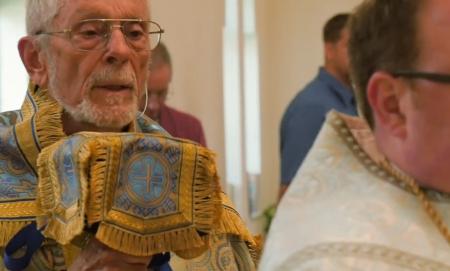
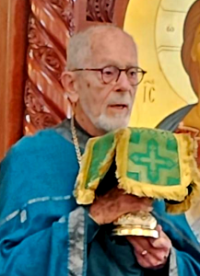
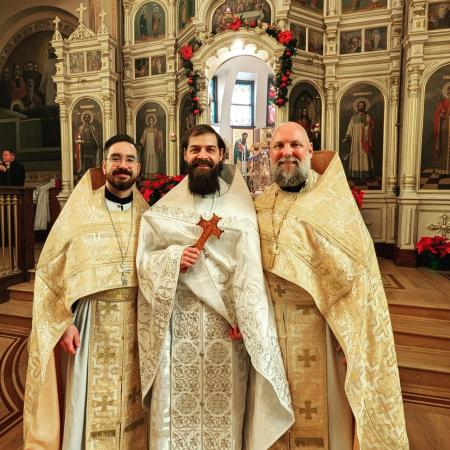
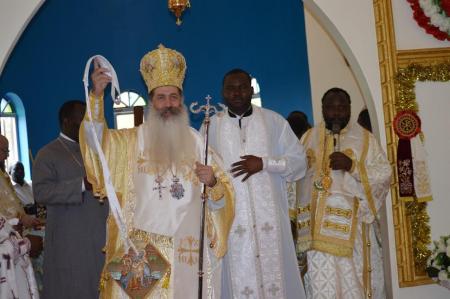
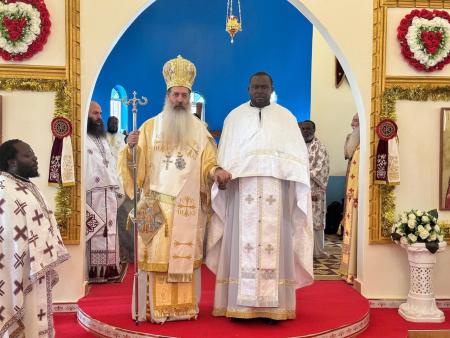
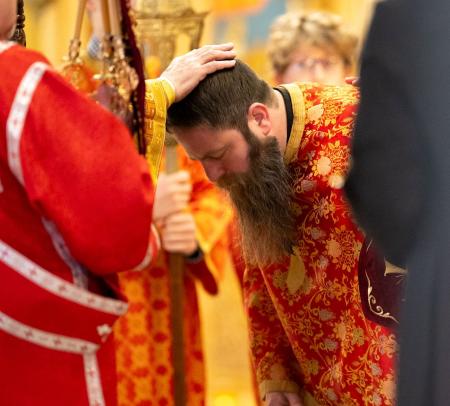
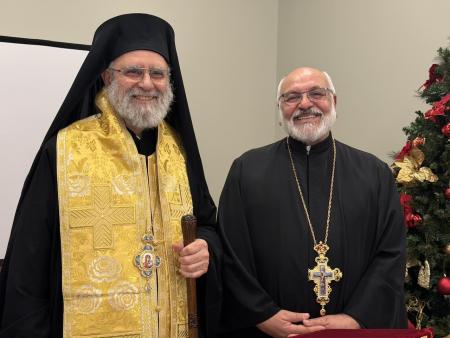
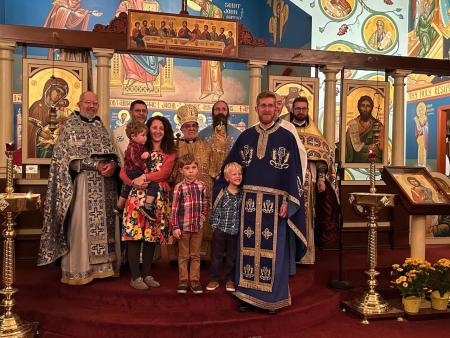
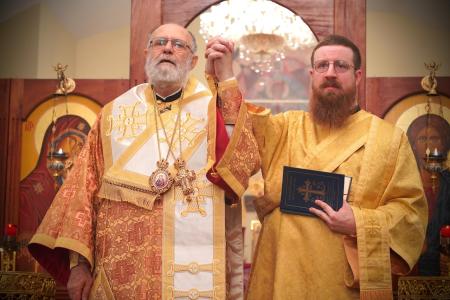
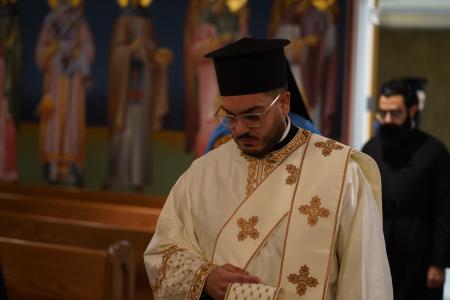
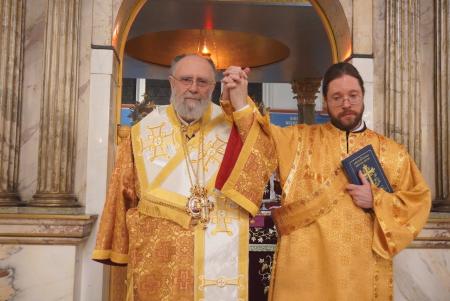
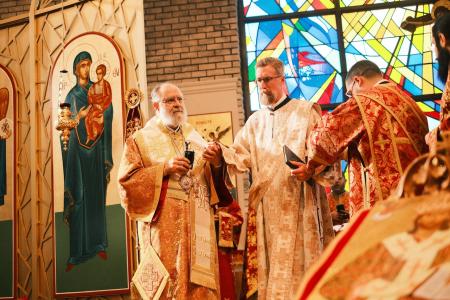
Bishop-Elect Philip (Mugadizi), an alumnus of St. Vladimir’s Seminary, was ordained Tuesday, November 25, to serve as Bishop of the Orthodox Diocese of Kisumu and Western Kenya.
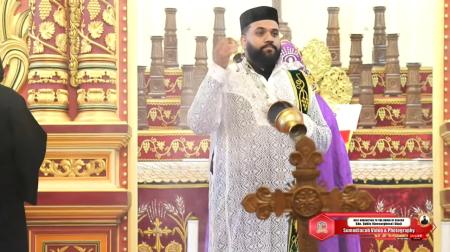
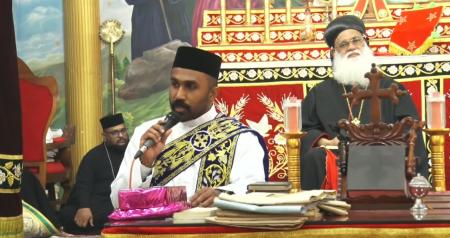
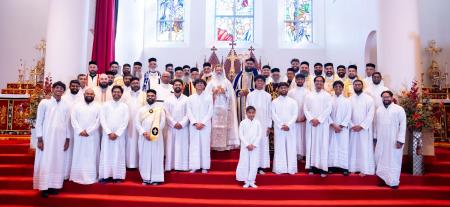
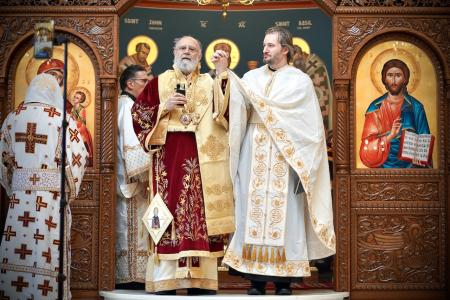
The ordination took place at the Holy Patriarchal Church of Saint Nicholas in Hamzawi, Cairo, Egypt. The Divine Liturgy and ordination rites were presided over by His Beatitude Theodoros II, the Pope and Patriarch of Alexandria and All Africa.
Following the ordination, the Patriarch recalled that the words of our Lord, “The harvest is plentiful, but the laborers are few,” remain alive and relevant, particularly in the missionary land of Western Kenya. His Beatitude called on the new hierarch to become a “laborer of this harvest,” fearless in the face of the difficulties of ministry, with the conviction that Christ will strengthen him, the Holy Spirit will enlighten him, and the Saints will accompany him.
Archimandrite Philip with Metropolitan Herman (Swaiko) at St. Vladimir’s Seminary in 2003
Bishop Philip expressed his deepest gratitude to Patriarch Theodoros II and assured His Beatitude that he would make every effort to prove himself worthy of the trust and great mission entrusted to him.
His Grace Bishop Philip holds a Bachelor’s Degree in Leadership and Management from St. Paul’s University in Kenya, and he graduated from St. Vladimir’s Seminary with a Master of Divinity (M.Div.) degree in 2003. He currently serves as Deputy Dean and Lecturer at the Orthodox Patriarchal Ecclesiastical School of Makarios III Archbishop of Cyprus in Nairobi, Kenya.
Archimandrite Philip with Metropolitan Herman (Swaiko) at St. Vladimir’s Seminary in 2003
Bishop Philip is described as “a devoted servant of God who has consistently demonstrated humility in his walk of faith, integrity in his leadership, and commitment to teaching the principles of the Orthodox faith. … His journey in education and ministry reveals a rare blend of intellectual excellence and spiritual depth, a proof that true leadership flourishes when knowledge and humility walk hand in hand.”
May God grant His Grace Bishop Philip many years! AXIOS, AXIOS, AXIOS!
Some information for this article was adapted from romfea.gr.
The Very Rev. Michael Nasser joined St. Vladimir’s Seminary in the summer of 2025 to serve as the Seminary’s Spiritual Formation Director. It was a return to the place he began his seminary studies and formation in the early 1990s. Fr. Michael studied at St. Vladimir’s Seminary for two years before completing his M.Div. at Holy Cross Greek Orthodox School of Theology, in Brookline, MA. He also received his Th.M. at Holy Cross following studies at Gordon-Conwell Theological Seminary in Beverly, MA, in the fields of Missions and Youth Ministry. Fr. Michael’s priestly ministry in the Antiochian Archdiocese has spanned more than twenty years, taking him to parishes in Massachusetts, Pennsylvania, Kentucky, and Michigan; to Antiochian Village where he served as Camp Director; and to Tijuana, Mexico where he served as a mission priest.
Fr. Michael has been married to Khouria Vicky since 1994, and they are blessed with three wonderful (and now adult) children: Maria, Joshua, and Elena.
Fr. Michael sat down with first-year seminarian Seraphim Hamilton to talk about his experience at St. Vladimir’s Seminary and to offer insights about forming the next generation of priests—as well as how best to go about discerning whether you are being called to ministry in the Church.
Watch the discussion in its entirety, or read an abbreviated transcript below.
Tell us about your history with St. Vladimir’s. How long have you been interacting with this institution?
Well, it began in the dark ages of the early 1990s. The Seminary played an important part of my journey to ministry. It’s actually the place that I was petrified of when I was just starting to think about life in ministry, and in the priesthood in particular. So I had to sort of get over that hurdle of coming here to this place. And once I came to visit, I came during college, I was all in. I was going to quit going to the college I was at and come to the collegiate program here (at the time you could actually finish college here). But no, I held off, and I didn’t actually graduate from here. I did two years here, and then a year at Holy Cross, and I finished up my M.Div. up there. But I loved my years here and great, great experiences.
Any big impressions on shifts between then and now?
It’s a much different place in lots of ways. I’m still finding parts of the campus that didn’t exist when I was here, it was all just forest area that you couldn’t even get to. Much bigger, much more complex. We had some—we would call them—luminaries that were here. My professors were Fr. Hopko, Fr. Meyendorff, Professor Kesich—names that are revered names now, so to not have them here was a little strange. I’ve adjusted now, of course, but so impressed with the faculty we have, so impressed with the leadership of Dr Tudorie and the staff. In many ways, the atmosphere on campus is better. It’s lighter. There’s a bit more joy in the air. So it’s almost the best of what it was, and now it’s even better. So I’m really enjoying my time here so far.
Fr. Michael meeting with seminarians in February 2024 during an organized visit to campus as spiritual formation resident.
Thank God! Between being a seminarian here and now Spiritual Formation Director, sketch out how you ended up back here.
I’ve had a very varied ministry—parishes, I was a camp director, I was a mission priest in Mexico for three years, all of which I feel so blessed for, all the opportunities that I’ve had. But the opportunity to come back here was really not in my mind in any formal way, although I thought even early on in my ministry, at some point, I would love to share what I was learning along the way with the next generation of leaders in the Church. I hadn’t really thought about how that would work, except maybe in retirement, volunteering. I told the previous dean of the school that someday—having been a parish priest at the time, for about thirty years—I said, I want to come back and teach a class, and the name of the class is “What It’s Really Like to Be a Priest” [laughs]. And we laughed about it at the time. And then there was a change in administration, and when they were looking for a new director of spiritual formation my name came up through some common colleagues that I share with some of the staff here, and they approached me. At first, I just thought it was a joke! I literally laughed at the first phone call. Then that was followed by a lot of intimidation about what it would mean to come back and help to work for the formation of the seminarians and their future ministry. But the more I thought about it, the more excited I got about the possibilities of sharing what God has taught me through the many different ways that I’ve served in many different locations and situations. And now that I’m here, I’m even more convinced that I think this is where God wants us to be. And I’ve just been loving my time talking with the seminarians.
Fr. Michael moved onto campus with Khouria Vicky and daughter Elena.
It is a heavy task, to direct spiritual formation of the people who are going to be spiritually forming others. … How do you approach that? What is your vision for what you want to accomplish here?
I look back at my own life and realize how many ways God was forming me through other people. Some of them knew they were doing that and did it intentionally. Some didn’t, but were still very beneficial to me. And just how many situations I was in and, I would say, especially the difficult ones. You know, when you go through a difficult time, the difficulty can be just all you see. Sometimes it just fills your vision. And at the time, it was hard to see those as good experiences. But now looking back, I look back at all my experiences, and especially the really tough ones, and I can recognize how valuable those were in my formation, my development, in my growth, both as just a Christian, as a human being, and as a priest.
So as I’m meeting with the students right now … we’re just getting to know each other. But one of the things I’m sharing with them is that I want to provide an environment and a relationship where the students can process their time here, and specifically their challenges with trying to find ways to grow from them. You know, life in seminary isn’t easy for married students. They’re uprooting their families. They’re bringing them here. Some have kids … and moves are always difficult for families. This is difficult in the sense that they’re not moving into their own house somewhere. A lot of them have moved out of houses, now they’re living in little apartments, and in all kinds of ways it’s difficult. The life of a seminarian is very full in terms of time commitment. So you know, the seminarians are torn between their schoolwork, their parish assignments, their other responsibilities being a student and in family life. And then you have single students who have their own struggles as they’re going through this phase of life, just a different struggle. But everybody has hard times here. In the past and even in my own experience here, those hard times were just seen by so many of us as things to get through, and at best survive. But as I look back at my life in ministry, so many of those challenging times were the opportunities that I needed to grow. I didn’t want those things to happen at the time. The last thing I wanted is to go through those difficult times. But as I went through them, and then reflected later on them, now I can look back at that as crucial to my growth. So one of things I’m hoping to do is help the students. And I told them, I said, “Come in. Tell me your tale of woe. I will be compassionate.” I’m not going to just tell you, you know, “Suck it up,” because they are difficult [experiences] and we should acknowledge that. At the same time if we just “get through it,” we’re missing big opportunities. So one thing I hope to do is help them process that and realize that God, even in those really difficult times, is using those difficulties to form them in really important ways that they’re going to benefit from later on, when they’re out doing ministry.
Speaking with incoming students at orientation, August 2025.
Could you speak a little more to the way in which you yourself were spiritually formed at seminary? What specific things kind of cut into you in a way that leaves that cross-shaped mark that we’re looking for?
Well, when I was here there was no spiritual formation program, and as I explained to the students in orientation this year, the whole program here, then and now, is spiritual formation. You know, I’m not in charge of the seminary, even though the seminary’s job is the spiritual formation of the students. I am a part of that, and it’s not the part that relates to the running of the chapel and the liturgical life, as much as I serve there, and that’s a part of what I do here. Father Alexander [Rentel], he’s the Rector of the chapel. That’s really his job in addition to the other things that he does. I don’t do the work of a professor, at least not at this point, and will always, if I teach, it’ll be the minor part of my time here. As I see it, and as I’ve talked with the Dean Dr. Tudorie and others, I really want to work on bringing all the rest of that experience: the community life, the challenges of operating in a tough schedule, the difficulties as students start to encounter real people in their ministry, whether it’s through a parish assignment or through their CPE program. Maybe they’re working in an emergency room, in a big city hospital, or they’re at a nursing home, dealing with real people and then learning how to process that. It’s all those other things that are not really part of any set program that I want to help the students process. And specifically—I love the way you say that, to “find that cross-shaped mark”—those are ways that we are called to serve and live out a crucified Christian life, which is not an option. Christ said, “If you want to follow Me, you deny yourself, you take up your cross.” He didn’t say, “One of the ways to follow.” That [taking up your cross] isthe way. And if we’re not learning to do that—and I would say especially in the seminary, if students are coming here and they’re being shown crosses, or there are crosses they come across, and all they want to do is get around them, or just survive them, get through them, get past them—then they’re not going to be formed in those situations, in those encounters with those challenges, with those crosses, and they’ll miss that opportunity. I tell students … “I don’t want to give you bad news, but life isn’t easier once you’re done.” It really isn’t. It’ll be easier in the sense that if you learn how to handle the difficulties and use them for your spiritual growth, or more properly, let God use them. Don’t close Him out of that struggle. Then those things become the ways that we all grow personally. And I think what’s unique to a seminary is we’re not growing just for ourselves. I think we should all be growing as Christians, but the people at the seminary, the students, are here specifically, as they can go out and minister to others who all need to be taught how to encounter the crosses in their life. So how does a priest or somebody serving any function in the Church as a leader of ministry, how do they teach somebody else how to bear their cross and grow spiritually if they themselves haven’t done it? And so that’s what I see is really my job, trying to help everyone process those challenges well and practice the ways that they’re going to have to continue bearing the crosses. Because once we get out of here, there are just different crosses in a life of ministry.
Fr. Michael with staff at Antiochian Village in 2005. (Photo: avcamp.org)
For someone to whom the thought has occurred, “Hey, maybe I should consider becoming a priest,” what is a good sign they should consider that?
It’s such a hard thing, because the call to ministry really is a mystery, no less mysterious than the other sacraments. We look at the Eucharist as a mystery, and we know that we don’t define how bread and wine become the very body and blood of Christ. In the same way, with the same respect, I think we should approach the mystery of men being called the priesthood. So it’s not that we don’t say anything, but we have to recognize that this is not something that can be fully explained or understood. It’s just something we know to be true. When I have heard of a young man who has either his own sense of a call or my perception of a potential call, one of the things that I’ve suggested they do is develop a relationship with the altar of their church, which I know sounds like a crazy thing. How do you develop a relationship with what some people consider a piece of furniture? Yeah, that piece of furniture, to some, is the meeting place of heaven and earth. It’s where the gifts are offered from the people through the clergy set up to be offered up to God in the Eucharist. It’s the source of so much of our life in the Church—the sacraments, the liturgical life. And then we ask a, typically, young man to go and stand at that altar. As Bishop John of the Antiochian Archdiocese says so beautifully, a priest stands before God on behalf of the people, and he stands before the people on behalf of God. So when a young man starts to sense that calling, that’s one thing I do is say, come and just be an altar server. See what developments happen, and see what understanding starts to grow because, principally, that’s what a priest does. This is the—you might call it—the paradox of the priesthood. The most central thing the priest does is serving at that altar. That defines him in so many ways … and yet, if we just go by time spent, it’s probably the place he spends the least amount of time. Even priests that serve daily services, the majority of their day is not served at the altar, but it does define everything else they do. So I think that’s one way to help them develop the potential for relationship with that very sacred place. And because it’s a mystery, I think all we can do is just try to remove barriers that can be removed. For me, it was the fear of, if that first domino fell, if I came to the seminary and if I wasn’t blocked through that, then maybe everything else is going to come, and maybe I’m not ready for all that. So walking slowly with somebody who’s trying to discern their call. Being reminded that every step that you’re not going to walk alone. You walk with Christ, you walk with your priest, and others that are going to walk with you. You’re not going to walk this path alone. Another barrier I think we really need to work harder at is, you know, fears of financial instability. There are some people who are called to poverty, especially monastics, and for them poverty is not a barrier. But for a married man, or a man who wants to be married, it’s not wrong to want to financially support your family. And so I think there’s lots that we could do to remove the barriers for—and I think we’ve come a long way—supporting clergy financially. I think we still have work to do, but then I think we have to communicate that. When I talk to young men and I say, you know, “Have you thought about priesthood?” “Well, I would, but I want to take care of my family, and I don’t want to put them through living a life of poverty.” Well, a lot of them don’t know that’s not necessarily the case. So removing those barriers that I think we can, and there are others.
Fr. Michael blessing Yonkers Police Department’s K-9 Unit during YPD’s visit to campus in September 2025.
How does a person distinguish if they’re concerned about, “Oh, maybe I’m just being spiritually delusional. How could I be a priest? How could I stand at that altar? I’m just going to put this away, because this is from the devil.” How do you manage all of those thoughts?
Don’t do it yourself. You process it with a father confessor that hopefully you have a good relationship with and that you can dialog with. I tell the students here, your job was to discern as best you can that God intended for you to come and get the experience of being at the seminary, and your job is to decide how much you’re open to. Are you willing to be ordained, first as a deacon and then later as a priest? Other than that I really think that those that our candidates really shouldn’t play much more of a role. Their job is to be available, to be perceptive, to dialogue with a good mentor, like a spiritual father, to take that spiritual father’s advice over their own. They might say, “Well, I could never stand there. And if their father confessor says, “I think you should at least pursue this next step”—if they don’t feel that it’s wrong, that it’s the wrong direction—I don’t think they should let either their pride or their humility stop them. I think, in their humility, they say, “Father thinks I should do this. I’m willing to do it. I take the next step and I present myself to the bishop and let the bishop decide.” … I just think it’s easy to get over involved. And we might say, in a worldly sense, you have every right to. It’s your life. Well, as a clergyman, it’s not! There are traditions where you get a new name. You are told where you’re going to live. You’re not typically asked. And you know, the bishops try to accommodate. They want a good situation for the priest, for his family, but ultimately you are submitting your life to service in the Church, and specifically through the bishop. And so practicing that, practicing that willingness to be obedient and to just present yourself and say, “Here I am, Lord. If it’s Your will, send me.” And let God and the bishop take care of the rest.
With orphanage director Luis Sanchez and Fr. Nicholas Andruchow (SVOTS Class of 2002) at the blessing of foundations for a construction project for Project Mexico and St. Innocent Orphanage in June 2013. (Photo: Project Mexico & St. Innocent Orphanage)
Father Michael, is there anything else you really want to communicate to people as they maybe consider coming to seminary or as they are praying for the seminary?
Yeah, we need prayers. This is a tough place to be. Just think about it as sort of a tactical area. You know, if we were in a physical war, the opposing army would try to knock out headquarters and ammo depots and training centers. This is the training center for those that are going to lead the spiritual combat for the Church in the years to come. So to be praying for the seminaries, even financially support the seminaries. … For people that are considering or even just get an inkling of service, learn about it. These days you can go on the website, you can take virtual tours, you can come and visit. We have an open house … or just like I did in my young adult years, come and make an excuse for a visit. I had a friend being ordained across the river, and I came here for a couple nights. And you know, there’s nothing like coming to see what it’s like. I still remember, even how old I am, that for the entire two nights I was here there was never a time I woke up for a second that I didn’t hear typewriters somewhere in the building! You don’t hear that anymore, thankfully, as people just click on their little keyboards. … Be open that maybe God is calling you, and if so, work on your trust that you’ll be okay. Work on your trust in Him, that He’ll get you through. I think for me, that was the big lesson of my journey to coming here as a student, was all these kinds of fears. I mean, it’s so many fears layered on fears, and what I got to by the end of the process was “Okay, it’s okay to be afraid.” But am I really thinking that if God wants me to do this, that He’s not going to provide for me a way through all those things I’m afraid of? And then it was just enough for me to say, “Let me give Him a chance to do that,” and I came. And thank God, I’ve been blessed ever since.
The Nasser family: Joshua, Fr. Michael, Khouria Vicky, Maria, and Elena.
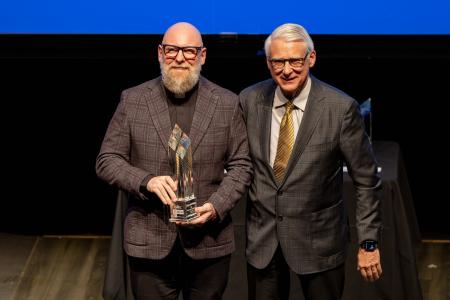
St. Vladimir’s Seminary faculty member Dr. Ana Iltis is being honored with the 2026 Paul Ramsey Award for Excellence in Bioethics.
The Paul Ramsey Award, named after the distinguished twentieth-century writer on bioethics, honors those who have made an outstanding contribution to the bioethics discussion and are actively engaged in society. Each year, the Center for Bioethics and Culture and the Paul Ramsey Award Committee select the recipient.
Ana S. Iltis, Ph.D., is St. Vladimir’s Seminary’s Professor of Philosophy for the Doctor of Ministry (D.Min.) program as well as the Carlson Professor of University Studies, Professor of Philosophy, and Director of the Center for Bioethics, Health, and Society at Wake Forest University. She has been working on both secular and Christian approaches to bioethics throughout her career, and she is an active teacher and scholar with a passion for integrating theory and practice in bioethics. Her scholarly focus is primarily on the ethical conduct of human research, including research involving children and mental health, first-in-human studies, and risk in research decision-making. She has published extensively on ethics and policy issues regarding organ transplantation and emerging biotechnologies as well as the role of religion in bioethics. Dr. Iltis is Founding Co-Editor of Narrative Inquiry in Bioethics (Johns Hopkins University Press), Associate Editor of the Journal of Medicine and Philosophy (Oxford University Press), Associate Editor of Christian Bioethics (Oxford University Press), and co-editor of the Annals of Bioethics (Routledge) series. She recently edited the Oxford Handbook of Research Ethics.
Dr. Iltis teaching Doctor of Ministry students during on-campus intensives in July.
Professor Iltis earned her Ph.D. in Philosophy at Rice University, studying under renowned bioethicist and SVS Press author Dr. H. Tristram Engelhardt, Jr., and completed bioethics training at Baylor College of Medicine in Houston, Texas. She is a past president of the American Society for Bioethics and Humanities.
Dr. Iltis, husband Steve, and daughter Sophia are members of Holy Cross Orthodox Church (OCA) in Kernersville, North Carolina. She also serves on St. Vladimir’s Seminary’s Board of Trustees.
Dr. Iltis is set to receive the Paul Ramsey Award in April at the 2026 Paul Ramsey Dinner in East Bay, California.
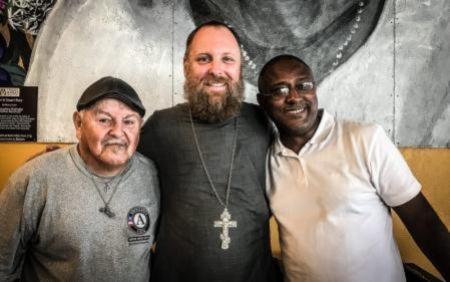
Christian media outlet theDove featured Priest Peter Runyon in a discussion about the surge of interest in Orthodox Christianity and other topics. Father Peter made an appearance on theDove TV’s Focus Today with host Perry Atkinson earlier this fall.
“[We’re seeing] a lot of young people coming in, middle-aged people,” said Fr. Peter. “It's a pretty broad demographic, but we're seeing probably the largest group are young people coming in. ... Our parish has been growing phenomenally. We're outgrowing our space.”
Fr. Peter also spoke more generally about the significant increase in seekers and catechumens seen in Orthodox parishes nationally and globally, and he also discussed other topics related to the Orthodox faith including liturgy, icons, and confession.
The Rev. Peter Runyon is a priest of the Orthodox Church in America. He graduated from St. Vladimir’s Seminary with a Master of Divinity (M.Div.) degree in 2021. In addition to his ministry as rector of Archangel Gabriel, he is a member of Seminary staff, serving as Systems Engineer.
Fr. Peter and Matushka Sophia after Divine Liturgy on the day of the Seminary’s commencement exercises in May 2021.
St. Vladimir’s Seminary Alumnus Archim. Philip Mugadizi has been called to join the ranks of the Holy Episcopate in Africa.
On October 7, 2025, the Holy Synod of the Patriarchate of Alexandria and All Africa, under the presidency of Pope and Patriarch of Alexandria, His Holiness Theodore II, elected Archim. Philip to serve as Bishop of the Orthodox Diocese of Kisumu and Western Kenya. Fr. Philip was one of several priests elected to the episcopate for the Patriarchate of Alexandria that day.
The Right Rev. Archimandrite Philip holds a Bachelor’s Degree in Leadership and Management from St. Paul’s University in Kenya, and he graduated from St. Vladimir’s Seminary with a Master of Divinity (M.Div.) degree in 2003. He currently serves as Deputy Dean and Lecturer at the Orthodox Patriarchal Ecclesiastical School of Makarios III Archbishop of Cyprus in Nairobi, Kenya.
Archimandrite Philip with Metropolitan Herman (Swaiko) at St. Vladimir’s Seminary in 2003
Father Philip is described as “a devoted servant of God who has consistently demonstrated humility in his walk of faith, integrity in his leadership, and commitment to teaching the principles of the Orthodox faith. … His journey in education and ministry reveals a rare blend of intellectual excellence and spiritual depth, a proof that true leadership flourishes when knowledge and humility walk hand in hand.”
Bishop Vasily (M.Div., '04) returned to campus for the first time since his ordination to the episcopate in August. His Grace served as a full-time member of the Seminary’s faculty leading up to his ordination, and now continues as part-time faculty as he oversees the Orthodox Church in America’s Diocese of the West. On Saturday, November 8, Bishop Vasily joined the Seminary community at Three Hierarchs Chapel for the Feast of the Synaxis of the Holy Archangels and the Bodiless Powers of Heaven. The festal celebration was further blessed by the presence of another beloved faculty member and alumnus, Archpriest Kirill Sokolov (M.Div., '07), who flew in from California for the intensive week of the Doctor of Ministry (D.Min.) program. Bishop Vasily then presided over Hierarchical Divine Liturgy the next day on campus.
New Icons in Memory of Archpriest Paul Lazor (+2020)
Following Divine Liturgy on Saturday, Bishop Vasily blessed icons of the Holy Four Evangelists newly adorning the Chapel walls. The four icons are the result of an incredibly generous gift from Matushka Natasha Lazor in memory of her husband, the Very Rev. Paul Lazor (June 28, 1939–May 9, 2020).
Father Paul was an inspirational spiritual father and teacher for generations of Seminary graduates and clergy. He graduated from St. Vladimir’s Seminary in 1964, and was married that same year to his beloved Matushka Natasha (Manturoff). After his ordination to the priesthood, by the hands of Archbishop John (Shahovsky) of San Francisco, Fr. Paul went on to serve parishes in Wisconsin and Connecticut. He later returned to the Seminary, where he served for many years as Dean of Students and full-time member of faculty, teaching courses in liturgics and liturgical theology, practical (pastoral) theology, as well as the Russian, Church Slavonic and Greek languages. He also served as priest and rector of the Seminary’s Three Hierarchs Chapel. During those years of service at St. Vladimir’s, Matushka Natasha worked on the Seminary staff and then for the special education organization BOCES. Father Paul retired from St. Vladimir’s Seminary in June of 2007.
Father Paul and Matushka Natasha at his retirement from St. Vladimir’s Seminary in 2007.
“Anyone who was a seminarian at St. Vladimir’s when Fr. Paul was Dean of Students will likely remember him in the choir or serving. He was always at services,” remembered Fr. Alexander Rentel, the current rector of Three Hierarchs Chapel. “He loved the services and believed in them, their power to bring us closer to God himself. He loved the services, but he also enjoyed the services. I learned so much from him about the services, organizing them, the underlying method beneath their structure, how to serve, but also just that enjoyment that I mentioned.
“I will always remember a quote, too, from him, which was really from his mother, whom he quoted frequently: ‘Any gift that comes from goodness has an inexhaustible source.’”
The St. Vladimir’s Seminary Chorale sang before a packed audience at Three Hierarchs Chapel and hundreds of online viewers Thursday evening, November 6, in memory of eminent Orthodox Church musician Boris Ledkovsky (1894–1975).
The concert, Fitting and Right, paid tribute to Ledkovsky’s foundational contributions to the repertoire and ethos of Orthodox liturgical music especially in America. One of the founding professors of music at St. Vladimir’s Seminary, Ledkovsky joined the Seminary faculty in 1953. His contributions to the school as well as the Church in North America continued until his repose in 1975. The year 2025 marks fifty years since Ledkovsky’s falling asleep.
The Chorale, directed by Seminary Liturgical Music Instructor Zachariah Mandell (M.Div. ’20), performed selections from Vespers, Matins, and Holy Saturday composed and arranged by Ledkovsky, before concluding the evening with a beautiful performance of We Have No Other Help.
A memorable celebration took place on campus as Theodore (Ted) Bazil was honored for his tremendous contributions to St. Vladimir’s Seminary and the Church. On Thursday, October 30, His Beatitude Metropolitan Tikhon bestowed the Primatial Gramota upon Ted Bazil in recognition of his more than fifty years of faithful service.
His Beatitude led an Akathist of Thanksgiving at Three Hierarchs Chapel before the reception of the Gramota.
“On these sacred grounds, you offered yourself, not primarily to buildings and facilities, but rather to the human persons who lived, labored and prayed here,” remarked His Beatitude. “Successive generations of these many constituents have come to know Ted, along with your faithful wife, Claudia, as a pillar of St. Vladimir's Seminary and its mission. But beyond these sacred grounds, you have become known to the wider Church—bishops, priests, deacons, and faithful from many parishes and missions—as an advocate for the work of the local Church here in North America.”
The occasion was further blessed by the presence of His Grace Bishop John (Abdalah), Seminary faculty member and auxiliary bishop of the Antiochian Archdiocese; His Grace Bishop Irinej (Dobrijevic) of the Eastern American Diocese of the Serbian Orthodox Church; and His Grace Bishop Nikodhim (Preston) of Boston and the Albanian Archdiocese of the Orthodox Church in America (OCA). Other members of the Seminary community, alumni, trustees, the extended Bazil family, and friends also gathered for the beautiful ceremony and reception.
It was a fitting celebration of Ted, whose contributions to the Seminary in particular have been so numerous, impactful, and varied, they can scarcely be summarized in any concise fashion.
“What sets Ted apart is not just his enormous energy, which anyone who has tried to keep pace with him knows better than I, but it's the way he channels that energy into service,” Trustee Emeritus Pdn. Peter Danilchick said during the reception. “Whatever the issue, whether problem or opportunity, Ted leaps into the breach, not for recognition, not for reward, but simply because the work needs doing.”
Ted Bazil is the most senior member of the management staff at St. Vladimir’s Seminary. Originally hailing from Michigan, he began his time at the Seminary as a student in 1969 after graduating from Michigan State University earlier that year (with a B.S. in Urban Planning, minor concentration in Engineering). He received his Master of Divinity (M.Div.) degree from St. Vladimir’s in May of 1973 and began his employment with the Seminary the very next month, in June.
Ted during his seminary years (back row, middle) with members of his family, including cousins Michael, Leonard, Mark, Philip, the future Fr. Thomas, and Matthew; and Frs. Vladimir, Gregory, and Igor.
“Ted Basil, then a student, would see the light on and come in many nights and help me collating orders, ordering books, looking up publishers of books … I was especially impressed with Ted's humility, and at the same time, he showed a genuine interest in theology, bookstore details, and theological publishing. This is when I really got to know Ted, his natural love for St. Vladimir’s.”
Professor Emeritus Dave Drillock was one of several speakers who paid tribute to Ted.
Prof. Drillock went on to recommend to then-Dean Fr. Alexander Schmemann that Ted be hired full time upon graduation. Since then, Ted has been instrumental in the rise of SVS Press and the expansion of St. Vladimir’s Seminary, holding many roles—most of them held simultaneously—including Business Manager, Director of SVS Press, Recording Secretary for the Board of Trustees, Director of Advancement CFRM, Planned Gifts Officer, and acting Chief Operations Officer. He both directed and was the project manager for construction and capital improvements totaling over $20 million, and was the lead person for campus expansion for over fifty years. During his tenure as the Director of SVS Press in its early years in the 1970s through 2013, the Press grew from 2-3 titles to over 500 titles, began generating over a million dollars in annual sales revenue, and established itself as the world’s largest and most active publisher of Orthodox Christian books in the English language.
“Over the decades, Ted has diligently and faithfully shared his talents through acts of service, love, and care in various roles in the Seminary administration,” said Seminary Dean Dr. Ionuț-Alexandru Tudorie. “As we have been renewing our commitment to the Crestwood campus, moving into a new era of the Seminary's history, Ted has been a constant source of strength, ideas, resilience, and support for our faculty, staff, and students.
“I am honored to call Ted a true friend and colleague,” added Dr. Tudorie. “It has been a great joy and pleasure getting to know him through our shared work over the years.
Dr. Tudorie presented Ted with tokens of appreciation on behalf of the Seminary administration, faculty, staff, and students.
During the reception Thursday, Ted’s eldest son Andrew (Drew) shared more about what makes his father such a faithful and dedicated servant.
“If you know my dad, you know what relationships mean to him. It's one of the most important things that I love about my dad. ... He's just a caring person, and he just keeps in contact with everybody,” Drew Bazil explained. “I mean, sometimes he’ll sit on the couch … and just start going through contacts. ‘Oh, I haven't called this person in a while. Maybe I'll give him a call or her a call and see what's going on.’ He just cares about people, and that's very important.”
Ted’s eldest son Drew spoke on behalf of the Bazil family.
Ted’s focus on relationships was evident throughout the celebration, as many friends and colleagues from near and far traveled to St. Vladimir’s Seminary to honor him. Many others who weren’t able to make the trip offered messages of appreciation and congratulations to Ted and his family.
“I have to say that I'm happy,” Ted said to conclude the memorable evening. “I'm happy that [Prof. Drillock and the Seminary] took a chance on hiring me. And finally, I just want to just conclude and say, ‘Where your treasure is there, your heart will be also’ [Mt. 6:21]. This is something that Fr Schmemann always used to quote from Scripture and tell me. And after all these years, I now realize that my treasure is here in this place, in my work, in this chapel, in the Seminary, in this community, my family and my wife, and my faith in Christ. So God bless you all.”
May God grant Theodore Bazil and his family many years! Axios!
The Bazil family (from left): granddaughter Emma, daughter-in-law Sarah, son Drew, Theodore (Ted), wife Claudia, daughter-in-law Alexandra, grandson Summit, and son Justin.
The St. Vladimir’s Seminary Chorale will honor eminent Orthodox Church musician Boris Ledkovsky with a public performance Thursday, November 6, 2025. The free concert will be held at the Seminary’s Three Hierarchs Chapel and will also be streamed online.
The Chorale concert is a tribute to Boris Ledkovsky (1894–1975), honoring his foundational contributions to the repertoire and ethos of Orthodox Liturgical Music especially in America, and specifically at St. Vladimir's Seminary. The year 2025 marks fifty years since Ledkovsky’s repose.
Theodore (Ted) Bazil (center) at the Seminary bookstore with then-seminarian Fr. Steven Belonick (left) and bookstore volunteer and longtime friend Joseph Domanick, circa late 1970s.
Have you ever enjoyed a book published by St. Vladimir’s Seminary (SVS) Press? Have you or has someone you know—perhaps your own parish priest—lived or spent time on campus, worshiped in Three Hierarchs Chapel, or listened to a lecture at the Metropolitan Philip Auditorium from some of the most renowned Orthodox theologians of our times? However you might have interacted with the Seminary, whatever building you stepped into, or whatever good things you might have seen come out of the Seminary over the past half-century—more than likely Theodore (Ted) Bazil played an instrumental role in making it happen. From the time of Fr. Alexander Schmemann’s deanship to the current administration under Dean Dr. Ionuț-Alexandru Tudorie, Ted has been an ever-present, ever-faithful figure over the past fifty-five years at St. Vladimir’s Seminary, working tirelessly in service of the Seminary’s mission.
Ted Bazil is the most senior member of the management staff at St. Vladimir’s Seminary. Originally hailing from Michigan, he began his time at the Seminary as a student in 1969 after graduating from Michigan State University earlier that year (with a B.S. in Urban Planning, minor concentration in Engineering). He received his Master of Divinity (M.Div.) degree from St. Vladimir’s in May of 1973 and began his employment with the Seminary the very next month, in June. Since then Ted has held many roles—most of them held simultaneously—including Business Manager, Director of SVS Press, Recording Secretary for the Board of Trustees, Director of Advancement CFRM, Planned Gifts Officer, and acting Chief Operations Officer. He both directed and was the project manager for construction and capital improvements totaling over $20 million, and was the lead person for campus expansion for over fifty years. During his tenure as the Director of SVS Press in its early years in the 1970s through 2013, the Press grew from 2-3 titles to over 500 titles, began generating over a million dollars in annual sales revenue, and established itself as the world’s largest and most active publisher of Orthodox Christian books in the English language.
Over his long history with St. Vladimir’s, Ted has diligently and faithfully shared his talents through acts of service, love, and care in his various roles in the Seminary administration. Inspiringly, his zeal for St. Vladimir’s Seminary has endured, and his tireless work ethic has seemingly never diminished, even after all these years. And Ted and his wife Claudia have been engaged and committed members of the extended Seminary community, generously giving to the Seminary themselves again and again.
In recognition of Ted’s exemplary service to Christ’s Holy Church, His Beatitude Metropolitan Tikhon is set to bestow upon him the Primatial Gramota.
In advance of receiving the honor, Ted graciously sat down to be interviewed about his life and to share memories about his time as a truly irreplaceable figure in the Seminary’s history.
Ted, what was your experience of the Church growing up, and what was it that drew you to St. Vladimir’s Seminary for the first time?
I grew up in a pious, Orthodox family, with a Russian background. My grandfather on my mother’s side was [Mitred Archpriest] Fr. Gregory Soroka, who came from the Belarus region of Russia. He went to the first Russian Orthodox Theological Seminary in Minneapolis. He had four sons, three of them were priests. The Soroka family were accomplished liturgical musicians. I had a very strong Orthodox religious background. Like many people who grew up in the 50s and 60s, the discipline was to go to church and go to all the services that were conducted in Church Slavonic. I had a strong spiritual influence through that side of the family. My father wasn’t a priest. He was a carpenter, but his side of the family were all Orthodox church members.
It was only in college that I started to understand more about the theology and history of the Church. I began attending church while at MSU and became good friends with the local Orthodox priest, who served the campus and local community. His name was [Mitred Archpriest] Photius Donahue. He was a Professor of History at the university. Father Schmemann and other members of the SVS faculty knew him and participated in his annual Orthodox catechetical conferences organized at the university. Father Photius taught a survey course on the Orthodox Church. Through this experience and readings in his course, I began to better understand the depth and tradition of the Orthodox Church. I got involved with the OCF. We had a large OCF with around 200-300 students. They made me president and I took on some leadership roles. I was on fire about learning more about the faith. This began my academic and spiritual interest in Orthodox theology and history. Father Photius opened my eyes to all of this.
Toward the end of college, I had a personal tragedy in my family. My sister passed away from an accident at a young age. I started to reconsider where my life was going. Then I met Fr. Schmemann during a church presentation in Michigan. He inspired me. He revealed another dimension to the possibilities of my life. He talked to me about the Seminary. I wanted to visit, and I did visit and eventually enrolled. I came to SVS in ’69 as a full-time student. It was a great time. It was a small community, but the community wasn’t much smaller than it is now—we had 80 to 90 students. The facilities were so much more humble, much smaller and tighter. Students today no longer share rooms. In those days we all did. We had up to three in a room in two common dormitories. We were young and we forged friendships and did everything together. Choir trips to parishes on the weekends were a highlight. I got to know the faculty well. I loved it. It was such a change coming from a major university, going from large classes to small classes with the same classmates every day for years. We had great respect for the faculty, our mentors and teachers. The liturgical experience was profound and our spiritual life intense.
Ted during his seminary years (back row, middle) with members of his family, including cousins Michael, Leonard, Mark, Philip, the future Fr. Thomas, and Matthew; and Frs. Vladimir, Gregory, and Igor.
What are some of your fondest memories of learning from some of those incredible teachers— Schmemann, Meyendorff, and others?
I remember every time we left Fr. Schmemann’s class. He always began the class by saying, “I have three points to make,” and then never got to the third point [laughs]. But it didn’t matter, because whatever he gave us in those two points was more than enough!
I have very fond memories of Fr. Schmemann. He was my dean, in charge of everything, and also my father-confessor. He was a great communicator. I often heard him effectively speak from the humblest to the most exalted audiences. He gave me direction but never told me what to do, either in confession or working at the Seminary. He wasn’t looking after my day-to-day operations. He was a person, in both his preaching and his presence, who would inspire you to do better. He gave you freedom and required you to work things out for yourself. This was especially true in his confessions. He gave direction but left you to work out your own salvation, which he always monitored to see if you were making progress. He imbued that kind of leadership quality to people at the Seminary at this time. That was a significant thing—he empowered people. I think that is what Dr. Tudorie is now trying to do. He’s trying to empower leadership at the Seminary and give back those responsibilities to each of the persons that have been delegated their work.
Father Meyendorff was a very different type of person. Father Schmemann was very extroverted, urbane, Parisian and Russian. Meyendorff was similar in this way but was more reserved. It took him a little longer to get to the point. His classes in both history and patristics were complete and detailed but were always related to the larger and more catholic universal history of the Church. I almost guarantee that most of his students still have his class notes! He would teach facts about Church history and provide theological insights using interesting stories from the Church Fathers. His explanation about the intricacies of the ecumenical councils and the relationships during these theological debates made history and patristics alive, not simply facts. You remember his stories. Meyendorff was incredible at doing that.
There were such great teachers in that generation—Schmemann, Meyendorff, Kesich, Hopko ... I realized transitioning from university to the seminary how significant they were. You go through so many professors in college, and then you get to seminary and there are only a few professors. They were so far advanced as teachers because they conveyed not only the material, the information, but they inspired you to read more, to do more, and research the topics yourself. That’s very rare. Interestingly, a few of us were in the last class ever to attend a course with Fr. Georges Florovsky down at Lehman College. Father Schmemann encouraged us to take this course. This was a real highlight being able to take a course from Fr. Florovsky. In my student years, I was profoundly inspired by the faculty’s dedication and knowledge, and wanted to share this in some significant way.
Seminary faculty, circa 1970s, with Metropolitan Theodosius (Lazor).
Did you feel called to ordained ministry as a seminarian?
No, my interest was theological and spiritual, not so much liturgical. I wanted to learn the history, the theology, and find the resources that Christ’s Church offered. I knew that I couldn’t find this myself. My former college professor led me to that, and then I started to find other things. I read Fr. Schmemann’s For the Life of the World (the first edition, 1964) and both Fr. Meyendorff and Bp. Kallistos Ware’s first editions of The Orthodox Church, and studied Isabel Hapgood’s service book. I wasn’t called to the ministry (actually, no one ever called me!) but I think I was always called to serve the Church somehow. I eventually found that niche in working for the Seminary and doing everything that I did.
What led to you being hired by the Seminary right after graduation, and how did you get involved with SVS Press?
I started doing things around the Seminary while I was a student. Everyone had jobs. My interest was in books. We had a small theological bookstore, just selling to students. We had two or three seminary Press books at the time. David Drillock was basically running it. Professor Verhovskoy wanted to close it because it wasn’t making much money, but Dave Drillock refused. He said no, thought we could do better, and he and Fr. Schmemann had the vision and dream to somehow use the bookstore to transition into the Press. They needed someone to help make it a reality. I was that person and got involved in helping develop the product while I was a seminarian. I was only volunteering, doing the work outside of my assigned seminary job. At one point Father Michael Oleksa and I put together a 124-page annotated book catalog. The books we featured of course weren’t Press books, as we only had two or three at that time, but we included a lot of quality theological books being sold by university presses. We put the catalog together and mailed it out to parishes and alumni. That’s how we started to use the bookstore as the sales arm of SVS Press. We developed a plan to sell these books outside of our normal orbit, and it was successful. I graduated that year, and wasn’t married. Fr. Schmemann came to me and said, “Why don’t you stay at the Seminary and help build the Press?” I knew David Drillock was behind that, because he was kind of the architect of the Press and understood what was going on. Father Schmemann knew that, but also said they could use some of my other skills that I had in planning and engineering to help physically develop and expand the facilities and campus. So that’s how I transitioned into my position at the Press and stayed at the Seminary.
SVS Press is extremely rare in how profitable it is, especially considering it’s attached to a small, non-profit religious school. Even large, well-known university presses mostly lose money and operate at a deficit! How did you go about growing SVS Press so tremendously into what it is today?
It was interesting because after I married my wife, we didn’t have children for five years. Claudia was a flight attendant for Pan Am Airlines, always doing international travel for a large part of the week. This afforded me the possibility of spending a tremendous amount of time working to build the Press. For five years, I know that I would often spend six to seven days a week, from ten to sometimes eighteen hours a day, working to build the Press, focusing on that work. Dave Drillock and I worked together. He taught during the day, and was the Secretary and later CFO, but would come over in the evenings to help me when he could. We did this together, and that is how we built a foundation for the Press.
We saw opportunities at that time. For example, we found a group of small patristic titles, On the Incarnation, On the Christian Sacraments, and St. John Chrysostom’s On the Priesthood, which were published in the UK by SPCK. We bought the rights and published them under SVS Press. We saw the popularity of these texts. These books launched what became the Popular Patristics Series. In the beginning, Fr. Meyendorff and Fr. Erickson were very helpful in identifying important patristic texts to translate and finding translators for new materials, e.g. St. Basil’s On the Holy Spirit among others. At the time there were large, often poorly translated patristic texts published in expansive and expensive editions such as the Nicene and Post-Nicene Fathers. We saw the Orthodox interest and necessity in publishing new, fresh, and readable patristic texts focused on a particular theme. Our patristic publications were small and inexpensive. This series became a tremendous success. Now we have something like seventy-five volumes in the series using this model.
Another important way the Press grew: In the 60s it started with the publication of a few faculty works; by the 70s we brought publication rights to some very popular and important books like The Orthodox Way by Kallistos Ware and books by other Orthodox figures who weren’t part of the Seminary faculty. Then we expanded our publication net even more and looked for works that weren’t necessarily written by Orthodox authors. These new titles represented the theology of the Orthodox Church and some from various traditions too, such as the Coptic, Syriac, and Armenian traditions. Occasionally we identified some respected Catholic and Anglican authors to publish some significant books on history, theology, and liturgical theology. We often published or bought publications or translations and North American rights from respected English Christian or French Roman Catholic publishers. We published these books in the US market and paid them royalties. We don’t co-publish much anymore. Either authors come to us with a manuscript or the Press through the Faculty Publication Committee solicits new titles from authors on various topics. That’s one of the big things that has changed.
With Bishop Daniel Findikyan, an alumnus and former faculty member of the Seminary, at the 2006 launch of the AVANT Series published by SVS Press in collaboration with St. Nersess Armenian Seminary.
There was another significant transition at the Press. At first, our market was Orthodox. Our initial market was Orthodox believers and parishes. But the market changed, and we began to expand beyond the traditional Orthodox audience, which actually grew the Press and grew its influence. That transition was tremendous. I don’t know the proportions now of how many non-Orthodox versus Orthodox people read our books and use our material—just go on Amazon and start reading reviews. You can surmise most of those people aren’t Orthodox. So many people have “read” their way into the Orthodox Church by reading a Press book!
SVS Press was created as a “mission.” I feel certain we never lost sight of this purpose. This is the raison d’être for SVS Press to exist. We hope that our publications are transformational and serve to guide spiritually and inform our readers. It’s significant that we established a model that made the Press profitable, which is unheard of for a university press. This is accomplished by keeping the expenses and prices of books low, while publishing the right material and distributing to expanding markets.
We were always a small operation, but very active. There was no template for us already set. You learned on the way, learned how to publish, learned what would sell, how to do acquisition, how to edit, how to design, how to find printers, and then warehouse, market, and manage the operation. There were always things you learned as you went along, and this grew our knowledge about everything.
After all that tremendous work to build the Press and doing countless other things at the Seminary, you “retired” as SVS Press Director in 2013. But it seems we just wouldn’t let you leave! And you still have so much enthusiasm for the work of the Seminary, and are working as tirelessly as ever. How have you kept that fire kindled year after year?
Well, there are a number of things. Number one is that, since I did so many things—I was the Director of the Press (that just fell into my lap), the COO, the business manager; I was charged with construction and property acquisition, fundraising, planned gifts—so it was never boring. I was always doing something different and something more exciting and something more challenging. And the great thing about that is that when you have the freedom to do things and you see successes, that feeds your passion. You know when it happens, and see it’s being done for the greater good. You want to be part of that, and it feeds your passion to continue. Then you throw that in with those inspirational leaders that you’ve met and worked with. It’s a wonderful formula.
Another element of the joy of being here is serving the Seminary. I never felt that I was called to anything else except to do this work. But part of the joy of being here is meeting so many people through the years: seminarians, alumni, new faculty, previous faculty, staff, and others such as the Board of Trustees and donors. For over twenty-five years I was recording secretary for the Board, and I met and got to know all the Board members. They stepped up their participation, especially at critical times when we were doing capital campaigns and supported these projects. They were so sacrificial and dedicated. They gave so much of their time and talents, and treasure. The fact that people like that sacrifice for the mission of the school inspired me. You hope that you can emulate them by some modicum of example. I met so many people like that through the years. I won’t use names, because I will forget someone. There are so many of them who were so instrumental in the life of the Seminary, both trustees and other donors. Then occasionally you met some really bright stars, like Jaroslav Pelikan, whom I got to know personally. My wife Claudia and I were godparents to his wife Sylvia when she was brought into the Orthodox Church in the chapel, and are godparents to one of his grandchildren. He just was a remarkable person who was a real rock of faith and knowledge. You are blessed to meet people like this on occasion. If I were not in this position, I would never have that opportunity. It is the gift of being at SVS so long that you are given these opportunities.
With Jaroslav Pelikan
As I mentioned, I had my hands in so many things. When I formally retired, I just stayed on part time, and helped the Seminary where needed. I sit in on meetings and share my experience when requested. I find that I am still interested in what is going on here and am not bored. I still come to work, get to meet people, and do different things. So even though I’m not doing all the things that I did before, I still am excited by the challenge of what goes on and seeing the changes, seeing how the Seminary has grown and has developed, and where it’s going. I’m very hopeful about the future of St. Vladimir’s.
With David Drillock (middle) and Protodeacon John Eby (+2021), a fellow alumnus of the Seminary and longtime SVS Bookstore manager.
One of the people you met here became your wife! Can you tell us how you and Claudia met?
It happened after I returned to the Seminary as a student. After my second year I had to take a hiatus from my studies, because I suffered a bad injury to my knee and needed surgery. I went back to Michigan and had a lot of reconstructive surgery and rehabilitation. In those days you didn’t leave the hospital and had to stay there for weeks. I returned to St. Vladimir’s the year after my surgery on Holy Thursday. I met Claudia that day for the first time. I was introduced to her by my cousin, Michael Soroka, who was a seminarian. She was the daughter of an Orthodox priest and was employed by Pan American Airlines. I met her in the chapel on Holy Thursday. We never separated since and share a wonderful life together. We think of Holy Thursday as a special time.
Ted and Claudia
That is so beautiful! Is Claudia still working these days?
She is still a flight attendant and works for Delta Airlines. In fact, that’s a part of our life too. She has afforded us the opportunity for both myself and our two sons to travel all over the world for free. We’ve been able to visit so many ultimate destinations that I could not have otherwise afforded.
Ted and Claudia celebrating their 50th anniversary with their family.
Can you talk about your sons and now grandchildren as well?
My oldest son, Drew, lives on my same street in Crestwood with his wife Sarah and my thirteen-year-old granddaughter. He’s a professional structural engineer and a project manager for the new NYC Hudson Tunnels. My other son is Justin. He works as an electrician for the entertainment industry. He comes back occasionally and works out of the New York City region. He and his wife Alexandra have our two-year-old grandson.
We have a very close family. We go on family trips together and get together often. It’s a nice time of life to share so much.
With sons Andrew and Justin
What else do you enjoy doing—maybe something people don’t know about you, even if they’ve worked or known you for a long time?
Well, aside from my absolute love of mountains, national parks, the great outdoors, extensive hiking, and canoeing, I think what most people don’t know about me is that I enjoy Hallmark-type of movies with my wife [laughs]. Some of them are great!
With alumnus and faculty member Gregory Abdalah (now The Rev. Dn. Gregory) at the Seminary’s 75th anniversary celebration in November 2013.
Having seen so much history at St. Vladimir’s Seminary under so many different leaders and administrations, what are your thoughts on the direction of the Seminary moving forward?
I think now, with this new leadership and direction under Dr. Tudorie and with the present Board, faculty, and staff, it bodes well for the future. There are some exciting possibilities that I see for development in all the areas. I think the right people are in place to do that. In my previous role as the Director of Advancement and Planned Giving, I have been blessed with getting to know incredibly generous donors that give in measure of their blessings. They support, believe in, and pray for the mission of the Seminary. Our school could not exist without their support to sustain the annual budget. Planned gift estates and capital campaign donors have provided transformational gifts that resulted in the growth of the Seminary’s programs and facilities. Our benefactors look for something hopeful and want to see things accomplished. We’re moving in the right direction. It’s our job to stay on the narrow path, work hard and do our best—we pray that God bless our efforts!
At the 75th anniversary celebration in Nov. 2013. Pictured (from left to right): Seminary Chancellor/CEO Archpriest Chad Hatfield; Alumni Association Board Chair Gregory Abdalah; Alex Machaskee, 75th Anniversary Co-Chair; Matushka Sharon Rubis and Tatiana Hoff, Banquet Co-Chairs; Tony Kasmer, 75th Anniversary Co-Chair; Theodore Bazil, Master of Ceremonies; Seminary Dean Archpriest John Behr.