
Newly published Florovsky talks, contemporary theological discussions featured in latest SVTQ
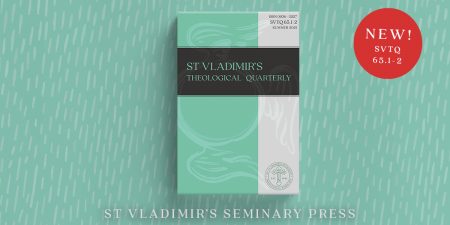
Saint Vladimir's Seminary (SVS) Press has released the first double issue of the St Vladimir's Theological Quarterly (SVTQ) of 2021.
Saint Vladimir's Seminary (SVS) Press has released the first double issue of the St Vladimir's Theological Quarterly (SVTQ) of 2021.
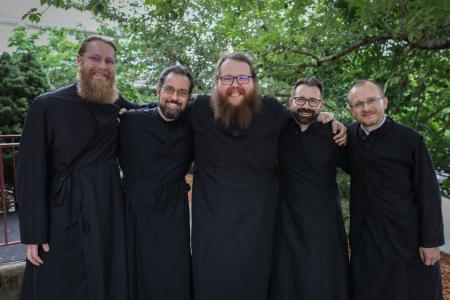
Saint Vladimir’s Orthodox Theological Seminary (SVOTS) welcomed twenty-five new seminarians and forty-four returning students for the start of the 2021-2022 academic year. Monday, August 23 marked the first day of classes.
Seminarian Paul Patane, a second-year student in the Master of Divinity program from the Orthodox Church in America, said his second year already feels different than his first at the Seminary—which can come with unique challenges as first-year seminarians adjust to leaving old lives and careers behind and transition to lives as seminarians.
“This morning I was singing in the choir, matins was very enjoyable and reflective, and classes were really good. I feel like I’m starting to get my feet under me, and that’s a good feeling. I’m really happy to be back.”
Anastasia Colchester joined St. Vladimir’s from the UK, and attended orientation sessions with her fellow first-year seminarians in the days leading up to the start of the fall semester.
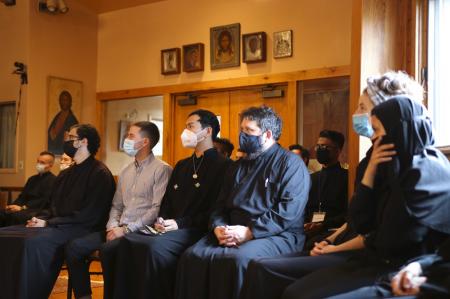
“I was keen to come to St. Vladimir’s as a result of its emphasis on both academic and spiritual excellence. I had heard good things about several different seminaries, but St. Vladimir’s was said to stand out for the rigor of its scholarship,” she said. “I am very grateful to have been accepted and am happy to see that the Seminary’s reputation as a place of deep learning—both in the classroom and in the chapel—is well deserved.”
The UK is one of eight countries represented among the twenty men and four women of the incoming class, also including the United States, Albania, Australia, the Republic of Georgia, India, Poland, and Romania. The new seminarians come from eleven different Eastern and Oriental Orthodox jurisdictions:
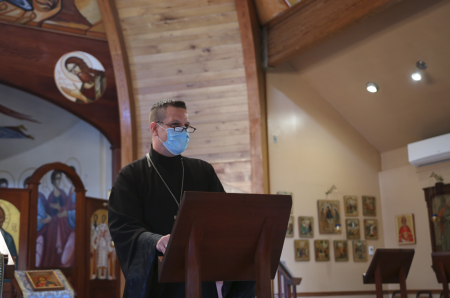
Twelve of the new students are enrolled in the Master of Divinity (M.Div.) program and thirteen in the Master of Arts (M.A.) program. Additionally, one of the Seminary's 2021 M.A. program graduates has enrolled in the Master of Theology (Th.M.) program.
Counting the incoming class, the Seminary’s total student body is 78 (including continuing and non-degree seminarians).
May the intercessions of the Theotokos and Ever-Virgin Mary, our patron Great and Holy Prince Vladimir, and all the saints be with our seminarians as they begin their new academic year in service to Christ!
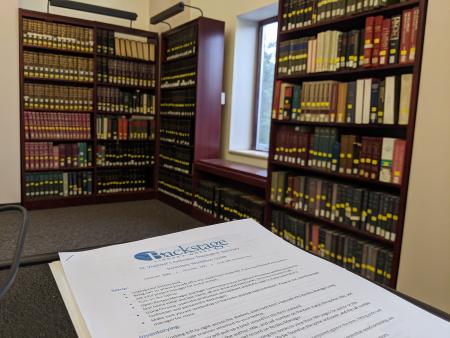
It has been a wonderfully eventful summer at the Seminary’s Father Georges Florovsky Library.
Under the leadership of Academic Dean Dr. Ionuț-Alexandru Tudorie and Librarian Danielle Earl, work has been ongoing to build the Florovsky Library—already considered one of the Seminary’s greatest assets—into the best research library possible.

Those efforts now include the recent addition of ProQuest Dissertations & Theses Global (PQDT): The Humanities and Social Sciences collection to the Library’s academic databases. PQDT is a curated collection of multi-disciplinary dissertations and theses from around the world. This new database and others offered by the Father Georges Florovsky Library are listed at library.svots.edu.
“This new resource will greatly aid students in both the research and thesis-writing process,” said Earl.
This summer, Earl has also been overseeing a project to assess the Library’s materials and catalog, with the help of Backstage Library Works. Backstage’s Inventory Plus project will allow students to find and access materials more easily, as well as enjoy the large breadth of the Library’s collection.
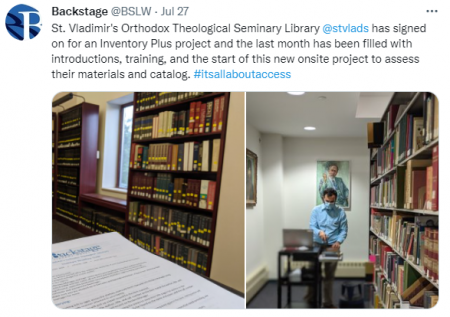
“This is made possible by BackStage’s extensive work on our collection, which totals 190,000 volumes. With a collection of this size, it is inevitable that items become missing, outdated, and need review,” Earl explained. “For these reasons, Backstage’s technicians are inventorying every single item to give us a clear picture of our collection.”
The technicians are barcoding the collection, repairing records, and making sure that the access points of the book in hand match the Library’s online catalog. They will also weed, shift, and ensure the collection is in call number order.
“These are labor-intensive tasks that require attention to detail and a care for patron accessibility. Students, faculty, and staff should be excited to see a completely transformed library by the end of October, one that demonstrates our commitment ‘to form and cultivate future leaders and servants in the Orthodox Church and the academy.’”
Efforts to further transform the Library won’t stop there, and another improvement at the Florovsky Library is already on the horizon. Earl said a dedicated space will be created for the Library’s archives in the near future.
“Much of the materials we have are from Frs. Schmemann and Florovsky. Giving the documents, photos, and writings of these great thinkers their due place will enhance the Library’s accessibility for both our local and global communities."
Check back at SVOTS.edu as more improvements at the Florovsky Library unfold soon.
The Father Georges Florovsky Library at St. Vladimir’s Seminary is a pan-Orthodox resource serving all levels of St. Vladimir’s institutional mission and vision, as well as scholars and researchers worldwide. It is dedicated to providing for the multifaceted research needs of its local and international community—academic, liturgical, pastoral—in order to form and cultivate future leaders and servants in the Orthodox Church and the academy. The Library currently holds 190,000 volumes and hundreds of periodicals.

Saint Vladimir’s seminarians have a shot at $3,000 in scholarship money as the annual St. Matthias Merit Scholarship Essay Contest opens for 2021.
The Essay Contest is offered each year at St. Vladimir’s thanks to the generous contributions of a family of anonymous donors. The winner of the contest—open to current seminarians only—will have the award money added to his or her scholarship fund to help pay for tuition at the Seminary.
The donors select the essay topic each year. Here are the details for this year’s contest.
Unlike wild dogs, domestic dogs have a long, steady history of loyalty and service to the peoples that took them in. One such dog was from Ithaca. An anecdote from “The Bow of Ulysses” by Eleanor Farjeon is as follows:
So he [Ulysses] disguised himself in rags and went up to the palace, and nobody knew who he was. Only his old dog, Argus, knew him. Argus had been a puppy when he [Ulysses] sailed away for Troy, and had waited twenty years, watching for his master's return.
(Farjeon also explores their bond in her poem, “Argus and Ulysses.”)
How does the perspective of cultures familiar with domestic dogs help the Syrophoenician woman in Mark 7:24-30, and how does it help us "watch" as advised in Mark 13:33-37? Write an essay on this topic in 750 words or less.
Entries for the 2021 St. Matthias Merit Scholarship Essay Contest should be submitted in PDF format—double-spaced and conforming to SVS Press House Style—to Ann Sanchez at aks@svots.edu. Entries must be submitted by September 14, 2021, the Feast of the Exaltation of the Holy Cross.
The contest is one of many offerings by the Seminary to help seminarians graduate tuition-debt free as they go forth to serve the Church. Saint Vladimir’s also administers need-based tuition grants, need-based scholarships, merit scholarships, continuing education grants, and matching grant opportunities for seminarians. These are made possible thanks to many benefactors who have graciously given funds to the Seminary.
To help more seminarians receive their education and formation, consider making a donation by visiting the Seminary’s Give Now page and selecting “Financial Aid for Current Students” as your designation.
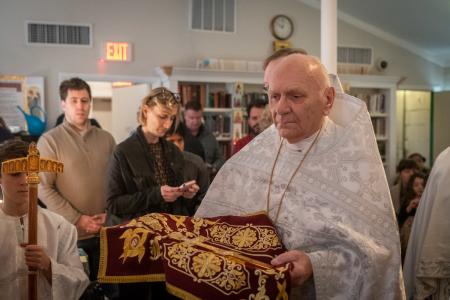
With faith in Christ and hope in the resurrection, we share news of the repose of Mitered Archpriest Michael Koblosh, an alumnus of St. Vladimir’s Seminary (’68). Father Michael fell asleep in the Lord in Alexandria, VA on the morning of August 18, 2021, following a battle with cancer.
The Very Rev. Michael Koblosh graduated from St. Tikhon’s Orthodox Theological Seminary in 1964 before pursuing a Master of Divinity (M.Div.) degree from St. Vladimir’s Seminary. He taught at St. Tikhon's in liturgical theology for many years during the 1970s.
Father Michael and his wife, Matushka Nadia, most recently served the mission parish of All Saints of North America, Alexandria, VA, and were integral to the beginning of the mission in 2008. They also served in a number of other parishes including Holy Trinity in East Meadow, NY; Sts. Cyril and Methodius Church in Terryville, CT; Holy Ghost Church in Bridgeport, CT; Christ the Savior Mission in Southbury, CT; and St. Nicholas Church in Whitestone, NY. During his time in Connecticut, Fr. Michael was dean of the Connecticut Deanery.
On January 5, 2020, Fr. Michael was elevated to the dignity of mitered archpriest in recognition of his decades of service to the Orthodox Church.
“He was a deeply faithful priest, who loved the Church with all his heart, and he served his flock selflessly until the very end,” said St. Vladimir’s Trustee Wesley J. Smith, J.D., who served at the altar as a subdeacon with Fr. Michael for more than four years. “As he slowly declined from cancer, he modeled how Christians can face the end of their earthly sojourn with good humor, steadfast courage, and deeply committed faith. He was a priest to the very last!”
Days before he reposed, when Fr. Michael could no longer attend church, he still insisted on writing the bulletin, in which he also included short reflections. Fr. Michael’s final bulletin reflected on the Feast of the Dormition, and fittingly looked toward the Kingdom:
On The Dormition—or “Assumption”—of The Mother Of God Scripture is silent about the death of the Mother of God. The story of that death is found in various apocryphal writings of the Early Church. There, we learn that upon her death she was “assumed” by God into the heavenly kingdom of Christ in the fullness of her spiritual and bodily existence. The silence of Scripture, however, is a “noisy silence.” The death and physical glorification of the Theotokos is the fulfillment of the whole Biblical story and of the death and resurrection of Christ. For what other reason did Christ come than to save us and to bring us, bodily, into His Kingdom? In His Mother, His suffering and victory find completion. And, because she is as human as we are, her glorification gives us a true and living icon of our own destiny in Christ. In Him and through His spirit, the resurrection and transfiguration of the world has begun. In the great Feast of the death of the Mother of God, the final resurrection of all and everything finds glorious and incomparably beautiful prefiguration. Her death has been described by a writer stepping outside of a dirty elevator and into a world full of nothing but joy, beauty, and infinite love. May such be the description of our deaths.
Father Michael is survived by his wife Nadia, and their daughters Larissa Chapin (Christopher) and Rebecca Edwards (Dr. Steven), as well as his grandchildren Jacob, Alexa, Noah, Zachary, and Andrew. He is also survived by his sister, Matushka Lydia Koblosh Westerberg (Mitered Archpriest Michael), as well as numerous close relatives, nieces and nephews, and loving parishioners and friends.
May his memory be eternal!
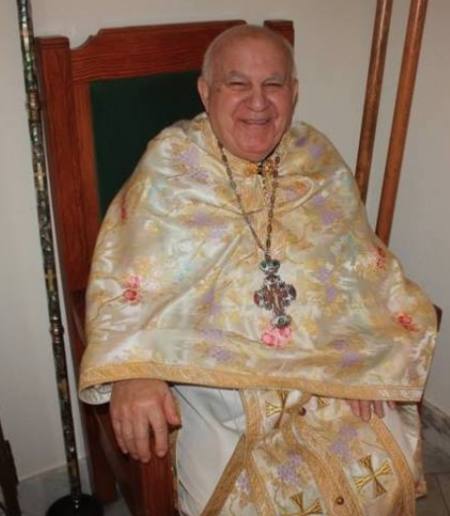
With faith in Christ and hope in the resurrection, we share news of the falling asleep of Archpriest Gregory Ofiesh, the pastor emeritus of St. Nicholas Antiochian Orthodox Church in San Francisco, CA. Father Gregory, an alumnus of St. Vladimir's Seminary, reposed in our Lord on the morning of August 11, 2021. His parishioners will remember him for his ministry to youth, warmth, and dynamic sermons.
The Very Rev. Gregory Ofiesh received a bachelor’s degree in philosophy and classics from Duquesne University in Pittsburgh, PA. He later attended Holy Cross Orthodox Theological Seminary in Brookline, MA and completed his theological training at St. Vladimir’s Seminary in 1967. Father Gregory received a master’s degree in Religious Education from Union Theological Seminary in Pittsburgh.
From 1959 to 1964, he served as pastor of St. Elijah Church in Oklahoma City, OK. In 1964, he became pastor of St. Nicholas Church in San Francisco, where he served until his retirement in 2000. Father Gregory was once chairman of the Antiochian Archdiocese's Dept. of SOYO and Inter-Orthodox Youth Relations and spiritual advisor for the North American Council of SOYO (now the Depts. of Young Adult Ministry and Youth and Parish Ministries).
His Eminence, Metropolitan Joseph asks that the clergy and laity pray the Trisagion Prayers of Mercy for Fr. Gregory for the next forty days, and also asks for prayers to Almighty God for comfort for Kh. Mary Jane and the Ofiesh family.
May the memory of Archpriest Gregory be eternal!
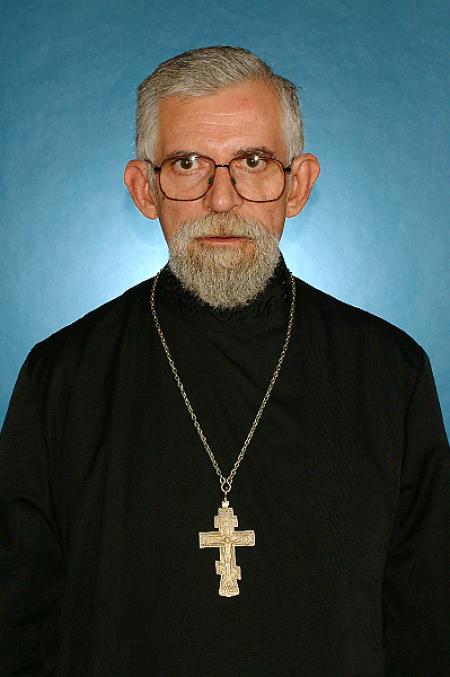
With faith in Christ and hope in the resurrection, we share news of the repose of Archpriest Stephen Janos, an alumnus of St. Vladimir's Seminary. Father Stephen fell asleep in the Lord on Saturday, August 7, 2021 at his residence in Mohrsville, PA.
The Very Rev. Stephen Janos was born in Lebanon, PA, to the late Anne (née Marko) and Stephen J. Janos, Sr. He graduated from Reading Central High School in 1965, and earned his Bachelor’s degree in Humanities, followed by a Master’s degree in Philosophy, from Villanova University. He then studied at St. Vladimir’s Orthodox Theological Seminary.
Father Stephen was ordained to the Holy Priesthood on May 8, 1982, by His Grace Bishop Ireney of the Patriarchal Parishes of the Russian Orthodox Church in the USA. He was received into the Orthodox Church in America on May 13, 1998, by His Beatitude, Metropolitan Theodosius. He was subsequently assigned as chaplain at Ss. Cosmas and Damian Home in Staten Island, where his wife was also employed on staff. On January 22, 2003, he was transferred to Saints Peter and Paul Church in Buffalo, NY; he was named rector of the parish a year later, and served the community there faithfully until his retirement on July 31. 2011. Father Stephen had been elevated to the rank and dignity of Archpriest and been given several ecclesiastical awards, including the palitza.
In the late 1990’s, Father Stephen translated 1,500 pages from Russian of The Lives of the Saints which vastly expanded the extent of this material for English readers. He has in print more than ten books devoted to Russian religious philosophy, primarily of the noted Russian émigré philosopher Nicholas Berdyaev. Father Stephen was well respected in academic circles as a scholar and translator.
Father Stephen was the husband of the late Matushka Suzanne E. (née Plotar) Janos, who fell asleep in the Lord on February 8, 2004. He is survived by his devoted son Andrew M. and daughter-in-law Bonnie L. Janos of Herndon, VA, and two granddaughters, Madelynn and Jocelyn Janos.
The schedule of services for Fr. Stephen is as follows:
A viewing will be held on Tuesday, August 10 from 6 p.m. to 8 p.m. at the Leibensperger Funeral Home, 223 Peach Street, Leesport, PA. There will be a Parastas Service at 7 p.m. at the funeral home.
Family, diocesan clergy, and former parishioners will be present on Friday, August 13, for a viewing at Ss. Peter and Paul Church, 45 Ideal Street, Buffalo, NY, where the Service for the Burial of a Priest will be celebrated at 6:30 p.m. by His Eminence, Archbishop Michael and area clergy. A Divine Liturgy, followed by a Litiya, will be served on Saturday, August 14, by Archbishop Michael and attending clergy, beginning at 10 a.m.
Following divine services at Ss. Peter and Paul Church, Fr. Stephen will be buried next to his beloved wife at St. Matthew’s Cemetery in West Seneca, NY.
May the memory of Archpriest Stephen be eternal!
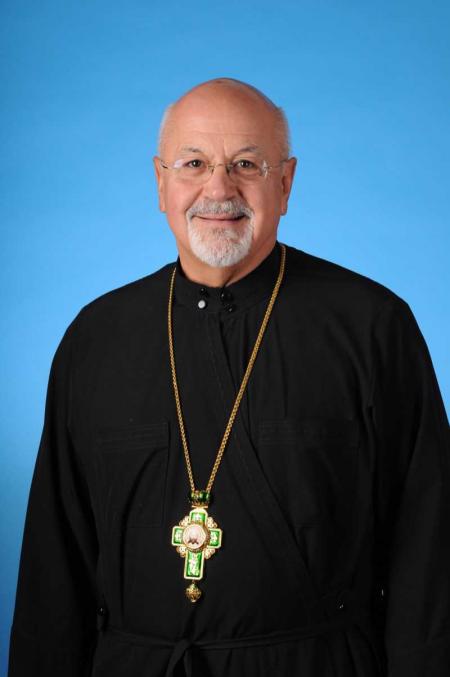
At its Board of Directors meeting held on July 19, 2021, the Orthodox Church Capital Improvement Fund (OCCIF) Board of Directors unanimously elected Archpriest John Dresko to serve as the second president of OCCIF, effective August 1, 2021.
Father John, an alumnus of St. Vladimir’s Seminary, has served on the OCCIF Board since 2016, and as interim treasurer for three years. The founding OCCIF president, John Della Monica, has stepped down due to increased demands on his professional life. During Della Monica’s tenure, OCCIF developed into a professional financial organization devoted to helping the growth of the Orthodox Church through capital improvement loans. He has agreed to remain on the Board of Directors to guide and mentor the new president.
“Every board member, as well as the many Orthodox parishes and institutions already helped by OCCIF, offer our profound thanks to John,” said incoming OCCIF president Fr. John Dresko. “We wish John and his family nothing but the best and continued good health.”
In addition to his years of work with OCCIF, Fr. John brings a thorough knowledge of Orthodox Church finances and administration. Father John is currently rector of St. Paul the Apostle Orthodox Church (OCA) in Las Vegas, NV. Ordained to the Holy Priesthood in 1979, he has had a long vocation in parishes and at the administrative levels of the Church. In addition to parish work and administrative positions, he has served on the Diocesan Councils of the Diocese of the Midwest, the Diocese of New England, and, currently, the Diocese of the West, where he serves on the Finance Committee. He has also served on the Metropolitan Council of the OCA for sixteen years over the past thirty.
“Over the years Fr. John has been an invaluable resource on OCCIF’s Board of Directors,” said Della Monica. “Now as president, Fr. John will help OCCIF continue to grow as the leading provider of capital improvement loans for the Orthodox Church.”
About OCCIF
The Orthodox Church Capital Improvement Fund (OCCIF) was established in 2011 as an outreach of the Mission Board of the Diocese of the West of the Orthodox Church in America. OCCIF is the leading provider of funding for capital improvement projects exclusively for the Orthodox Church, with over $4 million provided to Orthodox missions, monasteries, and institutions.
About Archpriest John Dresko
The Very Rev. John Dresko possesses a B.A. in history from Iona College, New Rochelle, NY and an M.Div. from St. Vladimir's Orthodox Theological Seminary (Class of ’80). In addition, he is a graduate of the Meyer Institute of Christian Stewardship and The Center for Philanthropy of Indiana University, both in Indianapolis, IN. While in the Air Force, he also graduated from Academic Instructors School at Air University, Maxwell AFB, AL with post-graduate credits in education.
In addition to St. Paul’s, Fr. John has served in Rochester Hills, MI; Mentor, OH; and New Britain, CT; and as director of Stewardship, then director of Development, for the Orthodox Church in America. He also served on active duty as an Air Force chaplain at Lackland AFB, TX. A past president of the Alumni Association of St. Vladimir’s Seminary, he served on the Board of Trustees of the Seminary and as chairman of the Dean’s Search Committee in 2006.
Father John has lectured on Christian Stewardship and giving at various locations throughout North America and authored numerous articles and reflections in numerous publications. He is married to his wife Elizabeth since 1977, and they have four children and seven grandchildren.
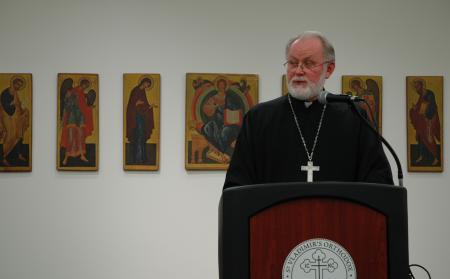
With faith in Christ and hope in the resurrection, we share news of the repose of Protopresbyter Leonid Kishkovsky, longtime Director of the Orthodox Church in America (OCA)'s Office of External Affairs and Interchurch Relations. Father Leonid fell asleep in the Lord on the evening of August 3, 2021 in Sea Cliff, NY.
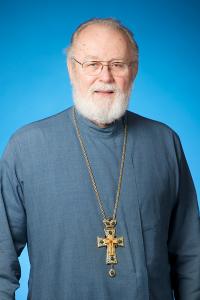
"Protopresbyter Leonid Kishkovsky will be remembered as one of the building blocks of what would become the OCA. His global contacts and influence in both Orthodox and ecumenical spheres had no rivals," said Archpriest Chad Hatfield, president of St. Vladimir's Seminary. "His legacy will be studied and interpreted for many years to come. May God grant him Paradise."
In addition to his work for the OCA, Fr. Leonid had vast experience serving the Church nationally and internationally through leadership in organizations such as SCOBA, IOCC, and the World Council of Churches. He was also the long-serving rector of Our Lady of Kazan Church, Sea Cliff, NY.
Father Leonid attended St. Vladimir's Seminary from 1964 to 1967, and returned to his alma mater in 2005 to deliver the 22nd Annual Father Alexander Schmemann Memorial Lecture, titled, "Orthodoxy Today: Tradition or Traditionalism."
"Father Leonid was one of my most cherished mentors, especially in church diplomacy, where he embodied both zeal and sobriety, and also realism, respect for the other, and love for the Church," said St. Vladimir's Professor Dr. Peter Bouteneff. "His unflagging commitment and hope (often in the face of deep disappointment), his knowledge, and his connectedness to the movers and shakers of the church and the political world made him into one of the giants of our time—all the while, grounded in his beloved little parish in Sea Cliff. In making the Orthodox Church known, understood, and respected throughout the world, his impact was incalculable."
All services for Fr. Leonid’s funeral will take place at Our Lady of Kazan Church, 2 Willow Shore Ave, Sea Cliff, NY. The schedule is as follows:
Wednesday, August 11
12 p.m. - Arrival of the Body and Panikhida
7 p.m. - Funeral Service for a Priest
Thursday, August 12
9:30 a.m. - Divine Liturgy, immediately followed by Litya from the Panikhida and interment at Roslyn Cemetery
All clergy who wish to concelebrate the funeral or the Divine Liturgy should contact the chancellor of the Orthodox Church in America, Archpriest Alexander Rentel, at chancellor@oca.org or (516) 922-0550 x130.
May the memory of Protopresbyter Leonid be eternal!