Diverse and ancient Oriental Orthodox liturgical music traditions were brought together as one on the campus of St. Vladimir’s Seminary in October, as scholars and practitioners explored their sacred chant traditions and brought them into dialogue with Eastern Orthodox musicians.
The Seminary hosted the Colloquium on Oriental Orthodox Liturgical Music in Theological Education October 29–30. His Grace Bishop Daniel Findikyan, an alumnus of St. Vladimir’s Seminary and St. Nersess Armenian Seminary, delivered the keynote address, “With One Voice: Sacred Chant, Liturgical Function, and Orthodox Theology.”
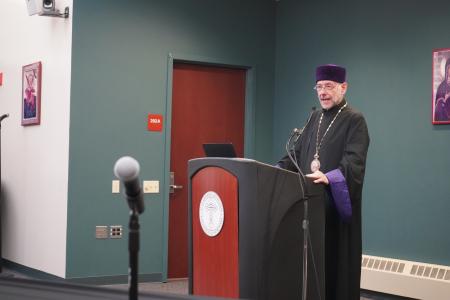
“Our deliberation of liturgical music today and tomorrow is invaluable on many counts,” His Grace asserted as he began his keynote, “perhaps most of all because it brings together specialists from both the Eastern and Oriental Orthodox churches. Together we constitute a family of churches with a diversity of liturgical rites and an even greater diversity of sacred music traditions. For some, that very diversity opposes an impediment to our full communion. Yet … beneath the diversity lies a common vision, a truly Orthodox vision whose coherence and legitimacy emerged precisely through the distinctive sonorities of our respective traditions—in other words, the old maxim “unity in diversity” is also borne out musically.”
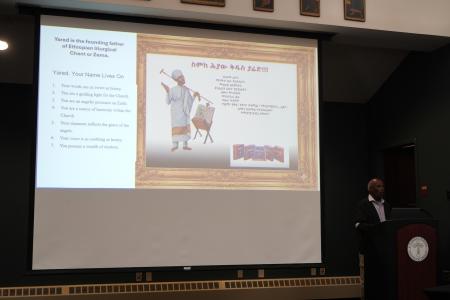
The evening program also featured a performance of select Ethiopian Orthodox hymns, led by Fr. Amde Tsion from St. Michael Ethiopian Orthodox Tewahedo Church in Englewood, NJ, and by second-year St. Vladimir’s seminarian Fr. Ephreme Megenta.
Watch a replay of the keynote address and performance on the Seminary’s YouTube page.
During the two-day curriculum, presentations and discussions surrounding Armenian, Ethiopian and Eritrean, Coptic, and Syriac liturgical music (both from the churches of the Middle East and India), took center stage. Eastern and Oriental Orthodox seminarians, faculty, and staff representing the Seminary and other institutions also held panel discussions to highlight the experience and implementation of sacred music within theological education. Along with His Grace Bishop Daniel, colloquium presenters, chairs, and panelists included Dr. Gabriel Aydin, Dr. Peter C. Bouteneff, Dr. Daniel Girgis, Dr. Habtemichael Kidane, Dr. Alexander Lingas, Fr. Arsenius Mikhail, Dn. Harrison Russin, Dr. Ani Shahinian, Dr. Haig Utidjian, and Juliana Woodill.
The Colloquium on Oriental Orthodox Liturgical Music in Theological Education was the culmination of a series of events, organized by the Seminary’s Institute of Sacred Arts (ISA), exploring commonalities and differences in Eastern and Oriental Orthodox approaches to sung worship. In 2024 the Seminary held a colloquium highlighting Eastern Orthodox liturgical singing. Last May the Seminary hosted Exploring the Orient: Syriac & Armenian Liturgical Chant, and earlier this October held a workshop on Coptic liturgical music. These events were made possible through a Vital Worship, Vital Preaching Grant from the Calvin Institute of Christian Worship, Grand Rapids, MI, with funds provided by Lilly Endowment Inc.
ABOUT THE INSTITUTE OF SACRED ARTS
The Institute of Sacred Arts (ISA) at St. Vladimir’s Orthodox Theological Seminary explores the intersection of human creativity and holiness. With a theology that is holistic, and a liturgy that unites multiple artistic disciplines and all the human senses, the Orthodox Christian tradition is ripe for the exploration and celebration of the sacred arts. Since its founding in 1938, St. Vladimir’s Seminary has fostered the study of icons, music, and liturgy. The ISA serves to extend the Seminary’s mission in exploring the mutual relationship between theology and the arts by: contributing to the work of people and institutions that practice and reflect on the sacred arts; engaging people and institutions of all backgrounds with Orthodox artistic tradition; inspiring wider public interest in spirituality and the arts. Learn more at www.instituteofsacredarts.com.
Scenes from the Colloquium
