Lenten Offices of the Third and Sixth Hours
Start Date
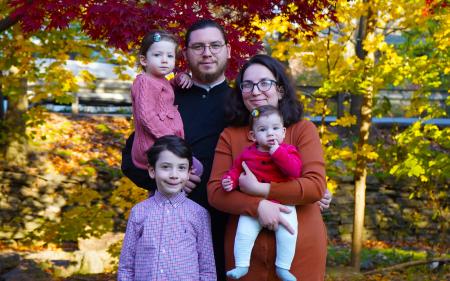
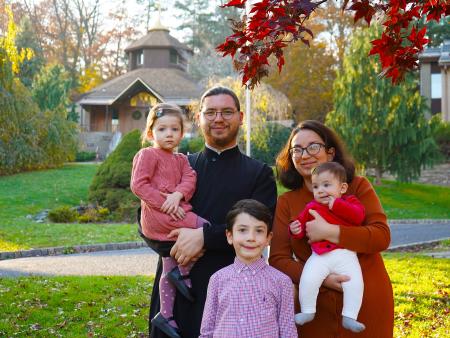
Giorgi, a seminarian from the Republic of Georgia, is in his third year studying in the Master of Divinity program with the blessing of Archbishop Alexander of the OCA’s Diocese of the South. He and Barbare are parents of a son, Gabriel, and two daughters, Eugenia and Dorothea, both of whom were baptized in Three Hierarchs Chapel with Seminary President Fr Chad Hatfield presiding.
I was born and raised in an Orthodox family in Tbilisi, Georgia. I spent most of my life serving in our parish, first as an altar server and then as a reader. When the time came to choose my profession, I decided to dive deep into historical Georgian literature, which is mostly related to the Georgian Orthodox Church so I enrolled at Tbilisi State University and finished my undergraduate program in Georgian Philology (literature and grammar).
During my undergraduate studies, I found that reading liturgical manuscripts was a fascinating and entertaining way to look into the minds of Georgian church scholars and understand the variances in liturgical practice in Georgia through the centuries.
The church texts written in the Middle Ages have very interesting characteristics. Before the printing press, manuscripts were written out by scribes, which means you see all their personal, human characteristics in the text—variances in calligraphy, grammar, knowledge, or sometimes the lack of those things are all on display. When you read the inscriptions, sometimes they're unrelated to the liturgical content, and sometimes you see the scribes’ personal comments. It was like the Twitter of the Middle Ages—you can tell when the scribe was upset with a fellow monastic or scribe, when they were happy, or if there was some kind of struggle in their lives. Seeing all these things preserved after all these centuries is really exciting.
I first started reading these texts as an assignment in one of my classes; eventually, I was invited to be part of a big project, a cooperation between Goethe Frankfurt University, Tbilisi State University, and the Holy Monastery of Iveron on Mount Athos. This project involved digitizing old Georgian manuscripts preserved in the Monastery. We spent a year preparing an English version of the manuscript collection in English and it has now been published by the Monastery of Iveron itself.
After that project, I realized we had to do more to make all this information available to the broader society and to start more effective research. By the time I finished my master's degree at Ilia State University in Medieval Studies, I knew that the next step would be to work on a digital framework for liturgical manuscripts. In 2021, I started a PhD program at Ilia State University in Digital Humanities. At the end of the first semester, I came to the realization that I had to know more about theology. I could mostly understand the text of the manuscripts, but as we know, liturgy is very complex—we need to know every aspect of it to see the whole picture.
Of course, I already knew about St Vladimir's Seminary and SVS Press. I had read about Fr George Florovsky and Fr Alexander Schmemann and had also heard from many people that St Vladimir's Seminary offers excellent coursework in Liturgical Theology. After I decided to apply, everything happened really quickly. My wife was very supportive and in August 2021, we moved to Yonkers and I enrolled as an M.A. student. After finishing my first year, I realized I wanted to explore more of the experience of liturgy, so I switched to the M.Div. program.
For me, the most important part of living here is everything related to liturgics. I feel very blessed to study under the Rev. Dn Dr Vitaly Permiakov, our professor of Liturgical Theology. Dn Vitaly shares so much information and advice about both the logical and practical parts of our worship tradition; the scope of his knowledge is extremely impressive. Attending the Academic Symposium on Liturgical Theology here last year was one of the brightest times in my life.
My academic goals for seminary were not the only reason I decided to come here – another main reason was the residential model, how we live here. I wanted to live in an Orthodox community. What we hear in class, we do in church, and what we hear and pray in church, we try to fulfill when we’re at home or spending time with our friends. We have single students (monastics among them) and some of us are married students; we see how the different kinds of lifestyles are united into Christ.
My children also enjoy living here. I came here with my wife Barbare and my son, Gabriel. We welcomed our second baby soon after my first year here, our daughter Eugenia, and another daughter, Dorothea, this past summer. A central part of living here is bringing our children to services. For them, our liturgical life and prayer are just part of their daily lives. Also, it is a great privilege to have neighbors who raise their children with the same mindset and values.
Living here is also a challenge sometimes because of the busy schedule–there is always something to do or something happening. It requires a lot of effort and attention from both my wife and I to divide our time properly, to find some time for our family and for my studies. On the other hand, everyone is living the same lifestyle and it’s very family-friendly. You can always ask for advice and you can also reach out and share your experience. This is a blessing not only for me but for my family too.
I would say the main characteristics of the Georgian Church today are the blend of our historical traditions and the current revival of Orthodoxy we are experiencing. On the one hand, we have a very long tradition, since we start counting the history of the Georgian Church from the period of the Apostles. According to our tradition, the Apostle Andrew preached in the western parts of my country. And then in the third century, St Nino converted the eastern part of Georgia.
This long history of the Orthodox Church mixes in with the current revival which began with the fall of the Soviet Union. During the Communist years, our tradition was restricted and limited, and was full of struggles and prohibitions. Now is a time of revival and restoration, which of course doesn't happen in an instant. And even though many things have been done, there's more to do. On the one hand, we need to rebuild our Church and renew our regional traditions; and on the other hand, we are blessed to have some content in liturgical texts or even in folklore, customs, and traditions, which are very ancient and enriched by Orthodox meanings. We need to find different ways to bring our voice to the world and to show others our traditions and customs. This is a challenge but of course not just a one-time challenge. We need to do this in every era and in every century.
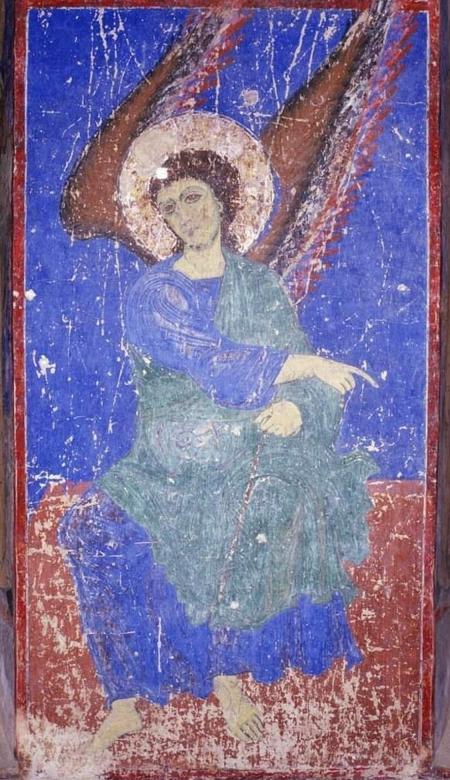
This icon is the fresco of an angel from the Kintsvisi Monastery, painted in the 13th century. The style is interesting and unique; the clothes of the angel are blue and the style itself shows a very characteristic Georgian style of art.