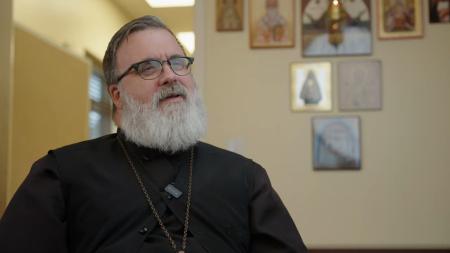
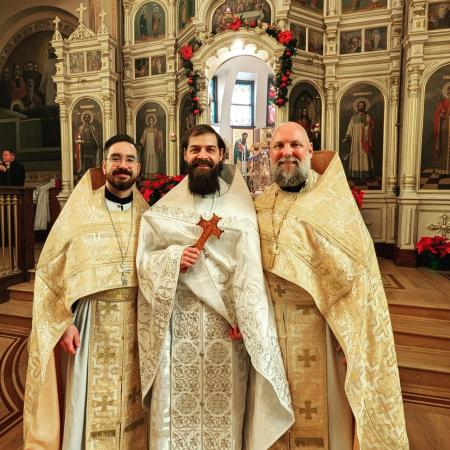
"What do you want Protestants to know about Orthodoxy?" an Evangelical church asked St. Vladimir’s Seminary alumnus Fr. Christopher Foley.
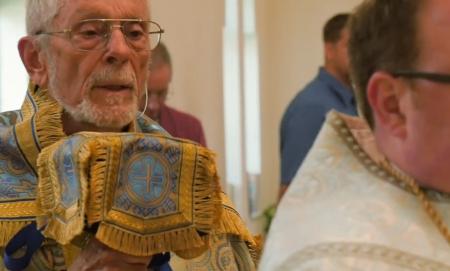
Fr. Christopher’s response to that question and other topics appeared in the video “Perspectives on Liturgy & Orthodoxy.” The interview was produced by Center City Church in Greensboro, NC, as part of a series on liturgy and beauty.
“St. Paul says, if you read it in the Greek, [Christ] is the ‘icon’ of the invisible God, the image of the invisible God. ... So the fact that Christ really took on flesh means that matter matters,” reflected Fr. Christopher. “And this is the underpinning of all of our sacramental and liturgical life and understanding, that we participate in Christ through the sacramental life of the Church. So our worship is extremely kind of sensual, in the sense that it engages all of the senses.”
Watch the full interview below. Fr. Foley appears in the video starting around the five-minute mark.
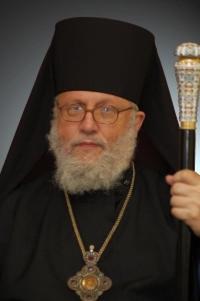
With faith in Christ and hope in the resurrection, we share news of the repose of His Grace Bishop Seraphim (Sigrist), former Bishop of Sendai, an alumnus of St. Vladimir’s Seminary. Bishop Seraphim fell asleep in the Lord on the morning of February 7, 2026.
Bishop Seraphim was born Joseph Sigrist on December 13, 1941, in New York and baptized in a Presbyterian Church. He was brought up in Pleasantville, NY, and studied at Nyack College. While studying at Nyack he began to attend the Orthodox Church and, on completing his degree there, he was received into the Orthodox Church at Holy Virgin Protection Cathedral in New York. He then began study at St. Vladimir’s Orthodox Theological Seminary and, after graduating in 1967, went to Japan to assist the Orthodox Church in that country.
In Japan, working first as a teacher in a church-related school and assisting as a deacon at the Toyohashi Church, he was tonsured a monk with the name Seraphim and served first as a parish priest in the town of Nakanida and then, being consecrated in Tokyo on December 19, 1971, from that time served as Bishop of East Japan living in Sendai.
Bishop Seraphim served in Japan for nineteen years, returning to the United States in 1987. He taught in the graduate department of religion at Drew University, wrote three books, and visited Russia frequently in recent years in support of mission especially to youth in Russia.
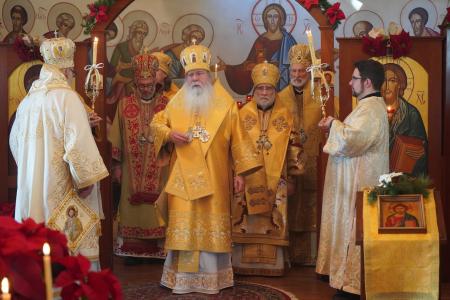
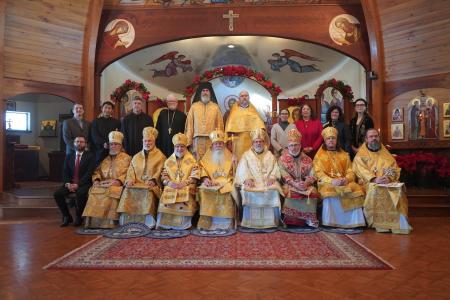
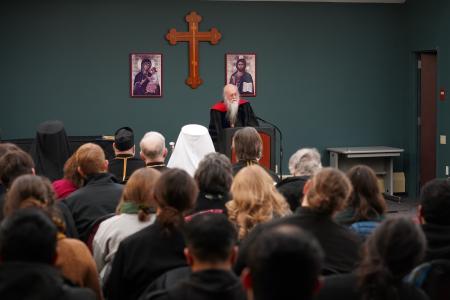
The St. Vladimir’s Seminary (SVOTS) community celebrated a truly joyous altar feast of The Three Holy Hierarchs on Friday, January 30, as the Seminary welcomed to campus seven hierarchs, a number of other noted clergy and alumni, Seminary trustees, friends, and renowned Orthodox theologian the Very Rev. Dr. Andrew Louth. Later that evening, following the morning’s Divine Liturgy, Fr. Andrew delivered the 43rd Annual Fr. Alexander Schmemann Memorial Lecture and received an honorary doctorate from St. Vladimir’s.
Feast of the Three Holy Hierarchs
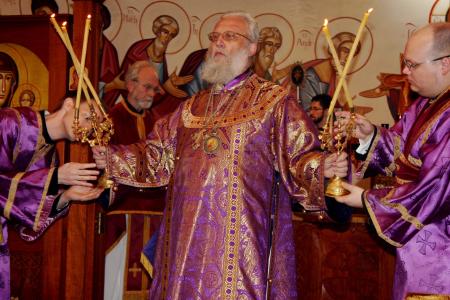
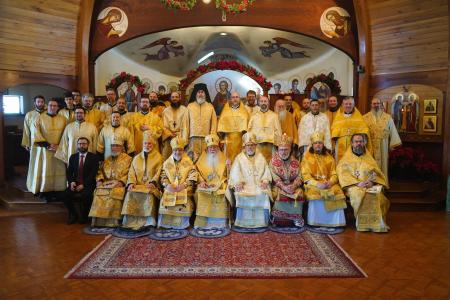
His Beatitude Metropolitan Tikhon, Archbishop of Washington, Metropolitan of All America and Canada, and President of St. Vladimir’s Seminary, presided over Divine Liturgy at the Seminary’s Three Hierarchs Chapel. Joining His Beatitude were His Eminence Archbishop Michael of New York and the Diocese of New York and New Jersey (OCA); His Grace Bishop John (SVOTS Class of ’84) of Worcester and New England (Antiochian Archdiocese); His Grace Bishop Irinej (’82) of Washington-New York and Eastern America (Serbian Orthodox Church); His Grace Bishop Nikodhim (’07) of Boston and the Albanian Archdiocese (OCA); His Grace Bishop Benedict (’10) of Hartford and New England (OCA); and His Grace Bishop Vasily (’04) of San Francisco and the West (OCA). Among the priests present were—including Seminary clergy, guests, and alumni—Archpriest Alessandro Margheritino (’14 and ’25), Chancellor of the Orthodox Church in America; Three Hierarchs Chapel Rector Archpriest Alexander Rentel (’95), SVOTS’ Assistant Professor of Liturgical Theology and Canon Law; Protopresbyter Nicolas Kazarian, Ecumenical Officer and Director of the Department of Inter-Orthodox Ecumenical and Interfaith Relations (Greek Orthodox Archdiocese of America); Archimandrite Jeremy (Davis; ’04), Archiepiscopal Vicar, Diocese of Toledo and the Midwest (Antiochian Archdiocese), and Seminary Trustee; Archpriest Andrew Louth, Archpriest Emeritus of the Diocese of Sourozh (Moscow Patriarchate); Seminary Spiritual Formation Director Archpriest Michael Nasser; Archpriest Volodymyr Zablotskyy, the Rector of Holy Trinity Orthodox Church in Yonkers, NY; and Archpriest Bogdan Bucur, SVOTS’ Associate Professor of Patristics.
“When a community celebrates its patronal feast day, they pause to give thanks to all those who came before them to bring us to this point … to express the kingdom of heaven in this place and in this time,” His Grace Bishop John noted as he gave the homily. “Let us remember the Three Holy Hierarchs and their love for each other as we learn to know each other and love each other, so that in unity we can, in one voice, proclaim the Good News and share the life that God chooses to share with the entire world.”
On behalf of Seminary Dean Dr. Ionuț-Alexandru Tudorie and the entire community, Fr. Alexander Rentel warmly welcomed all the hierarchs and guests at the conclusion of Divine Liturgy.
His Beatitude then offered a beautiful reflection on the numerology which marked this blessed feast of the Three Holy Hierarchs: Basil the Great, Gregory the Theologian, and John Chrysostom:
“The grace and peace of these three great saints is multiplied twofold through the presence of the venerable hierarchs and brothers who join me, six in number, for our concelebration today…”
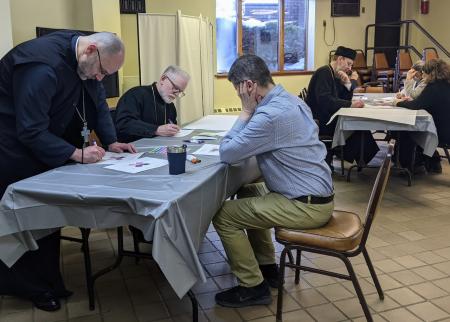
Part of this busy week at the Seminary, including Friday afternoon, was reserved for a major undertaking by SVOTS administration and the Board of Trustees. Board members engaged in the work of strategic planning that will guide the Seminary for the next several years and beyond. This work was a continuation of efforts that began during the Board’s October 2025 session. During the January session, trustees discussed and discerned important topics about the Seminary's future, work that involves the voice of the Church as well as the Seminary. The Board is eager to ensure this strategic planning reflects the close connection of SVOTS and the Church that has been a strong emphasis of recent administrative and board work overseen by His Beatitude and Dr. Tudorie. Input from stakeholders—including hierarchs, alumni, donors, seminarians, faculty, staff, and others—is part of this ongoing work.
Hierarchs, Seminary Administration, and Trustees
Many trustees were present on campus for the strategic planning work; others joined remotely due to travel difficulties brought on by the recent blizzard.
Schmemann Lecture & Honorary Doctorate
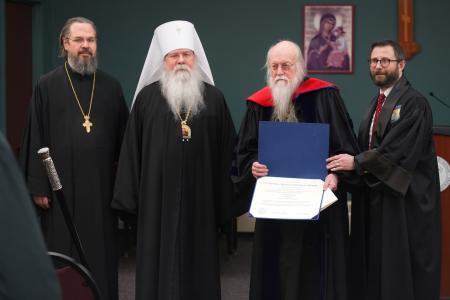
As the Fr. Alexander Schmemann Memorial Lecture got underway that evening, Dr. Tudorie announced a special honor for guest lecturer Fr. Andrew Louth: the bestowal of an honorary Doctor of Divinity degree from St. Vladimir’s Seminary.
“[Father Andrew] is a great teacher of the Church, a scholar of renown, and one of the most respected voices in patristic studies today, for whose decades of ministry both at the altar and in the library we are deeply grateful,” stated Dr. Tudorie.
The Very Rev. Dr. Andrew Louth is Professor Emeritus at the University of Durham; Honorary Fellow of the St. Irenaeus Orthodox Theological Institute at Radboud University in Nijmegen, Netherlands; a Fellow of the British Academy; and Archpriest Emeritus of the Diocese of Sourozh (Moscow Patriarchate). He is the author of several books, including St. Vladimir’s Seminary (SVS) Press’s Greek East and Latin West: the Church ad 681–1071, The Church in History, vol. III (2007); and he has also served as editor and translator for other Press titles over the years.
“I am completely overwhelmed,” said Fr. Andrew upon receiving the honorary doctorate. The honor was a surprise and kept secret from Fr. Andrew until shortly before the Lecture. “St. Vlad’s has always meant a great deal to me, and … over the last thirty years or so [I’ve] kept in touch with the Seminary. … I just feel very, very moved that you’ve chosen to give me this great honor.”
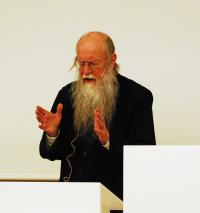
Father Andrew then offered his lecture, entitled, “Shadows and Darkness in Patristic Theology.”
“Orthodox Theology is often regarded, by ourselves and others, as essentially ‘apophatic,’” explained Fr. Andrew in his introduction. “Even though the language of apophatic/cataphatic, affirmation or denial, or negation, was only introduced into Greek Patristic theology by Dionysios the Areopagite in the early sixth century, a negative theology of an unknowable God already had a long history, both among Christian Fathers and among their contemporaries, the philosophers of the Greek Platonic tradition. There has, however, been a tendency to see Greek Patristic theology from the perspective of what is, in truth, Neoplatonic apophaticism, and to regard the various ways in which shadows and darkness feature in the Fathers somewhat as stumbling blocks towards a fully fledged apophatic theology.”
At the end of this memorable day of worship, fellowship, and meditation, His Beatitude offered a word of gratitude before concluding the event with prayer.
“Your inspiring exposition … [reflects] the years of prayerful labor and research that you have offered not just for your own spiritual growth and academic growth—or even for that of your students—but for the Church. And we are grateful to you not only for your words but your example, reminding us so clearly how we all must, in a certain sense, pass through those stages of shadow to image and truth.”
A joint tribute by St. Vladimir’s Orthodox Theological Seminary and the Orthodox Christian Studies Center at Fordham University
Join us for a two-day commemoration honoring the 100th birthday of Fr. John Meyendorff (February 17, 1926–July 22, 1992), one of the most influential Orthodox theologians of the twentieth century.
A scholar of extraordinary range, Fr. John shaped the study of Byzantine theology, Orthodox ecclesiology, and ecumenical dialogue for generations. His dual role as Dean and Professor at St. Vladimir’s Seminary and Professor of Byzantine History at Fordham University made him a unique bridge between Orthodox theological education and the broader academic world. This joint tribute honors that legacy at both institutions where he left an indelible mark.
Registration is closed.
Friday, February 6 | St. Vladimir’s Orthodox Theological Seminary
5:30 PM — Memorial service in the Seminary Chapel followed by reflections on Fr. John’s legacy:
His Grace Bishop Irinej (Dobrijevic), Bishop of Eastern America, Serbian Orthodox Church
Dr. Vera Shevzov, Professor of Religion and Director of the Program in Russian, East European, and Eurasian Studies, Smith College
Dr. Paul Meyendorff, Father Alexander Schmemann Professor of Liturgical Theology Emeritus, St. Vladimir's Orthodox Theological Seminary
Reception to follow, open to all.
Saturday, February 7 | Fordham University, Rose Hill Campus
9:00 AM — Breakfast and coffee
9:30 AM–12:00 PM — Academic Symposium: “Orthodoxy, Byzantium, and the Rise of Russia Revisited”
Speakers:
Dr. Ionuț-Alexandru Tudorie, Dean, St. Vladimir's Orthodox Theological Seminary
Dr. Aristotle Papanikolaou, Professor of Theology and Archbishop Demetrios Chair in Orthodox Theology and Culture, Fordham University
Dr. Nadieszda Kizenko, Professor of History, University at Albany
Dr. Dimiter Angelov, Dumbarton Oaks Professor of Byzantine History, Harvard University
Dr. Tikhon Alexander Pino, Director of the Pappas Patristic Institute, Hellenic College Holy Cross
Attendance at this joint, two-day event is free and open to the public.
Renowned Orthodox scholar and author the Very Rev. Dr. Andrew Louth will deliver the 43rd Annual Father Alexander Schmemann Memorial Lecture at St. Vladimir’s Seminary on Friday, January 30, 2026, on the Feast of the Three Hierarchs.
The lecture is free and open to the public to attend in person or online. It begins at 7 p.m. EST/4 p.m. PST.
Registration is closed.
Fr. Andrew’s lecture is titled, “Shadows and Darkness in Patristic Theology.”
“Orthodox Theology is often regarded, by ourselves and others, as essentially ‘apophatic,’” writes Fr. Andrew. “Even though the language of apophatic/cataphatic was only introduced into Greek Patristic theology by Dionysios the Areopagite, a negative theology of an unknowable God already had a long history. There has, however, been a tendency to see Greek Patristic theology from the perspective of Neoplatonic apophaticism, and overlook the various ways in which shadows and darkness feature in the Fathers. This lecture is an attempt to redress this.”
The Schmemann Lecture is part of St. Vladimir’s Seminary’s yearly celebration of the feast of our chapel patrons, the Three Hierarchs: Holy and Ecumenical Teachers Basil the Great, Gregory the Theologian, and John Chrysostom. His Beatitude Metropolitan Tikhon will preside over Divine Liturgy at 9 a.m. that morning at Three Hierarchs Chapel. A light reception will follow the lecture.
About Fr. Andrew Louth
The Very Rev. Dr. Andrew Louth is Professor Emeritus, University of Durham; Honorary Fellow of the St. Irenaeus Orthodox Theological Institute, Radboud University, Nijmegen, Netherlands; Fellow of the British Academy; and Archpriest Emeritus of the Diocese of Sourozh (Moscow Patriarchate). Author of several books, including The Origins of the Christian Mystical Tradition: from Plato to Denys (1981; revised ed., 2007); Denys the Areopagite (1989); St John Damascene: Tradition and Originality in Byzantine Theology (2002); SVS Press’s Greek East and Latin West: the Church ad 681–1071, The Church in History, vol. III (2007); Modern Orthodox Thinkers: from the Philokalia to the present (2015); and numerous articles, a selection of which can be found in Selected Essays, in two volumes: I. Studies in Patristics; II. Studies in Theology, edited by Lewis Ayres and John Behr (2023).
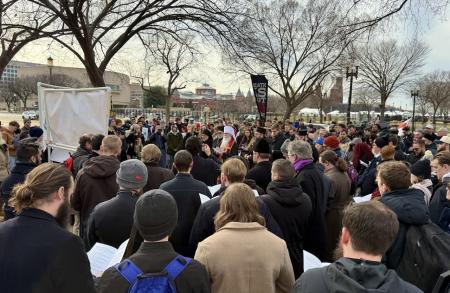
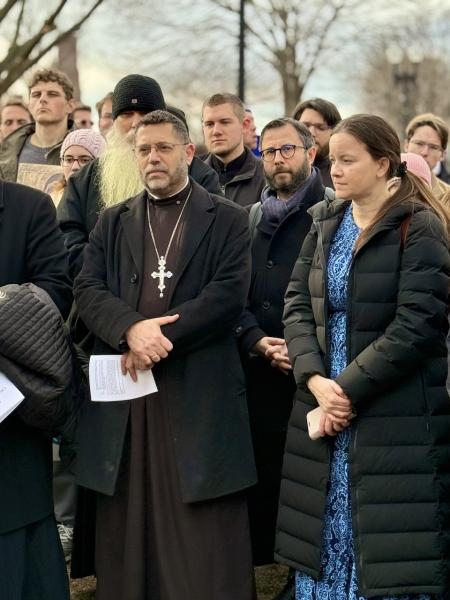
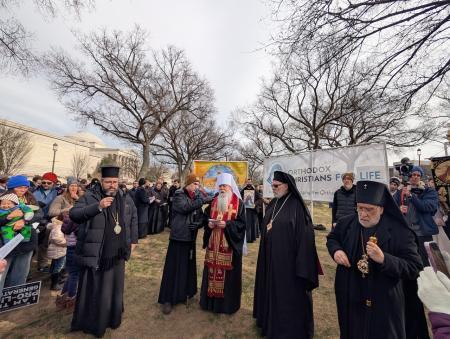
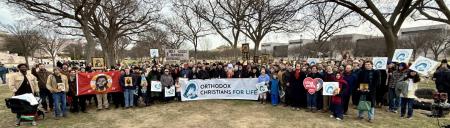
Seminarians from St. Vladimir’s and St. Tikhon’s Orthodox seminaries offered prayers and marched alongside His Beatitude Metropolitan Tikhon and other Orthodox clergy and laity Friday, January 23, at the annual March for Life in Washington, D.C.
"After many years of wanting to attend the March for Life, I was thankful that I was able to attend for the first time,” said Fr. Michael. “I was so impressed to see the Orthodox hierarchs, other clergy, and faithful gathered together to pray for an end to the killing of unborn children in our country. And I was thankful our seminarians could see the dedication of these beloved brothers and sisters—and the thousands of others alongside whom we marched—and with whom we could add our own efforts."
The Seminary’s Spiritual Formation Director Fr. Michael Nasser and Dean Dr. Ionuț-Alexandru Tudorie at this year’s March for Life (Photo: OCA.org).
“It was wonderful to see so much support for the Pro-Life movement from so much of the Orthodox Church in North America,” said second-year seminarian Benjamin Franks, who helped lead the group of seminarians on the trip. “There were bishops from several jurisdictions present as well as local parishes, and both St. Tikhon's and St. Vladimir’s seminaries. Being together and advocating as one for the Orthodox Christian witness to life was an immense blessing. As seminarians, it is important for our formation to participate in pan-Orthodox engagement in society to advocate for an end to this and all injustice.”
Each year the student-led St. Ambrose Society plays a major role in organizing St. Vladimir’s Seminary’s participation in the March. A few days prior to the March, the St. Ambrose Society hosted an informational session for seminarians with leaders of the group Orthodox Christians for Life (OCL). OCL is a key part of the Orthodox presence at the March every year.
Hierarchs at the March (from left): Bishop Andrei (Hoarște), Metropolitan Tikhon (Mollard), Bishop John (Abdalah), and Archbishop Michael (Dahulich).
The gathering for the March for Life Rally began at noon Friday at the National Mall. The assembled hierarchs gathered to offer the opening prayer, given by Seminary Alumnus and Trustee His Grace Bishop Irinej (Dobrijevic) of the Serbian Orthodox Church. His Beatitude presided at the Service of Supplication to End Abortion, after which the March for Life began.
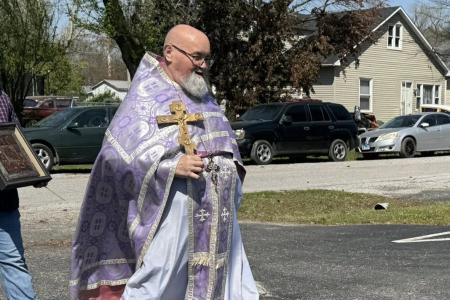
With faith in Christ and hope in the resurrection, we share news of the repose of Archpriest John Pawelchak, an alumnus of St. Vladimir’s Seminary. Father John fell asleep in the Lord on January 17, 2026.
The Very Rev. John Pawelchak was born on February 17, 1954, in Terryville, CT, where he grew up as a member of Sts. Cyril & Methodius Orthodox Church. He began studies at St. Vladimir’s Seminary in 1975 and graduated from the Master of Divinity (M.Div.) program in 1978. He was ordained to the priesthood in April 1979.
Father John received his first parish assignment at Annunciation Albanian Orthodox Church in Natick, MA. Over the course of many decades of priestly service, he served parishes in Wisconsin, Connecticut, New Hampshire, Maine, and Illinois, dedicating his life to the spiritual care of the communities entrusted to him. He also worked as a professional counselor to those in need.
Father John was predeceased by his parents, sister, and nephew. He is survived by his children and grandchildren.
Visitation will be held at Nativity of the Virgin Mary Orthodox Church, 416 Ewing Ave, Madison, IL, from 4:30 p.m. until 8 p.m. on Friday, January 23; the funeral service will begin at 6 p.m. Divine Liturgy is scheduled for Saturday at 10 a.m. at Nativity of the Virgin Mary, with Archbishop Daniel (Brum) as celebrant. Burial will follow at Nativity of the Virgin Orthodox Cemetery in Glen Carbon.
May the memory of Archpriest John be eternal!
Much of the information in this article was adapted from the Irwin Chapel website.
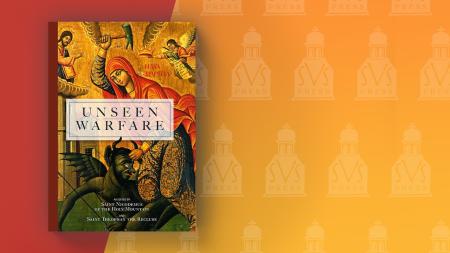
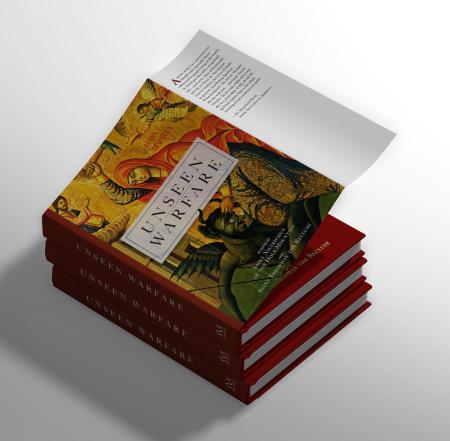
The new edition has been revised to include a new introduction and a number of footnotes intended to help clarify for the reader the relation of this book to Orthodox spirituality in general and especially to the tradition of the Philokalia, while also providing patristic citations that were previously missing. The book is presented in hardcover (6×9) with dust jacket, perfect bound, and newly typeset for improved readability.
Unseen Warfare is a spiritual classic that explores the inner struggle every believer faces in the pursuit of holiness. Originally written by Lorenzo Scupoli, a sixteenth-century Venetian priest, the book became influential across both Western and Eastern Christian traditions. It was recognized for its spiritual depth by Nicodemus of the Holy Mountain, who revised it somewhat, and later substantially refined and translated by Theophan the Recluse in the nineteenth century.
This work draws richly from the wisdom of saints and Church Fathers, uniting insights from a host of Christian sources to guide readers in their spiritual journey. It emphasizes that the true battleground for spiritual growth is within the human heart. As Theophan wrote, “The time of battle is our whole life.”
With its practical advice on resisting sin and cultivating virtue, Unseen Warfare remains a profound companion for those seeking deeper spiritual discipline and complements other essential works like the Philokalia, with which both Nicodemus and Theophan realized it shared much in common.
The new edition of Unseen Warfare is available for purchase at SVSPress.com.
With faith in Christ and hope in the resurrection, we share news of the repose of Archpriest Stephen Plumlee, an alumnus of St. Vladimir’s Seminary. Father Stephen fell asleep in the Lord January 14, 2026, at the age of 86.
Born on May 25, 1939, the Very Rev. Stephen Plumlee graduated from St. Vladimir’s Seminary in 1969, and was ordained to the priesthood that same year. Following graduation he was assigned to the Chapel of St. Innocent of Irkutsk, an English-language community at the Cathedral of the Holy Virgin Protection in Manhattan.
In the 60s and 70s, Fr. Stephen and his wife, Matushka Lois, were instrumental in organizing monthly trips with seminarians to hospitals and mental health institutions in the New York area. Father Stephen was a licensed and practicing psychotherapist who at one time served as Dean of Students at Blanton-Peale Graduate Institute in Manhattan. As a member of the OCA’s Department of Lay Ministries, he was actively involved in the Church’s official outreach and ministries to people with special needs and disabilities. He had also participated in various activities of the Orthodox Christian Association of Medicine, Psychology, and Religion (OCAMPR).
Father Stephen was attached to St. Mark Church, Bradenton, FL, in his retirement. During his active priestly ministry, he had served there for several years starting in 1988, and also pastored the English-speaking community at the bilingual Christ the Savior Church in New York City, beginning in 1976, which was then under the leadership of Fr. John Meyendorff.
Father Stephen was preceded in death by his beloved Matushka Lois, who fell asleep in the Lord on April 30, 2013.
Funeral services will be held at St. Mark Church in Bradenton, FL. Funeral vigil is scheduled for Monday, January 19 at 6 p.m.; funeral liturgy is Tuesday, January 20, at 9 a.m.; the committal and burial will take place later that day at 2:30 p.m. at Oak Lawn Cemetery in Sanford, FL.
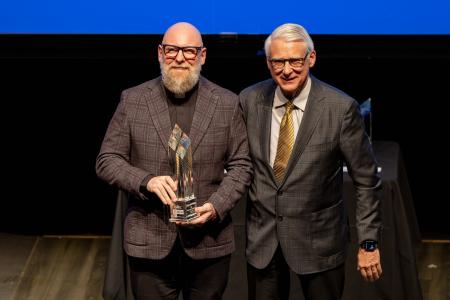
This winter, St. Vladimir’s Seminary Alumnus Fr. Justin Mathews was recognized for his work as CEO of Reconciliation Services and the founder of Thelma’s Kitchen, Kansas City’s first “pay-what-you-can” café.
Fr. Justin received the Marion and John Kreamer Award for Social Entrepreneurship, given by the University of Missouri-Kansas City (UMCK), at the UMKC's 39th Annual Entrepreneur of the Year Awards held on December 3, 2025. The awards honor local, national, and global changemakers.
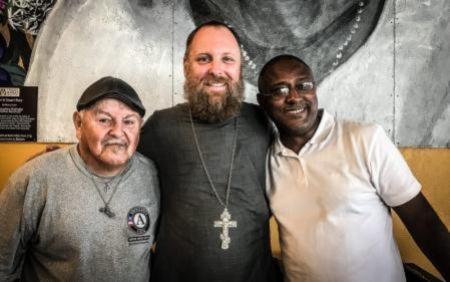
Fr. Justin with community members at Reconciliation Services.
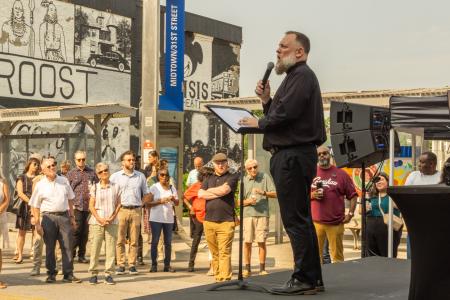
Reconciliation Services is a faith-based nonprofit founded by St. Mary of Egypt Orthodox Church located on Troost Avenue in Kansas City, Missouri. The street is well known locally as a symbol of generations of racism and poverty the surrounding neighborhood has suffered.
“There are so many partners and neighbors who believe in the dream of tangible, social, racial, and economic reconciliation in our city,” Fr. Justin said as he received the award. “There is no Reconciliation Services, there is no Thelma’s Kitchen, and there is no award tonight without their heart and their sacrificial love for our neighbors most in need.”
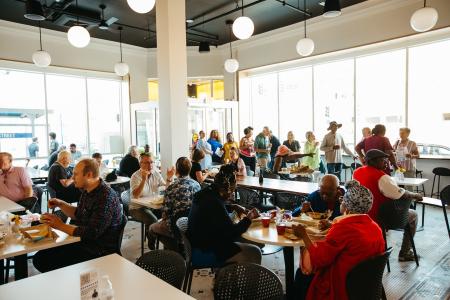
Reconciliation Services provides to clients—99% of whom live below the federal poverty line—medical, mental health and dental services, classes, and mentoring programs. Part of their outreach is Thelma’s Kitchen, founded by Fr. Justin in 2018 and located in the same neighborhood as the parish and the nonprofit. Thelma’s Kitchen is a gathering place for delicious meals served up to neighbors, program volunteers, staff, and church people who, based on their ability, pay what they can or chip in with kitchen duties.
In 2023, Reconciliation Services also opened the Chapel of St. Maria of Paris, under the OCA’s Diocese of the Midwest. The chapel was opened at Reconciliation Services’ location on Troost Avenue, and Fr. Justin serves as Priest-in-Charge. The chapel is adorned with iconography by Fr. Justin’s fellow St. Vladimir’s Seminary alumnus, Seraphim O’Keefe (M.Div., 2018).
Fr. Justin has directed Reconciliation Services since April 2013. (Photo: Reconciliation Services)
Third-year seminarian Fr. Jarrod Huffman interned at Reconciliation Services in the summer of 2023 and spoke highly of his experience.
“It’s an amazing organization with a fantastic staff,” said Fr. Jarrod.
The Very Rev. Justin Mathews graduated from St. Vladimir’s Seminary with a Master of Divinity (M.Div.) degree in 2007. In addition to his ministry at Reconciliation services, he is a priest of Holy Trinity Orthodox Church in Overland Park, KS.