“How Readest Thou?” (Lk 10.26): Orthodox Biblical Scholarship Between Church and Academy
Saint Vladimir’s Orthodox Theological Seminary (SVOTS) will hold its Fourth Annual Academic Symposium on October 16–18, 2025.
Orthodox interpreters are relative latecomers to the field of biblical studies. When the discipline came into its modern form in the mid- to late-eighteenth century, it received its shape largely from Protestant scholars. Among Jewish and Roman Catholic scholars, there were some pioneers and “early adopters” in the beginning stages, but it was not until the twentieth century that these two groups fully entered the discourse. As we enter the middle part of the twenty-first century, Orthodox biblical scholars, when compared with these groups, hardly seem visible at all within the wider academy, and “Orthodox biblical scholarship” is poorly known, if known at all, outside Orthodox countries.
What would it mean to do scholarly work from an Orthodox perspective today? Is there or could there be a distinctively Orthodox mode of biblical scholarship? In many places, Orthodox Scriptural interpretation has and will no doubt continue to proceed without regard for the concerns and methods of the academy (e.g. sermons, talks, podcasts, videos, etc.). On the reverse side, it is certainly possible for Orthodox biblical scholars to do their work entirely within critical frameworks, bracketing or ignoring Tradition. But what would it mean for Orthodox scholars to pursue a kind of via media, to do scholarly work that is, one the one hand, shaped by and responsive to disciplinary questions and methods and, on the other hand, guided and informed by Tradition?
The aim of this symposium is to gather biblical scholars to explore this question. We will consider whether or under what conditions an “Orthodox biblical scholarship” might be possible and what, if anything, makes Orthodox biblical scholarship distinct from other kinds of biblical scholarship.
The first part of the symposium will consist of a keynote address on Thursday, October 16, at 7 p.m. (EDT), in the Metropolitan Philip Auditorium. A reception will follow.
“Orthodox Biblical Scholarship: Possibilities and Prospects”
The keynote address is open to the public and will be published on the SVOTS YouTube channel after the conclusion of the event.
Please register to attend the keynote address (in person or online) by clicking below.
Registration is now closed.
The second part of the symposium (Friday and Saturday, October 17–18) will consist of scholarly presentations by:
The Rev. Dr. Michael Azar (University of Scranton)
The Very Rev. Dr. Silviu N. Bunta (University of Dayton)
Dr. Lydia Gore-Jones (St. Andrew’s Greek Orthodox Theological College)
Dr. Michael Legaspi (St. Vladimir’s Orthodox Theological Seminary)
Dr. Rebecca Luft (St Herman Theological Seminary)
The Rev. Dr. George Parsenios (Holy Cross Greek Orthodox School of Theology
The Rev. Dr. Eugen Pentiuc (Holy Cross Greek Orthodox School of Theology)
The Rev. Dr. Cosmin Pricop (University of Bucharest)
Dr. James Wallace (Christian Brothers University)
The Rev. Dr. Daniel York (Orthodox Church in America, Diocese of the West)
This portion of the Symposium is open by invitation only. Scholars and students interested in attending the presentations and discussion on October 17 & 18 are asked to email the organizers at symposium@svots.edu.
For more information on the presentations and the schedule, click the links below.
Join us at this year’s Orthodox Education Day (OED) Online, Saturday, October 11, from 10 a.m. to 4 p.m. EDT (7 a.m. to 1 p.m. PDT).
Attendance is free—we invite you to join us for one session, several sessions, or for all six!
Registration is closed.
It's your chance to be a seminarian for a day—to listen to discussions by St. Vladimir's Seminary professors and other Orthodox scholars on a variety of interesting topics in the fields of doctrine and spirituality, the Church Fathers, the reception of converts, canon law, liturgy, the sacred arts, and Christian leadership. You'll also have a chance to submit your own questions to our panel of scholars. *(You will be able to ask questions live, and you may also submit them in advance when you register.)
Don’t miss this once a year opportunity as Orthodox Education Day returns to its traditional fall season!
Leaders today face enormous challenges, whether they are pastors in the church, supervisors in the workplace, or spouses and parents at home. True leadership begins not with the latest secular leadership techniques, but with spiritual transformation. What, then, does true leadership look like, and how do we go about living it out?
11am EDT/8am PDT
The Reception of Converts into The Orthodox Church
In recent years, the different Orthodox Churches have seen a wonderful influx of new converts. These conversions have also raised questions regarding the method of receiving converts according to the tradition of the Church. During this session, two priests of the Church who are also scholars of canon law will address these important questions from the liturgical and the canonical tradition.
12pm EDT/9am PDT
Orthodox Doctrine & Spirituality: Thinking with the Fathers
The language in which the Church delineates its Orthodoxy seems full of abstract concepts and distinctions, related to substance, persons, essence, energies, natures… This language is, of course, the bread and butter of studious seminarians and of the more zealous catechumens or members of the Church. But what does all this have to do with the "life in Christ", the mystery of our transformation towards the glory of God's Kingdom? Hear how the Fathers of the Church help us see doctrine and spirituality as inextricably linked and mutually illuminating.
An unprecedented number of inquirers and catechumens are coming through the doors of our parishes these days, many of them, in fact, young men. How can we as Orthodox faithful welcome and encourage them and what are some of the opportunities and challenges presented to the Church by this new wave of spiritual seekers?
A discussion of foundational, often overlooked questions: What do we mean by “sacred arts”? Are there boundaries that delineate sacred from secular arts? Can an object be inherently holy, or does sacredness lie in its use? This session brings into dialogue the two co-editors of a new SVS Press volume that addresses these very questions.
3pm EDT/12pm PDT
Realities and Responses for Orthodox Church Music in North America Today
What is the current state of Orthodox Church music in North America? With a focus on the OCA, this discussion will address anecdotal and data-informed evaluations of the state of music; consider interventions which have been implemented in the past 10–15 years, such as the St Tikhon’s Music Residency and new publications; and express hopes and desires for the future.
This year’s St. Matthias Merit Scholarship Essay Contest challenged seminarians at St. Vladimir’s Seminary to reflect on the liberation of Dachau 80 years ago, toward the end of World War II, and the remarkable celebration of Pascha that followed—recited entirely from memory—by the Orthodox Christian clergy and other survivors of the concentration camp, on May 6, 1945.
Four seminarians offered deeply thoughtful responses to the question of what prayer(s) and/or passage(s) they would likewise hope to always cherish and retain in their memory, whatever situation might befall them in life. After a rigorous evaluation of the excellent essays entered into the competition, Benjamin Franks was selected as the winner of the 2025 St. Matthias Merit Scholarship Essay Contest. In addition, fellow seminarian Mother Melania (Mikhaiel) was awarded a smaller scholarship as the contest’s first-ever honorable mention.
Franks’ winning entry is titled, “Christ: The Conqueror of Hells.”
“Just as the Church gave her sons at Dachau the words to interpret their experience and to worship in the midst of it,” wrote Franks, “this prayer [the Paschal Stichera] has allowed me to enter into the despair of the Myrrhbearers at not finding the Lord in the tomb, and to realize with them that the Living One is not among the dead. He is not conquered by my encounters with death, but in conquering Hell He conquers each iteration of it.”
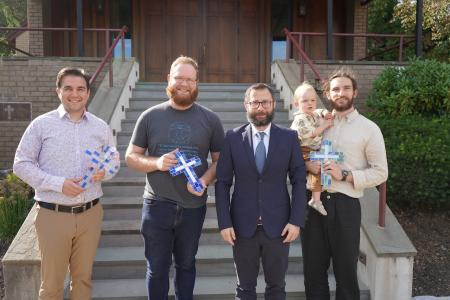
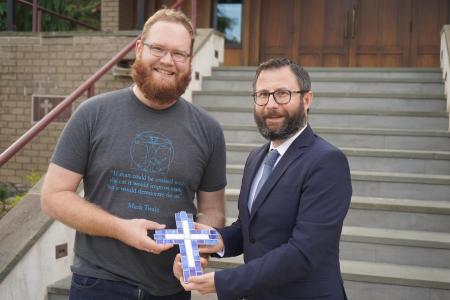
Seminary Dean Ionuț-Alexandru Tudorie presented hand-made, stained-glass crosses to the participants of this year’s St. Matthias Merit Scholarship Essay Contest. The crosses were made by a member of the family of donors, and were tagged with the seminarians’ names and quotes from each of the participants’ essays. (Pictured from left to right: Nicolas Sheridan, Benjamin Franks, Dr. Tudorie, and Henry Brink. Not pictured: runner-up Mother Melania).
For his winning entry, Benjamin Franks was awarded $4,000 in scholarship money. Mother Melania received a $500 scholarship award as an honorable mention. All four participants this year were gifted hand-made, stained glass crosses. The crosses were made by a member of the family of donors who sponsor the essay contest each year. Each cross was labeled with the recipient's name and a tiny phrase linking the participant's essay to its respective resolution.
That generous family of anonymous donors has sponsored the St. Matthias Merit Scholarship Essay Contest every year since 2018, and increased the scholarship award for the 2025 edition. They also select the topic of the essay contest each year and develop thorough and thoughtful criteria to determine the winner.
The contest is one of many offerings by St. Vladimir’s Seminary to help seminarians lower their tuition expenses as they prepare to go forth to serve the Church. The Seminary also administers need-based tuition grants, need-based scholarships, merit scholarships, continuing education grants, and matching grant opportunities for seminarians. These are made possible thanks to many benefactors who have graciously given funds to St. Vladimir’s.
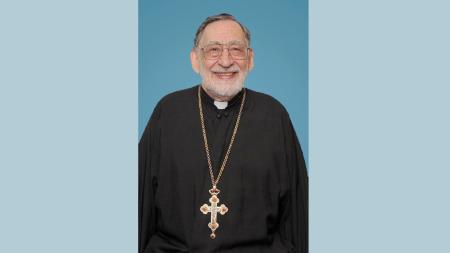
With faith in Christ and hope in the resurrection, we share news of the repose of Archpriest Michael Zaparyniuk, Jr., a former student of St. Vladimir’s Seminary. Fr. Michael fell asleep in the Lord at the age of 92 on Monday, September 22, 2025, in West Palm Beach, FL, following a decline in health in recent years.
The Very Rev. Michael Zaparyniuk, Jr. was attached to Christ the Saviour Cathedral, Miami Lakes, FL, in his retirement. Early in his priestly ministry, he assumed pastoral duties at the Ukrainian Orthodox Church of the Holy Trinity in Trenton, NJ, from his father the Very Rev. Fr. Michael, Sr., following the elder Fr. Michael’s repose in 1958. Fr. Michael, Jr. served at Holy Trinity from February 1959 until March 1968. He also served for many years at St. Herman of Alaska Orthodox Church in Lake Worth, FL, before his retirement from pastoral ministry.
Father Michael enrolled at St. Vladimir’s Seminary in 1956 and continued studies at the Seminary through the early 1960s. He remained an ardent supporter of the Seminary, and he and his family were incredibly generous donors. He also left an enduring impression on many who knew him, such as the Seminary’s former Dean of Students and Chaplain Archpriest Steven Belonick (+2019). Fr. Steven credited Fr. Michael as his inspiration in becoming a priest and the reason he attended St. Vladimir’s Seminary himself.
Information regarding Fr. Michael’s funeral is available on the OCA website, here.
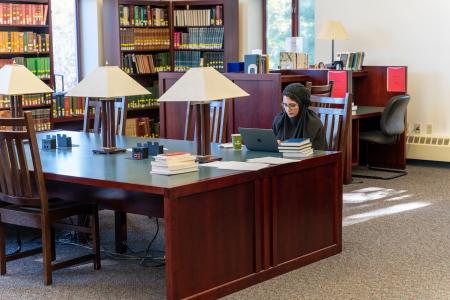
St. Vladimir’s Seminary’s Fr. Georges Florovsky Library has greatly expanded its electronic research resources by acquiring full access to the JSTOR Archival Journal & Primary Source Collection.
The Florovsky Library previously had access to JSTOR Essential (nearly 700 titles). The upgrade to the Archival Journal & Primary Source Collection means seminarians, faculty, and visiting scholars and students now have access to a total of 2,892 titles.
“This is an important expansion to our electronic collections, and we are happy to be able to offer this to our seminarians and faculty,” said Seminary Dean Dr. Ionut-Alexandru Tudorie. “We have been working to make St. Vladimir’s Seminary a hub for Orthodox scholars, and having the best research library possible is an important piece in attracting the best scholars here.”
In addition to JSTOR, patrons of the Fr. Georges Florovsky Library also have access to ProQuest Dissertations & Theses, Sources Chrétiennes Online, Thesaurus Linguae Graecae, ATLA, plus a selection of theological journals published by De Gruyter, Brepols, Peeters, Cambridge University Press, and Oxford University Press.
About the Fr Georges Florovsky Library
The Library at SVOTS has always been considered one of the Seminary’s greatest assets, with over 160,000 volumes in holdings ranging from the sixteenth to the twenty-first centuries and hundreds of periodicals. It has been called the “richest library of Eastern Christian holdings in the Western Hemisphere” by Dr. James Billington, the former Librarian of Congress (1987-2015). In addition to serving the students, faculty, and alumni, the Library is now used by scholars from all over the world, and many outside patrons regularly request use of library materials.
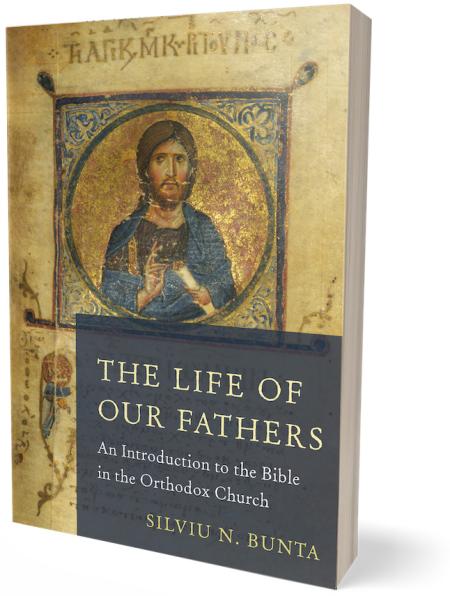
Scripture has never been just a text. In the Orthodox Church, it is a way of life.
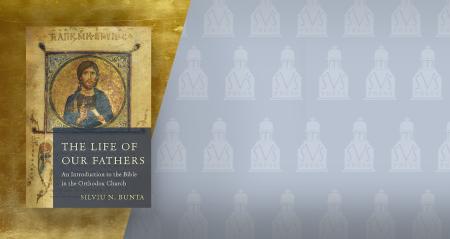
In SVS Press’s new book, The Life of Our Fathers, Fr. Silviu Bunta shows how Scripture functions in the Orthodox Church. Rather than giving a method to interpret Scripture, he points to the way Apostolic Christianity has always engaged biblical revelation—by living the ascetical and liturgical life of the Church. There is no distance between reader and text, and the Bible is not an object of study and analysis but a reality that we participate in through the life of the Church in her services and ascetical practices. As we put off the old man, and with it the crushing weight of our fallen egos, the words of Scripture become our own speech and we ourselves are transformed and made new.
Born from talks given to lay audiences, this book remains deeply accessible. It challenges common assumptions about how to approach Scripture, showing us a far deeper and richer path of participation. This is not a call to interpret better, but to live differently. For anyone seeking to understand how Scripture functions in the Orthodox tradition, The Life of Our Fathers offers a rare and timely guide.
The Life of our Fathers is available in paperback (5×7) and as an eBook at SVSPress.com.
The Very Rev. Silviu Nicolae Bunta, Ph.D., is Senior Scholar in Scripture at the University of Dayton, where he taught from 2007 to 2022. He now serves as a priest at St. George Orthodox Church in Pharr, Texas, while continuing his research and writing. His scholarly work spans the Hebrew Bible, the ascetical and mystical traditions of early Judaism, and the ancient Christian and Orthodox interpretation of Scripture. With both academic depth and pastoral experience, Fr. Silviu brings a unique and compelling voice to contemporary conversations about the life of Scripture in the Orthodox Church.
Dr. Peter C. Bouteneff could certainly be described as a “Renaissance man.” He is a theologian, widely traveled speaker, successful author, conservatory-trained musician, Luminous Podcast host, and devoted husband and father, with a myriad of passions, interests, and achievements.
After taking a degree in music in 1983, he lived and worked in Japan and traveled widely in Asia and Greece. He then obtained an M.Div. from St. Vladimir’s Seminary and a doctorate from Oxford University, where he studied under Metropolitan Kallistos Ware. Dr. Bouteneff is now a long-serving and beloved faculty member at St. Vladimir’s Seminary, where he is Professor of Systematic Theology and Kulik Professor of Sacred Arts.
Professor Bouteneff’s productivity and achievements are testament to his diverse talents. He worked for many years in theological dialogue, notably as executive secretary for Faith and Order at the World Council of Churches. He conceived of and edits both the Foundations Series and the recently launched Sacred Arts Series for SVS Press. Among his numerous books, his pastoral/theological reflection, How to Be a Sinner, has long been an SVS Press bestseller, and his book, Arvo Pärt: Out of Silence, has been hailed as “a triumph,” “a game-changer,” and “a must-read for any listener or performer of Pärt's music.” He co-founded and directs the Arvo Pärt Project and is founding director of St. Vladimir’s Seminary’s Institute of Sacred Arts. He frequently finds himself traveling across North America and internationally, as an oft-requested and invited speaker at parish retreats, conferences, and symposia.
With each passing year, it seems Dr. Bouteneff’s importance to the Seminary only continues to grow. Following his appointment as Associate Dean for Institutional Mission & Engagement, he kindly set aside time for us to explore his fruitful history with the Seminary and his new role.
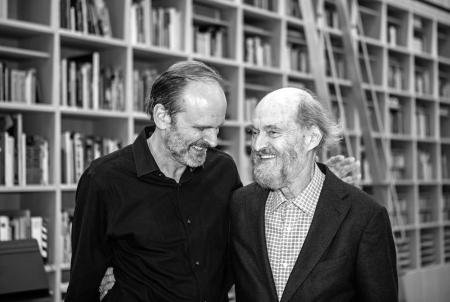
With Arvo Pärt, the world’s most performed living composer (Photo: Birgit Püve).
St. Vladimir's Seminary has been a part of your life since you were a child, right? Could you describe your history with the Seminary?
My connection with the seminary is … prehistoric. The old seminary chapel was one of the places I attended church in my childhood in the 1960s—we would alternate between there, the ROCOR Nyack parish, and another parish in upper Manhattan. The sermons of Frs. Schmemann and Meyendorff, and Dave Drillock’s choir, are part of my mental and spiritual soundtrack to this day!
I began as a seminarian in the fall of 1987, coming just after two years in Japan and travels through Asia and Greece, and I graduated with an M.Div. in 1990. Fr. Tom [Fr. Thomas Hopko] invited me to be his teaching assistant in 1993–94, and also asked Patricia—whom I married in 1992—to teach New Testament and Modern Greek. I was eventually invited to teach Dogmatic Theology from fall 2000 onwards, and I have been here ever since.
So the Seminary has been in and out of my life for as long as I can remember. As for my more than twenty-five years on the faculty, riding on the wings of my revered predecessors has been a great blessing–but especially in the early years it felt like a daunting task. For a long time I felt like I had these crazy-large shoes to fill. I still carry these teachers (and Metr. Kallistos) in my heart and soul—I quote them all the time—but I’ve been coming into my own here, especially in recent years. I am grateful for it all.
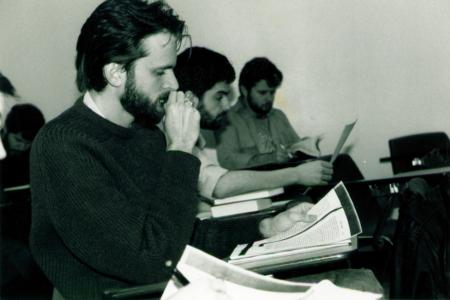
Dr. Bouteneff as a seminarian at St. Vladimir’s in the late 1980s.
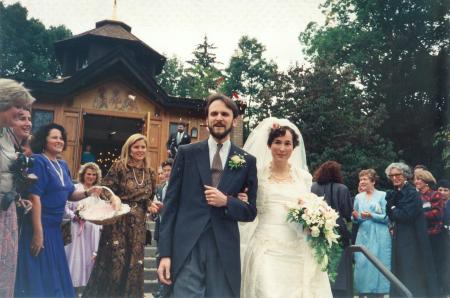
The Bouteneffs were married at the Seminary’s Three Hierarchs Chapel in 1992.
Over these years you have been deeply involved with the multiple facets of the Seminary, in addition to teaching. Talk about your new role as Associate Dean for Institutional Mission and Engagement. How did the appointment come about?
Our dean, Alex Tudorie, is an astute and listening leader who likes to maximize people’s gifts. He observed that I was naturally filling certain roles here, such as liaising between faculty and staff, listening to where people are within the institution, and reaching out to our constituents in parishes and advancement settings. So he drafted a job description that capitalized on all of those. As a result, on top of my teaching and other responsibilities, I continue to deepen my involvement in the school’s inner life, at the same time speaking more to people whom we serve and people who currently support us or might in the future. All the while I’ll also be working to ensure that we’re doing what we promise in our mission.
The Seminary is in the very beginning stages of a strategic plan process, and I am working on that alongside trustees and colleagues. I was just providentially elected to the OCA’s Metropolitan Council. It’s another way for me to deepen relationships, serving the Church and our school.
Following commencement in 2024.
So much happening! What are Patricia and the rest of your family up to these days?
My wife, Patricia, stays very busy with Axia Women, which she founded and runs with an outstanding team of women across the Eastern and Oriental jurisdictions. Axia is a fabulous organization that lifts up and celebrates the many things women are doing in the Church—making them visible and showing that they matter. She also continues to make time to further her research into the folktales of the Pontic Greeks; her latest article comes out in December. (Our evening conversations are endlessly entertaining!)
Our son Michael turns 30 this year (cue whiplash sound effect). He is a professional stagehand and sound equipment tech, as well as a touring drummer. Our daughter Elizabeth is well into her fourth year in Daejeon, South Korea, where she has moved from teaching English to schoolchildren to teaching it to corporate professionals; she is about to finish top of her class in the highest level course in Korean language offered at the university level, which will open an array of opportunities for her.
Dr. Peter and Patricia with their daughter, Elizabeth, in South Korea.
The Bouteneff Family: Patricia, Elizabeth, Dr. Peter, and Michael.
You're so firmly part of the fabric of St. Vladimir's Seminary. Though you have been around the seminary in some way or another since your childhood, what's something most people here may not know about you?
Some may not know about my passion regarding the relationship between Eastern and Oriental churches. I have a new book coming out in early 2026 about that schism and some of the ways it might be healed—it’s called Union Without Confusion: Councils and Christology Beyond the Chalcedonian Divide (T&T Clark). For decades now, the St. Vladimir’s Seminary community has been blessed with students and colleagues from both families. Our lack of communion is a thorn in the flesh, and we absolutely must be working on it. We pray, in St. Basil’s Liturgy, “Reunite the separated.” I believe God desires our unity.
Prof. Bouteneff regularly teaches the course Christology in Dialogue at the Seminary. Here, the class is pictured with guest speaker and Seminary alumnus Fr. Athanasius Farag of the Coptic Orthodox Church (October 2019.)
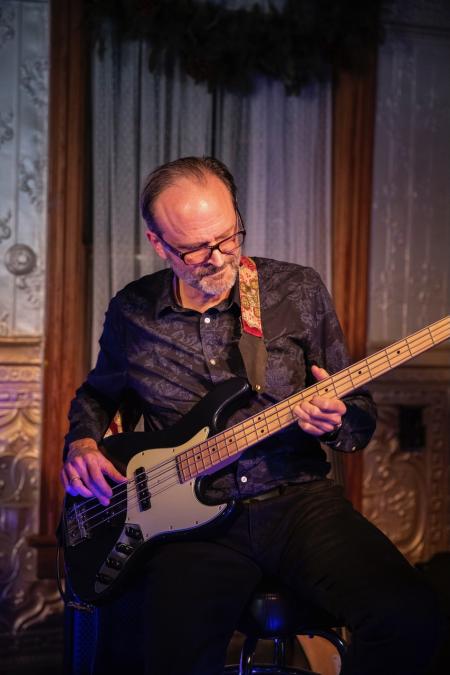
I think by now everyone knows I’m a jazz bassist. My first degree was a conservatory degree. Founding the Institute of Sacred Arts, and watching it flourish through my amazing colleagues and students, is more fulfilling than I can possibly say. All these elements of my life: music, theology, liturgy, writing, all come together here. I am blessed.
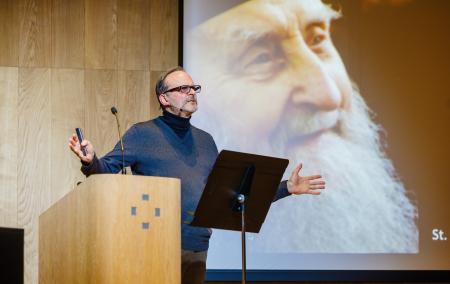
Headline photo: Dr. Peter Bouteneff delivers a presentation on St. Sophrony and the spiritual life, at the Arvo Pärt Centre in Laulasmaa, Estonia, April 2024.
Meal times at St. Vladimir's Seminary (SVOTS) have been completely transformed with a distinctly new look and flavor this academic year.
This is due in large part to a new partnership with FLIK Hospitality Group, a subsidiary of Compass Group USA—one of the largest hospitality providers in the world. FLIK began managing food and catering services on campus at the start of this academic year.
FLIK’s partnership with the Seminary not only brings new menus and services, but also a revamped and updated kitchen and eating space in SVOTS’ Germack building refectory. These improvements are thanks to considerable capital investments from both FLIK and St Vladimir’s Seminary.
The enhancements to the student dining experience are the result of a long and deliberate, collaborative process led by the Dean and the Associate Dean of Residential Life. Together, they continuously collected feedback and input from students on their needs and experiences during the last academic year. They also relied on the advisory support and guidance of other members of the administration, as well as outside culinary experts, in a rigorous process of discovery and design.
“The process of bringing FLIK to St. Vladimir’s Seminary was one that took more than half a year of diligent research and planning—countless hours listening to students, exploring multiple possibilities, and ensuring the appropriate financial and logistics preparation—in order to give seminarians and their families the best experience possible,” said SVOTS Dean Dr. Ionuț-Alexandru Tudorie. “It was a tremendous amount of work, and I believe was essential for the community here in Crestwood. I am grateful to my colleagues and partners for their focus on this important part of our student, faculty, and visitor experience”
“We have been impressed with FLIK in every regard,” said The Rev. Dn. Dr. Harrison Basil Russin, SVOTS’ Associate Dean for Residential Life. “The quality of their food is very high, and their professionalism and business communication is admirable. They have been investing in our seminary kitchen and refectory, and it looks like a different and improved space.”
Dr. Tudorie and Seminary staff undertook a careful interview process of several providers, guided in part by the expertise of former student Matthew Nelson (M. Div. ’25), in addition to the recommendations of other local institutions.
SVOTS was especially pleased to pursue references and its own assessment of FLIK’S food service experience by visiting institutions that FLIK already serves. SVOTS was referred to FLIK by several groups, including St. Joseph’s Roman Catholic Seminary in Yonkers (Dunwoodie). FLIK provides the catering and meal service for many institutions in the Roman Catholic Archdiocese of New York.
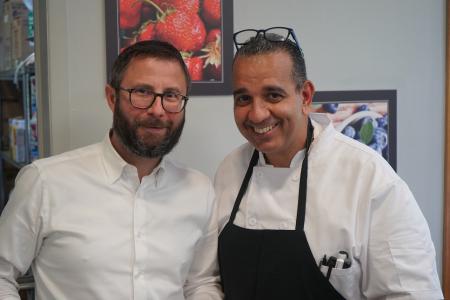
Dr. Tudorie and head chef Hector Morales
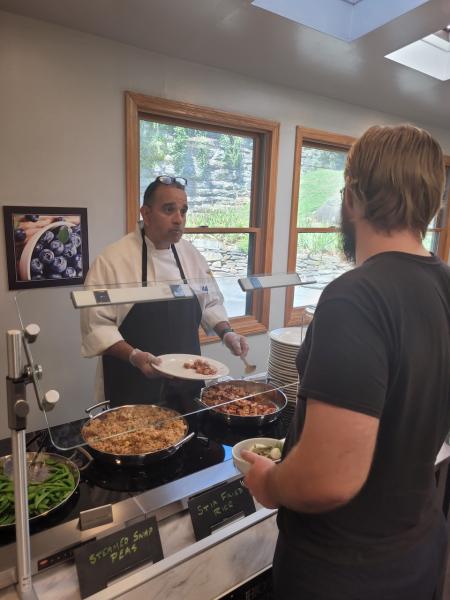
The new kitchen staff, led by chef Hector Morales, sous-chef Joe Gatzmer, and Hugolina Vidals Ponce, take over from longtime seminary Chef, Nat Fasciani.
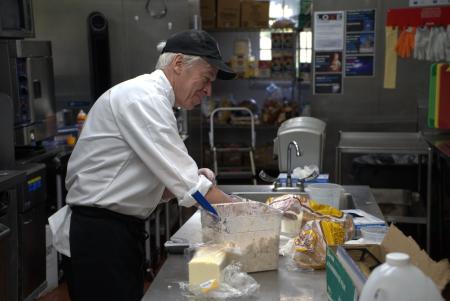
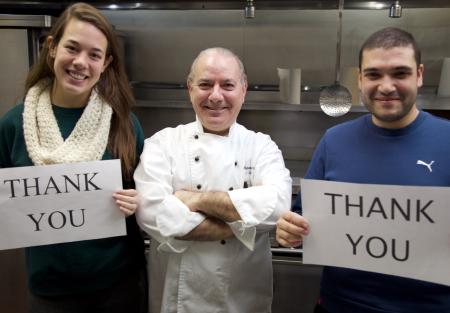
“We are so grateful to Chef Nat for his service to St. Vladimir’s Seminary over the past 20 years.” said Dr. Tudorie. “He has been a beloved member of our community, is an SVS Press author, and was the driving force behind nearly all of our community events. Thank you, Chef Nat!”
Longtime Seminary Chef Nat Fasciani posing with seminarians
The new meal service will include a number of changes, such as expanded meals—notably including the offering of breakfast six days per week (except Sundays or feast days when Divine Liturgy is celebrated).
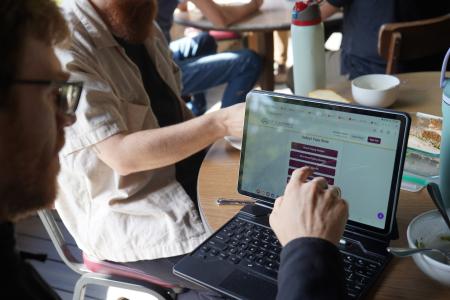
A final component of the enhanced food services experience is a custom digital application, which provides the community (including faculty, staff, and visiting married students who are not on the meal plan) with a practical and easy-to-use tool for meal reservations. This concept and execution were made possible through the personal generosity and investment of longtime donors and Trustees Mr. and Mrs. Jeffrey D. Hoff.
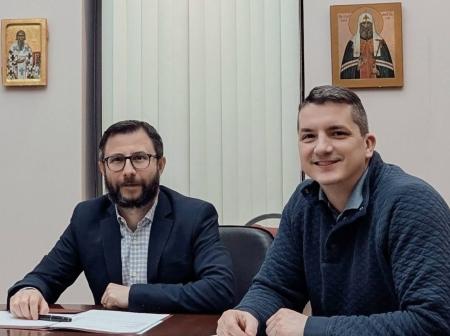
Dr. Tudorie with Trustee Jeffrey Hoff
The reservation system allows the food services staff to manage resources, streamlines kitchen operations and the student experience, and enables flexibility for take-out for community members who are unable to be seated with the community for any given meal.
Dn. Harrison Basil Russin uses the meal reservation application on his tablet.
“The positive feedback from seminarians and faculty has been overwhelming, and this is so important for us to know—that we are serving them well and getting it right,” added Dr. Tudorie.
“Here at the seminary, we look to create connection and build relationships in our community. Partnering with FLIK is an essential investment in the student experience, in fellowship, and in food quality and standards. We look forward to our continued partnership in this service.”
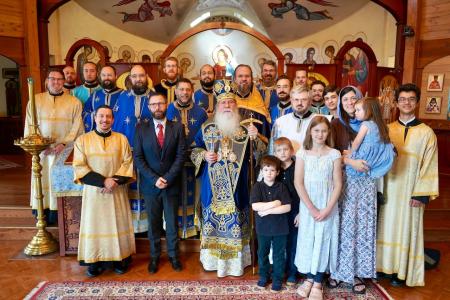
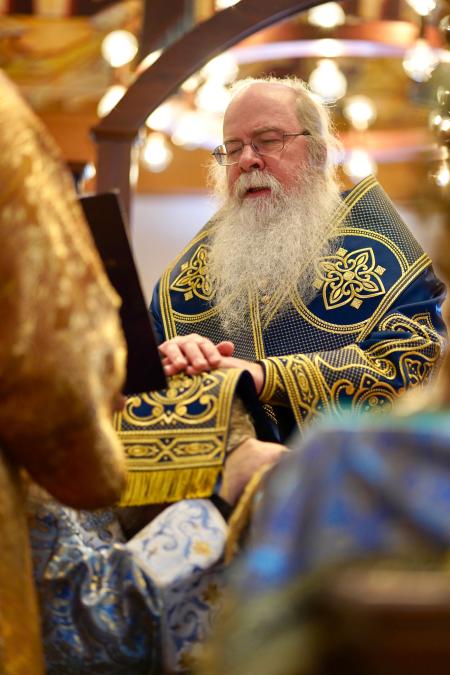
The Seminary’s celebration of the Feast of the Nativity of the Theotokos was made even more joyous with the presence of His Beatitude Metropolitan Tikhon and the ordination of Seminarian Daniel Werner to the Holy Diaconate.
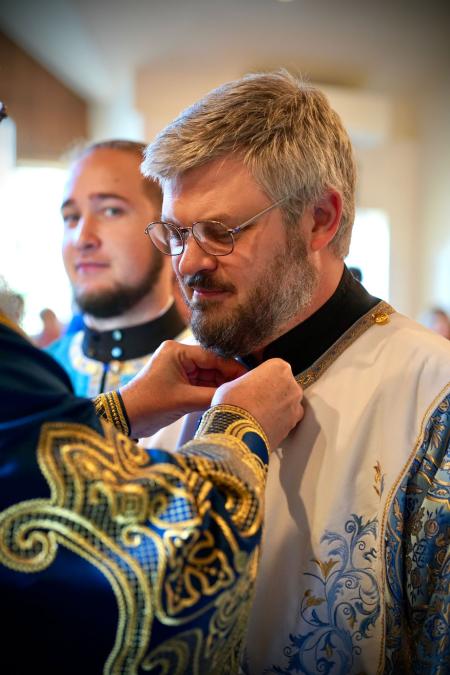
His Beatitude arrived to campus Sunday evening, September 7, and celebrated Vigil with the community at Three Hierarchs Chapel. The following morning, His Beatitude presided over the festal Divine Liturgy, during which he ordained Subdeacon Daniel.
The Rev. Dn. Daniel is a third-year seminarian (M.Div. Program) from the Orthodox Church in America (OCA)’s Diocese of the South. Dn. Daniel, his wife Matushka Aly, and their children attended St. Athanasius Orthodox Church in Nicholasville, KY, before Dn. Daniel began his studies at St. Vladimir’s Seminary.
“Glory to God! I am humbled to receive ordination to the Holy Diaconate and am grateful to His Beatitude for entrusting me with this ministry,” Dn. Daniel reflected. “I am also grateful for St. Vladimir's Seminary. I love all my teachers and mentors here, and I am indebted to them for the formation I am undergoing. I also thank my family and friends for their support and encouragement.”
May God grant the newly ordained Dn. Daniel, his wife Matushka Aly, and their family many years!
Following the Divine Liturgy, His Beatitude blessed two newly-painted icons of St. Herman of Alaska and St. Olga of Kwethluk for the Seminary chapel.
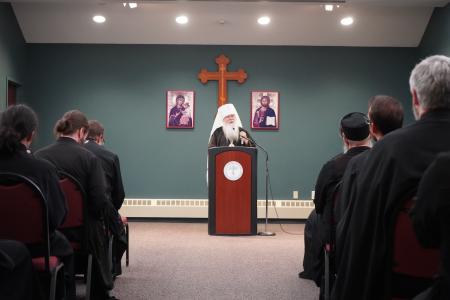
Monday afternoon, His Beatitude met with the newly ordained Dn. Daniel and his fellow seminarians and their families to discuss life as seminarians and the importance of prayer.
“My prayer is that each of you will receive the blessing of renewal at this time of year, which is the time of harvest and preparation for the next planting season,” His Beatitude said to the community. “In terms of life at the Seminary, you might say the incoming class and the return class have been gathered together, and now is the time to plant yourselves in the earth of humility, so that you might be watered by your professors, be nurtured by your experience of the ascetical and liturgical life, suffer the growth pangs of formation and blossom as genuine servants of Jesus Christ.”
The visit marked His Beatitude’s first archpastoral visit to the Seminary of the new academic year.
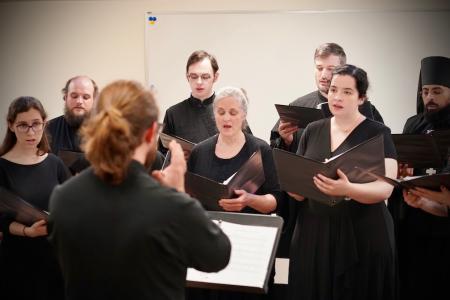
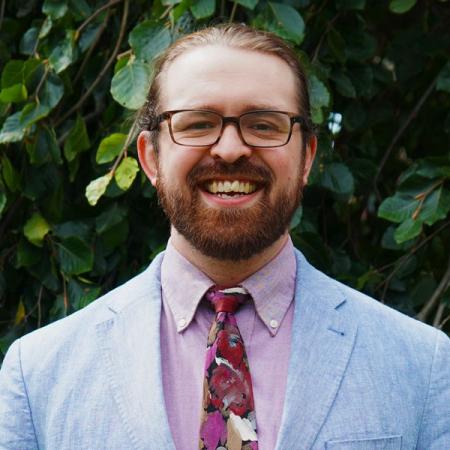
The St. Vladimir’s Seminary Chorale has had several incarnations over the last two decades. Most recently, it was reestablished at the beginning of the Spring 2025 semester by Seminary Liturgical Music Instructor Zachariah Mandell (M.Div. ’20), with assistance and input from Assistant Professor of Liturgical Music, The Rev. Dn. Dr. Harrison Basil Russin. We spoke with Zach about the decision to reassemble the Chorale, the process of training and preparing for future performances, and the overall history of the Chorale and other performing groups and recordings at St. Vladimir’s Seminary.
Zach, please tell us more about how the Chorale came to be this time around. What has it been like to begin rehearsing with an entirely new ensemble?
Basically, starting at the beginning of this spring semester, we put together a revival of the Chorale as an auditioned ensemble among our choirs. Yes, everybody who studies at seminary sings, everybody participates in chapel services, but for the students involved in the Chorale, this is their choir requirement. Additionally, professors and community members can audition for the Chorale. For example, Fr. Sergius Halvorsen, Mka. Nancy Rentel (wife of Fr. Alexander Rentel), and several students’ wives have joined. So it's been going well.
We rehearse Tuesday nights in various ways—sometimes singing full services or parts of services, especially during significant feasts like the Annunciation. This allows the women of the Chorale to prepare some music, while the entire ensemble can work on more complex pieces for the service. During the semester, we aimed to have the Chorale sing a part of a service once every two weeks.
How is the Chorale dovetailing with the required choirs for the people who are not in the ensemble?
That’s definitely something we’re still figuring out, but there are aspects of it that are really positive. For those who aren’t in the Chorale, they still have a chance to sing with Chorale members when we have joint rehearsals and focus on some of the fundamental core things we’re trying to work on. In the broader scheme, we’re trying to align what we do in chapel choir rehearsal with our music curriculum. These two things inform one another, so the actual singing of services is guided by the principle that we are preparing to sing well and to sing appropriately for services. We’re also working on helping everyone understand the music they’re singing. One thing we’re balancing is that sometimes the male and mixed choirs do need to rehearse separately, so finding the right balance is a work in progress. But we’re willing to work on it and find a way to maximize everything within the limited time we have.
In your musical selections, are you focusing more on the OCA/Russian tradition? Or are you also incorporating some Byzantine or other traditions?
In this new ensemble, the focus has been on new compositions. That focus spans various traditions, probably more in the Russian-OCA idiom, but we’ve also sung “Receive the Body of Christ,” a setting by Tikey Zes, a Greek composer who did Byzantine-style music with harmonization. In honor of his recent repose in the Lord, we performed this composition at the Commencement ceremony in May. We’ve done some Byzantine pieces as well, and we’re also considering incorporating something with a more “American” or Appalachian sound.
Is this focus on highlighting new compositions in any way inspired by your experience at the 2023 Summer Institute, which had a distinct composing element?
Absolutely, yeah. That experience definitely inspired a funneling and focusing of this kind of vision. And then I think a “let's go do it” mentality kicked in. Before I came back to work here, following that Institute, I was working in the Twin Cities at St. Mary's in Minneapolis. Several of us attended that Institute together. When we went back to Minnesota, we organized composers' workshops for those in the area who were composing. There were people dabbling or experimenting, trying things out, but that experience made it clear: “This can be real, and this should be real.” We were able to do a lot of really good work that way. I know that, although I’ve since left and am now here, Mark Bushy, Peter Tabeling, and David Lucs—they're still working on those events in Minnesota.
Dn. Harrison Basil and Zach at a recent Summer Music Institute
Can you tell us a little bit about who the Chorale musicians are?
The Chorale last Spring had sixteen singers, plus me as the director, and of course, Dn. Harrison Russin also sings with the group when he can. So, the composition was twelve students, one faculty member, one community member, and two spouses, with people from varying jurisdictions, including both Antiochians and OCA members. So, it was a mixed ensemble—eight women and eight men.
Will you be continually doing auditions once a semester?
I think going forward, it will be once a year, likely in the fall semester, at the beginning of the year, so that there can be a sense of direction throughout the year. That’ll also be part of the information for incoming students, because every year there's vocal testing when students come in, along with placement for the ensembles. But this will also be an opportunity to offer auditions for the ensemble each year.
How does the Chorale relate to the Institute of Sacred Arts at St. Vladimir’s Seminary?
There's an active relationship. Recently, we renovated the music room and reintroduced it as the Sacred Arts Room, expanding its purpose and versatility. The Institute of Sacred Arts hosted a beautiful opening event for the new Sacred Arts Room back in May, and the Chorale gave its first official performance as part of that event.
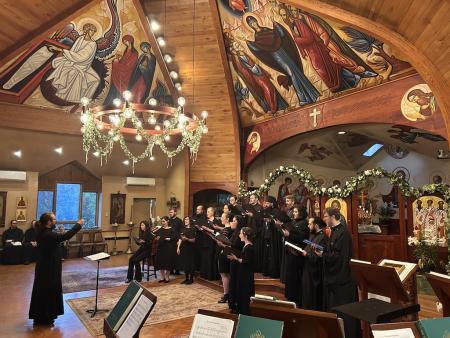
The Chorale performed May 6, 2025, at the Seminary's Three Hierarchs Chapel.
Do you see the potential for anything in terms of new coursework, or expanded composition seminars, etc., related to the Chorale?
From time to time, there have been these courses in the past, and I hope that the presence of the Chorale can allow those kinds of courses to be offered more frequently. The vision would be that, with the partnership with the Institute of Sacred Arts and the development of projects that highlight what's happening here, students and people interested in the music program will be drawn in. This could allow for greater offerings year to year, both in composition and conducting.
Some of the compositions sung by the Chorale are, in fact, the result of previous composition courses. One example is my composition of Gladsome Light, which I did when I was a student. Another is the rendition of Gladsome Light by recent graduate Jaime Rall (M.A. ’25), composed in her composition class with Dn. Harrison last year, which the Chorale also sang at Commencement.
I would say that whether formally or informally, through class or just by composing, the Chorale can, and already has, acted as a workshop choir for people who have composed pieces. They can sing with a group that makes it sound like it's supposed to, allowing for tweaking or adjustments. It also continues to serve as a place where people who want to conduct can get time to learn things like how to lead warm-ups for a group and how to prepare for rehearsals. This is a place where we can cultivate those skills for people who are going to be choir directors in parishes.
It’s really beautiful that the Chorale is also a great learning experience for someone who might not be sure of their musicianship but has growth potential. It’s for someone who wants to challenge themselves. Who wants to practice and improve, and who can realize that this is serious work. The rehearsals will be fast-paced, and that’s part of pushing development.
How would you say this new group relates to the past musical groups at St. Vladimir’s Seminary? What’s the same and what's different?
What’s the same is that it’s an attempt to live the legacy of public-facing musical performance. The Octet was the first public-facing ensemble that St. Vladimir's had, and also the male choir in general, through some of the early recorded albums: e.g., The Liturgy of the Presanctified Gifts (SVS Male Choir, 1972), Great and Holy Saturday (SVS Male Choir, 1975), Pascha (SVS Male Choir, 1977), and so on. Then, of course, the Octet also became a traveling ensemble.
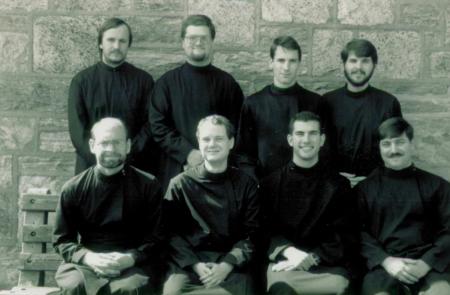
The St. Vladimir’s Seminary Octet, circa mid-1990s. Faculty member Fr. Sergius Halvorsen, who sang with the Chorale at their May 2025 performance, is pictured in the back row, far right.
In 2005, when Kevin Smith was the choir director, he conceived the idea of the Chorale. There’s been a shift in demographics over the years, of course, in terms of the seminarians in general. Back in the Octet days, most of the guys here were not married; they were single, and many of them had come through the pre-theological program. They were undergraduates, and this was their early twenties, studying here for their M.Div. Being single and unattached, they had more time to travel, as the Octet did. Over time, though, the demographic has shifted toward married students. There’s also been a shift in the curriculum, especially with things like diocesan internships or, for the M.Div., Clinical Pastoral Education (CPE). We don’t have the same ability to travel as we did in the past, and there are also broader jurisdictional requirements that don’t allow for that kind of thing anymore.
However, what this new setup does is provide a chance to cultivate a cohesive sound. By having a standing ensemble, we can focus on specific projects. It gives students with higher-level musicianship the chance to engage more broadly with music. It also allows us to revisit the possibility of traveling on a limited basis, if a group is dedicated to that.
One of the challenges that recent alumni remember is that balancing student life and concert preparation can be difficult. Having a group like this, with a standing repertoire, makes it easier to be prepared for a concert on demand. The vision is to be perpetually building a repertoire so that we can pull from it when needed. It also helps to solidify the music we are interested in singing, and that deserves to be sung, and that we want to share.
Something that really struck me when I was reading about the original version of the Chorale was something Director Kevin Smith said: there’s a trajectory of singing from chapel to performance. Everything we do is rooted in liturgical worship. So, when we prepare this other music, it’s not just for the sake of music. It’s not just a concert for the sake of a concert, but it aligns with that very Schmemann-y way of thinking, where chapel, library, and classroom are interconnected. That’s kind of the vision here—to be present and engaged, not just singing old music but also singing what is new and inspiring. It also offers the chance for people interested in composition and directing to engage in those areas. By having the group as a standing ensemble that regularly sings services together and rehearses, it’s not just, “Oh, we’ve been asked to do a concert, so we’ll put the word ‘Chorale’ over that.” It’s a cohesive entity, and I hope that’s what will give it the longevity to continue.
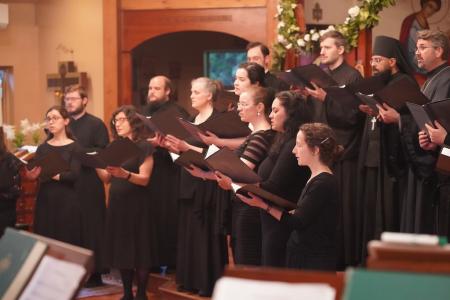
The newly re-formed St. Vladimir’s Seminary Chorale, May 2025
Why do you think music from St. Vladimir's Seminary has been so influential in the Church in North America in the past? Why do you think people have related to it so well?
In the past, there was a sense of alignment in vision—”we are here now, and therefore, we need to sing things in English.” That was such an incredible and inspiring aspect, even before Dave Drillock was the choir director. When he was a student, working with the conductor at the time, Boris Ledkovsky, a Russian composer and choir director, Dave would translate things on the fly and create music in real-time. There was a living momentum of “this is important, this is a priority, this is something we need to do.” Then, with SVS Press, they were able to produce that music.
Early on, many of the seminary’s recordings—whether by the Octet, male choir, or the seminary choir—accompanied music books. The Pre-Sanctified music, the Pascha book, and the first green liturgy book all came out alongside recordings of this music. Maybe not exactly at the same time, but around the same period. There was a showing and telling happening at that time, and that was very successful because it was necessary.
Now, the next step, I think, very much follows what Father Sergei Glagolev did through the 80s, 90s, and 2000s, and what’s been carried on by new generations of composers: “Alright, now we have English, so now what?” There are new sounds, a living tradition here and now. I hope we can continue this with the Chorale—bringing new music forward, both in recording and performance. And, God willing, if it's music produced here, in sheet music, so that it can live on and be experienced.
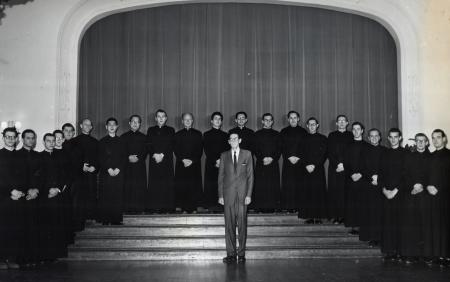
Prof. Boris Ledkovsky (1894–1975) and the St. Vladimir’s Seminary Choir
Can you tell us if you are planning to start venturing out for a few concerts off campus, maybe starting this fall?
Yes, in fact we are planning one for November 6 [Stay tuned for details!]. We are getting the word out that the ensemble is here and available for requests. We would definitely like to do at least one significant concert per semester. We’d also like to possibly have one or two trips per semester. But with a group like this, there’s also the possibility of being asked to provide services. For example, we’re open to sending a few people from the group, if someone needs a quartet to sing liturgy or a wedding, to accommodate that. These are the kinds of things we’re really open to and would like to do.
If you would like to learn more about inviting the St. Vladimir’s Seminary Chorale to sing liturgically or give a performance, please contact Zachariah Mandell at zmandell@svots.edu.