Solemn Feastday Marked by Faculty Member Ordination to the Priesthood

 exaltation-headline

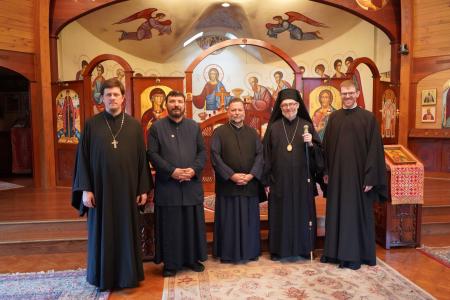
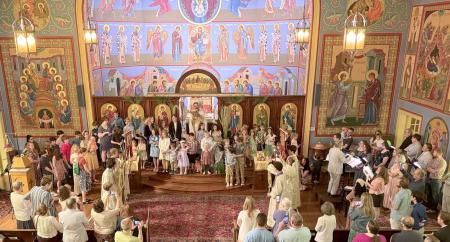
On the Feast of the Exaltation of the Precious and Lifegiving Cross, His Beatitude Metropolitan Tikhon (OCA) raised Seminary faculty member, Assistant Professor of Liturgical Theology, the Rev. Dn Dr Vitaly Permiakov, to the Holy Priesthood. His Beatitude arrived on Friday, September 13, and presided over the Festal Vigil that evening and the Divine Liturgy on the following day. The Vigil was sung by antiphonal choirs; a male ensemble led by the Rev. Dn Dr Harrison Russin, and the mixed choir led by Zachariah Mandell. Several smaller student ensembles sang select pieces prepared for the feast. At the conclusion of the Great Vigil, His Beatitude performed the solemn rite of the Exaltation of the Cross, as the choir sang 500 repetitions of the petition “Lord have mercy.”

 exaltation-article-1a


Concelebrating at the Divine Liturgy with His Beatitude were the Very Rev. Dr Chad Hatfield, Skvir Professor of Pastoral Theology, the Very Rev. Dr Alexander Rentel, OCA Chancellor, the Very Rev. Alessandro Margheritino, OCA Secretary, the Very Rev. Dr Kirill Sokolov, Chancellor of the Diocese of the West, the Rev. Alexis Torrance (University of Notre Dame, Protopresbyter of the Ecumenical Throne), the Rev. Demetrios Harper (St Tikhon's Orthodox Theological Seminary), and chancery, seminary, and visiting clergy.

 exaltation-article-1.jpg


In his homily during the Divine Liturgy, His Beatitude spoke of the Cross as central to our Christian worship and path to salvation; through the Cross, “Christ has made death a passage way into life, life everlasting, life abundant and overflowing, life incomparable to this fleeting life, life not as the world knows or gives.”

Read His Beatitude’s Homily

 exaltation-article-2.jpg


At the conclusion of the Liturgy, Interim President and Academic Dean, Dr Ionuț-Alexandru Tudorie, welcomed His Beatitude and the visiting clergy warmly, and expressed his joy and gratitude for the ordination of his fellow faculty member. Seminary students, staff, and faculty congratulated Fr Vitaly heartily, at the service and via the Seminary Whatsapp group, with one student saying, “Axios to the man who taught me the Liturgy!” 

 exaltation-article-3.jpg


Fr Vitaly celebrated his first Divine Liturgy as a priest the following day, Sunday, September 15, in Three Hierarchs Chapel. 
 

 exaltation-article-4.jpg


About the Rev. Dr Vitaly Permiakov

Born to a Russian family in Riga, Latvia, Fr Vitaly Permiakov, Ph.D. relocated to the United States in 1999 after completing his undergraduate studies. He entered St Vladimir’s Seminary with the blessing of the late Archbishop Dmitri (Royster) of Dallas (OCA) (d. 2011). After finishing seminary, Fr Vitaly enrolled in a doctoral program in Liturgical Studies at the University of Notre Dame, where in 2012 he defended his dissertation on the history and origins of the Byzantine rite for the consecration of churches. Fr Vitaly taught at Holy Trinity Orthodox Seminary (Jordanville, NY) from 2011 to 2020, and joined the full-time faculty at St Vladimir's Seminary in August 2020.

Fr Vitaly's ordination to the priesthood marked the next milestone in his 22-year journey through the ecclesiastical ranks of the Church, all of which took place at Three Hierarchs Chapel at St Vladimir’s Seminary. He was tonsured to the rank of reader as a seminarian in 2002. In 2021, on the Feast of the Annunciation, he was ordained subdeacon. On the Feast of the Exaltation of the Cross, September 14, 2021, he was ordained to the Holy Diaconate through the hand of His Beatitude, Metropolitan Tikhon. Three years later, His Beatitude ordained Fr Vitaly to the priesthood on the Feast of the Exaltation of the Cross, September 14, 2024.

 exaltation-article-5.jpg


May God grant the newly ordained Fr Vitaly Permiakov many blessed years!

Respected Author Presents Upcoming Book on the Mission of the Syriac Orthodox Church in India's Margins

 fr-jacob-joseph-headline

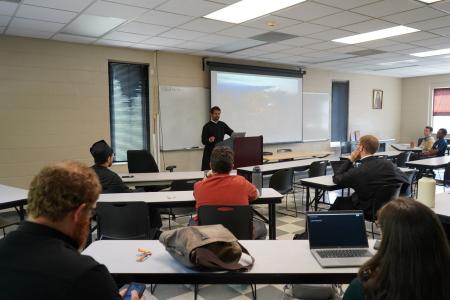
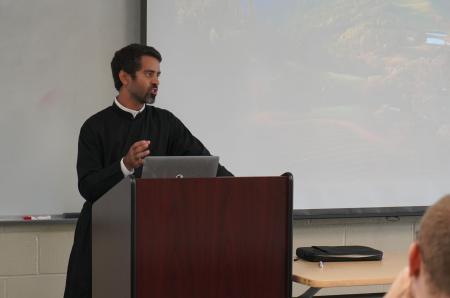
On Friday, September 6, at 1 p.m. in Bashir Auditorium, the Rev. Dr Jacob Joseph presented a talk based on his forthcoming book, The Christ Who Embraces: An Orthodox Theology of Margins.  

The Rev. Dr Jacob Joseph's book delves into the intersection of Orthodox Christian mission and caste dynamics among the St Thomas/Syrian/Orthodox Christians in India. It necessitates Orthodox theology's engagement with society and contemporary challenges.  The book introduces the profound concept of a liturgical embrace in the context of 'untouchability,' where individuals recognize each other as equals, without discrimination. This reflects the inseparable unity of divine (transcendental) and human (immanent) in Christ. Fr Jacob proposes a 'patristic symbiosis' in which the voices of the patristic and contemporary Fathers engage in a discourse, which is the correct methodological vision for Orthodox theology to engage in the modern context. It favors polyphonic responses over monophonic ones, taking into account the missionary signs and symptoms of the time.

fr-jacob-joseph-article-1.jpg


His Eminence Mor Titus Yeldho, Syriac Orthodox Archbishop of the Malankara Archdiocese in North America and an alumnus of St Vladimir’s Orthodox Theological Seminary (M.Div. ‘03), presided at the event.

SVOTS Assistant Professor of Pastoral Theology, the Very Rev. Dr Eric Tosi introduced Fr Jacob and his new book, inviting all those in attendance to consider how Christ lived on the margins of his contemporary society.

 fr-jacob-joseph-article-2


This presentation was a unique opportunity for SVOTS seminarians across various jurisdictions to come together and deepen their understanding of Christianity in India and how Gospel teachings inform the missionary efforts there. Seminarians who attended the event gave enthusiastic feedback on the presentation. One student from the Ukrainian Orthodox Church, Pavlo Kurganov (Th.M. ‘25), remarked,

“Fr Jacob Joseph started by saying that the mission to the people begins from within the Church. First, we should seek peace and theological agreement within the  Orthodox communities in India, and theology and liturgical practice are very helpful in this. Father Jacob spoke about the "kiss of peace" in the Liturgy as the symbol of unity that we shall all strive for.

He also suggested the idea of patristic symbiosis: hearing the Church Fathers and trying to understand the same truth they proclaimed, which they delivered to us through different languages, symbols, and traditions. Father Jacob emphasized acquiring the Church Fathers' mind or mindset which is a foundation of effective missionary work.”

 fr-jacob-joseph-article-3


Another student, Mother Melania Mikhaiel (M.A. ‘26), from the Monastery of St Macarius the Great (OCA), expressed her appreciation for Fr Jacob’s talk, saying, “I didn’t have any exposure to the Orthodox Church of India before coming to the seminary. It was a great experience to get to hear directly from Fr Jacob about how they too cherish the patristic teachings of the early Church and see it as the fundamental foundation of the Church through which Christ will embrace all.” 

Luke Anderson (M.Div. ‘27), hailing from the OCA Diocese of the Midwest, commented that he “appreciated that His Eminence Mor Titus Yeldho led students and faculty in prayer after the event. Not only is such prayer valuable in of itself, but it gives an insight into the theological heart of Syriac Orthodoxy that Fr Jacob is writing from in his book.”

About the Rev. Dr Jacob Joseph

Fr Jacob Joseph is a Syrian Orthodox priest from India. Fr Jacob holds a Ph.D. (2020) with a Chancellor's Award from the University of Divinity, Melbourne, Australia, and teaches patristics and the contemporary theology of mission at St Athanasius Coptic Theological College, Melbourne, Australia; at Agora University in Virginia, USA; and the Malankara Syrian Orthodox Seminary in Kerala, India. He has presented numerous papers on Orthodoxy, liturgy, mission, and theology at various national and international academic conferences. 

Academic Year 2024-25 Begins with Incoming Class of 32, New Faculty & Staff

 new-ay-headline.jpg

St Vladimir’s Orthodox Theological Seminary (SVOTS) marked the beginning of the 2024 Fall Semester on Thursday, August 22, 2024. His Beatitude Metropolitan Tikhon of All America and Canada (OCA) led the Moleben (prayer service) for the Beginning of a New Academic Year, attended by SVOTS faculty and the incoming class. At the conclusion of the service, His Beatitude exhorted the new students, saying, “…the task at hand for you, as incoming seminarians, is to take up your studies, under the oversight of the interim President and Academic Dean, Dr Alex Tudorie, learning from the distinguished faculty with their many years of collective wisdom and experience, and supported by the hard-working staff. And to take up this task within the often challenging context of the seminary community.”

Dr_Tudorie

Interim President and Academic Dean, Dr Ionuț-Alexandru Tudorie, addresses the new students and faculty

Immediately following the Moleben, each member of the faculty welcomed the new students and shared encouragement for the rigorous training ahead of them. Interim President and Academic Dean, Dr Ionuț-Alexandru Tudorie, urged the students to engage deeply with the faculty throughout their studies and to always speak up in case of need, academic or otherwise. Applauding the students for leaving behind comfortable careers and homes to come to seminary, Associate Professor of New Testament, Dr John Barnet, offered his words of thanks to the students, saying, “I am in awe of each and every one of you.”

Later in the evening, the St Juliana Society also hosted its first gathering for the Fall 2024 semester. The St Juliana Society, named after St Juliana Lazarevo, was formed in 2010 by Mka Thekla Hatfield to support future clergy wives by hosting speakers on topics related to parish life and service. A separate women’s group was also established to facilitate events encouraging fun and fellowship for all the women on campus. In response to recent suggestions by women on campus, the SJS will now be open to seminarian and faculty wives, single women students, and female SVOTS staff and faculty. Dr Patricia Bouteneff and returning trustee Tatiana Hoff have stepped in to guide the Society for the coming semester.

 new-ay-2.jpg

His Beatitude Metropolitan Tikhon addresses the St Juliana Society

After enjoying refreshments near the John G. Rangos Building koi pond, Dr Tudorie opened the meeting, before His Beatitude Metropolitan Tikhon gave the opening remarks. His Beatitude encouraged the attendees to remember the words of the Lord to St Peter, "...when you were younger, you girded yourself and walked where you wished; but when you are old, you will stretch out your hands, and another will gird you and carry you where you do not wish (John 21.18)." He assured the women that life at seminary and in future ministry would often involve challenging situations and circumstances. Using his own experience as an example, he suggested that, even when you find yourself going "where you do not wish," humility and trust in the Lord's will can lead to deeper love for God and spiritual maturity. 

The group adjourned to the seminary board room to meet incoming Director of Admissions Zach Mandell, after which Patricia Bouteneff then gave a brief overview of upcoming events, invited the group of 25 women to introduce themselves and consider discussion topics and questions they would like to ask potential future speakers. As Dr Bouteneff said, “It is always a joy to bring Orthodox women together across jurisdictional lines, and we can’t wait to get things underway this year!”

 new-ay-3.jpg

Members of the St Juliana Society at this year’s inaugural meeting

Student Orientation sessions continued over the following three days, concluding with the  General Student Meeting in the afternoon of Sunday, August 25. During this annual meeting including the entire student body, faculty and staff reviewed updates to policies related to community service and residential life. 

Thirty-two students are beginning their first year of studies in their respective degree programs: fifteen in the Master of Divinity (M.Div.) program, three in the Master of Arts (M.A.) program, six in the Master of Theology (Th.M.) program, one in a special one-year program, and seven in the Doctor of Ministry (D.Min.) program.

 new-ay-4.jpg

Faculty, staff, and seminarians and their families enjoy a welcome reception at the Germack building

The incoming class of twenty-nine men and three women hail from four countries: the United States, Canada, Ukraine, and Serbia. The seminarians represent eight Eastern and Oriental Orthodox jurisdictions:

  • Orthodox Church in America (OCA)
  • Antiochian Orthodox Christian Archdiocese of North America (AOCANA)
  • Greek Orthodox Archdiocese (GOA)
  • Serbian Orthodox Church
  • Ukrainian Orthodox Church
  • Macedonian Orthodox Church
  • Armenian Apostolic Church
  • Malankara Syrian Orthodox Church

One first-year seminarian, Scott Strickland, is coming to seminary from the Antiochian Orthodox Diocese of Miami and the Southeast (DOMSE) to enter the Master of Divinity program and offered his thoughts on beginning his theological studies.

"I am looking forward to exploring the depths of the Orthodox understanding of the deification of man. The future of the church rests on unlocking the potentiality of every human person in relation to God. It is time for us to believe and reclaim who we were always meant to be in Christ."

Counting the incoming class, the total student body at SVOTS this year is ninety-five seminarians.

 new-ay-5.jpg

Assistant Director of Chapel Music and Director of Admissions, Financial Aid, and Alumni Relations, Zach Mandell

Welcoming the students this year is the latest addition to the SVOTS faculty and staff, Zachariah Mandell, Assistant Director of Chapel Music and Director of Admissions, Financial Aid, and Alumni Relations. Zach is an alumnus himself (M.Div. ‘20), and is “excited to engage with students from their earliest explorations of seminary education, during their time at St Vladimir’s Seminary in class, in choir, and in life, and as alumni in their work and ministries.”

 new-ay-6.jpg

Assistant Professor of Liturgical Music and Associate Dean for Residential Life, the Rev. Dn Dr Harrison Basil Russin

In another notable update to the Seminary administrative team this year, the Rev. Dn Dr Harrison Basil Russin will serve as Associate Dean for Residential Life, in addition to his faculty position as Assistant Professor of Liturgical Music. Dn Harrison brings a hands-on approach to residential life at the seminary, drawing upon his own experience living on campus with his family for close to a decade. Regarding his new position, Dn Harrison remarked, “I look forward to serving the residential community of the Seminary, helping to keep it a safe location with an edifying community centered around the liturgical worship of the chapel. This position is certainly brand new to me, but I am willing to serve however I am called.”

The new academic year also brings two new additions to the part-time faculty: Dr Ani Shahinian, Assistant Professor of Armenian Christian Art and Culture, and Dr Sarah Byrne-Martelli, Assistant Professor of Spiritual Care. 

May the intercessions of the Theotokos and Ever-Virgin Mary, our patron Great and Holy Prince Vladimir, and all the saints be with our seminarians, faculty, and staff as a new academic year commences in service to Christ!

In Memoriam: Anthony “Lew” Scott

ascott

With faith in Christ and hope in the resurrection, we share the news of the repose of longtime friend and supporter of St Vladimir’s Seminary, Anthony “Lew” Scott (M.Div. ‘75), who fell asleep in the Lord on Monday, September 2, 2024. After a full life in the service of God and the Orthodox Church, he underwent an arduous struggle with dementia and deteriorated rapidly in the last several months. His passing was a peaceful one and he was attended to by family and friends.

The Seminary and the Board of Trustees send their sincere condolences to the Scott family and offer their prayers for the repose of Anthony Scott.

According to Theodore Bazil, Senior Advisor to the Office of Advancement, "Anthony Scott, the former Director of Advancement, played a significant role in leading and securing the most successful capital campaign in the Seminary's history. The campaign resulted in the construction of the John G. Rangos Building, major campus infrastructure improvements, construction of the Erickson and Hopko buildings, and new faculty housing. Through Anthony Scott's efforts, the campaign was additionally credited with advancing alumni relations, establishing programmatic initiatives, and assisted to recruit a new generation of professional, committed Orthodox lay leadership to the Board of Trustees.

Anthony Scott was a vibrant, articulate leader who brought great energy and passion to his position. The Seminary acknowledges his leadership, commitment, and achievements. St Vladimir's Seminary is deeply grateful for the work of Anthony Scott."

Aside from a life of service in the Church, Anthony was known for his love of family, nature, the arts, travel, and adventures. His family is grateful for his life and that he is now at peace. Anthony is survived by his daughters Stephanie Scott and Katherine Scott Dirkes (Stephen), and his son, Alex Scott.

Further information about the life of Anthony Scott will be posted as it becomes available.

Below is information for the funeral service, his burial, and donations.


Funeral Service and Reception

Friday, September 6, at 10 a.m., followed by a light reception

Nativity of Christ Greek Orthodox Church

1110 Highland Drive, Novato, CA


Burial (family only after the reception)

Pleasant Hill Mortuary

1700 Pleasant Hill Road
Sebastopol, CA


In lieu of flowers, please consider donating to:

International Orthodox Christian Charities (IOCC)
www.iocc.org

110 West Road #360
Baltimore, MD, 21204


May the memory of Anthony Scott be eternal!


Interview with Fr Joshua Burnett

burnett_family

After graduating from St Vladimir’s Seminary, Fr Joshua Burnett (M.Div. '15) was sent to St George Antiochian Orthodox Cathedral in Wichita, Kansas, where he served as assistant priest for three years. He is now the proistamenos of Holy Cross Church (Antiochian Archdiocese), just south of Baltimore. He and his wife Khouria Meredith have ten children in their care. 

Remembering the arrival at St Vladimir’s Seminary

My father had been diagnosed with brain cancer, and two months into our first semester at seminary, he died. About a week after he died, Hurricane Sandy hit… It was a turbulent first semester! But it was also formative. Fr John Behr was the dean at the time, and his whole understanding of suffering and death—the centrality of the Cross to our Orthodox faith—informed the way I began to speak about my father’s death. When I gave the eulogy at his funeral, it was the first time I had the sense of speaking as an Orthodox Christian from an Orthodox perspective.

After seminary, I was sent to St George Cathedral in Wichita, a very large parish, where they had a funeral every week. Serving so many funerals was cathartic. Every death had its own particularity and grief, but it also carried within it, for me, echoes of my father’s death. Serving funeral after funeral helped me become aware of my own grief, and the comfort offered by the Orthodox funeral service became a comfort that sunk into my bones week after week. 

Memories of Seminary

Family! We came to SVOTS with three kids and thought, “I guess we’ll have to wait for three years to have another kid.” Then, we saw all the families on campus, learned that there were midwives in the area and that insurance pays for them, and decided, “This is the perfect place to have a baby,” so our son was born halfway through seminary. 

My wife didn’t expect me to be gone as much as I was. We went traveling with the bishop quite a bit. That was more of a burden than we were expecting. And I had a lot of growth points related to the bishop. Before I came to seminary, I had gone to the cathedral in Pittsburgh when (then Father and now) Bishop John was there. He was very laid back. He made me a subdeacon and had me help in the altar. I was so green, I wouldn’t even kiss his hand when I handed him things! I’d hand him the censer as if to say, “Here you go.” I think he must have been chuckling a little to himself, but he never insisted I pay him special honors.

So, I got to seminary and it was mind-blowing to learn all the protocols. When my dad died I simply wrote an email to my bishop notifying him that I’d be gone for the funeral, and he wrote back—very kindly—but saying, “OK, but this is how you address a bishop. You don’t TELL him, you ASK him!” (laughter) There was this whole world of hierarchy and courtesy that I had never been exposed to in my days as an Evangelical Protestant, but at seminary I learned—quickly! 

Another aspect of seminary that I remember was the community service assignment. My wife asked me to try to get assigned to prosphora-baking most semesters because that was something that she could help me with at home (or, in most cases, do entirely on her own!). Because she did my community service, I had a little extra time with the family, and she had an opportunity to join me in service. This pattern followed us into the parish after seminary. 

 fr-joshua-burnett-1.jpg


Life after seminary

I was at St George Cathedral for three years and it was lovely. I wish everyone could be given an assistant position right after seminary. You learn really valuable things in seminary but they aren’t what you learn as an assistant in a parish. At St George, Bishop Basil was there (he’s also a SVOTS alumnus) and his regimen was very similar to the SVOTS chapel. “We don’t mess around, there is an order to things, you should not be moving or talking, this is the altar of God.” He taught me this. He was both serious but warm and hospitable at the same time.

What I gained from SVOTS

During those years in Wichita, I had a Lutheran friend who talked about his seminary experience, saying, “Seminary just gave me the tools to give a Bible study off the cuff or maybe even a sermon. That’s basically what I got from seminary.”

And I certainly got that from seminary too; I could walk into a Bible study mostly unprepared and still be able to give something because of my seminary training. I gained confidence, and things to say without having to look in a book because we’d read deeply and widely.

But I received more than just a few pat answers from St Vladimir’s Seminary. I received a good academic education, something I’ve appreciated more and more as the years have gone on. I learned how to interact both with the Fathers and with modern scholars. That was helpful in terms of trying to figure out how to walk this line between what the Academy knows and what we know from our experience as Orthodox Christians. At SVOTS, I received a “critical appropriation” of the Christian tradition. Yes, we learned that there are things we receive dogmatically without giving it a second thought. But we weren’t led to believe that the deposit of faith is simply an inanimate thing that people pass on from generation to generation without any kind of interaction with it. We bring questions from our experience of the world, and being honest about those questions is important. It guards us against becoming too abstract or too blindly ideological. For me, SVOTS was like a gymnasium. It trained me to grapple—in an embodied, personal way—with the truth of our faith.

What have been the joys and challenges of clergy life?

We became foster parents in Wichita and had several children placed with us; we ended up adopting the final two children placed with us. We were moving away from Wichita and had to decide whether to adopt or to send them back into the system. That decision required a lot of prayer and deliberation. Foster kids have experienced a lot of trauma, and that trauma often gets expressed in troubling ways. For instance, our now daughter would get up to the sink and wash her hands and leave the water running, and then say “Susie!” (Susie was a little younger than her.) “I left the water on for you, you can wash your hands!” But what she had done was leave just the hot water on, and it was scorching hot, and Susie would put her hands up under the water and scream! Our kids were pretty peaceable but suddenly, with the introduction of these foster kids, our house felt like a war zone. We struggled as parents, especially as we watched our kids struggle. When it came time to make the decision to adopt, we went around and asked our biological children, and one of them said, “You know, I think it’s going to be very hard, but it will provide us an opportunity to exercise self-control.”

I believe this child had absorbed some of the teaching that we had received in seminary: that it is through our suffering that we are united with Christ’s suffering, and that the suffering we would go through, with and for these kids, would be good for us and, of course, good for them too. We were opening up the possibility for God to transform them and us, and so we prayed and hoped for that possibility.

And God has provided. With the stability of a loving home, our adopted children went through a transformation, almost overnight. The girl who would turn on the hot water for her sister is now a compassionate and trusted caretaker of her younger siblings. And, of course, the rest of the family has changed as well. We are learning to trust in God’s providence and to put less stock in “reasonable” calculations. Our adoption has even been transformative for our parish on a number of levels. We have one family that became foster parents after we arrived and two other families are in the process of becoming licensed. People see it up close and it inspires them to take the same step, thank God.

Our big clergy family also changes people’s expectations. Parishioners recognize that I’m not as available as an empty nester priest would be. That changes how parishioners view themselves, their relationship with the priest, and with the rest of the church. In some ways—when it works well—people are more self-sufficient and interdependent on one another rather than dependent on the priest.

 fr-josh-burnett-2.jpg


Challenges of many new inquirers and catechumens

We’ve always had catechumens, but it used to average between 6 –10 or so. Now we have 25 catechumens and I know of brother priests who are seeing 70, 100, and more! Our catechumenate is a formal program with classes, and it lasts a year. I describe it to them as like getting engaged.

There is another group of people though. We have a lot of inquirers who are just staying inquirers, who have been attending and learning for a while. So, altogether, almost 50 people are either catechumens or inquirers! In addition, almost every week we have visitors. Some of our visitors probably are seeing how crowded our parish is and so they go looking for something less crowded (laughter). As long as they end up in another Orthodox parish—thank God, I’m happy with that.

So yes, it is a challenge. Our parish identity is being challenged by how many new people there are here. Oftentimes I think that the old timers have felt like the outsiders and have felt displaced. I’m working on some things to help them with that. 

Also, our parish tends to be on the conservative end of the political spectrum. That comes with some plusses and minuses. It would be great if people didn’t talk politics at all, but they do! And newcomers hear conversations during coffee hour and they think, “Oh—is that the kind of people who are here?” and they get worried. But usually, for most of the parishioners, regardless of their politics, their faith really is first. Yes, they care about politics and they are talking to others who have the same leanings during coffee hour, BUT when it comes down to it, are they going to avoid a fellow parishioner of a different persuasion politically? No. 

Even if these differences between our parishioners have at times become really fractious on social media, at the end of the day the people involved have said, “Look—we need to come together here and put this aside and recognize that, first and foremost, we are brothers and sisters in Christ.” The few times there have been social media “fights,” in the end it has ended peaceably. 

Dealing with social media 

It’s usually on the topics on the fringe where people butt heads. One of these is how men understand women. We have a lot of young men coming into the Church and many of them are disenfranchised and/or feel disenfranchised, and they feel like they can’t make it in life. “I have a job but I can’t buy a house, can’t seem to find a girlfriend”; there’s a lot of discrepancy between the expectations they had growing up as opposed to the reality of their adult lives. 

Then the reaction is, “Feminism has been ascendant for a while and now men are second-class citizens and I am angry about the place women occupy in the world.” But also, “I am going to learn how to be a player and date women serially.” 

Often this is being brought into the Church and is something I’ve had to address very directly, in our catechism classes and general parish classes, like a class I did on marriage. I am talking about the dynamic between men and women, and making sure our parishioners are not OK with unhealthy attitudes. We try to understand where these attitudes are coming from, and we aren’t going to denigrate people. We will be compassionate but also express the Orthodox understanding of the relationship between men and women. 

How do we rehabilitate these young men? In my parish what is working well is to get them involved in service. I have actively said, “We need the dishes washed, or, someone’s donating a couch, can you help move it? Our playground is a mud pit, let’s have a workday to dig everything out and put in mulch, can you help?” And the young men have stepped up in ways that have really touched my heart. They are serious about this and are asking, “What else can I do?” They’re going above and beyond, counting Sunday collections, visiting people who are homebound…it’s beautiful to see the ways they have found their place. Belonging through service has been transformational. By God’s grace, some of these young men who are learning and growing in the Faith will even eventually become priests. We sent one family to seminary last year and will do so again this year.

SVOTS Board of Trustees Clarifies the Seminary’s Direction

press-release-headline-photo

FOR IMMEDIATE RELEASE

YONKERS, NY, Tuesday, August 20, 2024—At its meeting on August 9, 2024, the Board of Trustees at St Vladimir’s Orthodox Theological Seminary (SVOTS) announced its decision to indefinitely pause the relocation of St Vladimir's Seminary, and pursue the needs of the Seminary for recruiting a new president, strengthening the Seminary’s finances, and creating a strategic vision and direction in fulfillment of its core mission. 

The Seminary’s core mission remains to “train priests, lay leaders, and scholars to be active apologists of the Orthodox Christian Faith—focusing on academic rigor and spiritual formation within a residential Orthodox community.”

Over the course of the summer, SVOTS began proceedings for a comprehensive search for the next Seminary President, while also conducting an in-depth analysis of the Seminary’s organizational structure, budgetary gaps, and future growth needs. 

The Board of Trustees commends Dr Ionuţ-Alexandru Tudorie, Interim President and CEO for his diligent work in leading St Vladimir’s Seminary during this time of transition, and assisting in the maintenance and development of the internal structure of the Seminary in order to prepare for the incoming class of students this fall. The Board of Trustees and Dr Tudorie, together, acknowledge that the near-term focus on the Seminary’s mission especially includes looking inward and refocusing the institution as Christ-centered, student-focused, and education-driven. Dr Tudorie remarks: “As we renew our focus on what St Vladimir’s Seminary needs most at this moment, we tune into the needs of our students here and now, beginning foremost with spiritual formation and academic excellence.”

ABOUT ST VLADIMIR’S ORTHODOX THEOLOGICAL SEMINARY

Saint Vladimir’s Orthodox Theological Seminary (SVOTS) is a higher education institution that embraces the challenge of serving the Church and the needs of Orthodox Christians in the twenty-first century. SVOTS trains priests, lay leaders, and scholars to be active apologists of the Orthodox Christian Faith, focusing on academic rigor and spiritual formation within a residential Orthodox community. The Seminary is chartered by the University of the State of New York and accredited by the Commission on Accrediting of the Association of Theological Schools in the United States and Canada (ATS) to offer the following program degrees: Master of Divinity, Master of Arts, Master of Theology, and Doctor of Ministry. www.svots.edu

Alumni Help Lead World Gathering of Orthodox Youth in Poland

 suprasl_4

Over the summer alumni from St Vladimir’s Seminary (SVOTS) joined students and clergy from around the globe for Suprasl’s annual World Gathering of Orthodox Youth. The event was held June 30–July 8, 2024, at the Monastery of the Annunciation and the Suprasl Academy in northeastern Poland.

SVOTS graduates served as speakers and workshop leaders for the gathering’s ninety youth participants hailing from twenty-five countries. Alumni at the event included Archpriest Vladimir Misijuk ('91) from Poland; Archpriest Theodore Svane ('15) from Norway; and Archdeacon Joseph Matusiak ('06), former director of alumni and recruitment at SVOTS and who now serves in Poland. St Vladimir’s Seminary (SVS) Press author Dr Elizabeth Theokritoff, who penned Living in God’s Creation: Orthodox Perspectives on Ecology (2009), was also among the speakers.

 suprasl_1

Suprasl 2024 was organized with the blessing and support of His Beatitude Metropolitan Sawa of Warsaw and All Poland, in conjunction with OrthNet and the Fellowship of Orthodox Youth in Poland. Participants represented ten of the world’s autocephalous Orthodox Churches.

Read a full recap of the 2024 World Gathering of Orthodox Youth at OCA.org.

Suprasl’s forthcoming events include a student trip to Cappadocia in January, led by former SVOTS dean and professor Archpriest John Behr. Learn about more future Suprasl events on the organization’s website, suprasl.org.

 suprasl_2
Fr Vladimir Misijuk (right) and Archdeacon Joseph Matusiak (middle) serve the Proskomedia.
 
 suprasl_3
Fr Theodore Svane and Simon from Norway singing during the cultural evening.
 

Photos and information for this article were adapted from Suprasl.org and OCA.org. 

A Unique Graduate: Fr Renish Geevarghese Abraham

 fr_renish_gheevargese_abraham

On May 18, 2024, The Rev. Dr Renish Geevarghese Abraham did something remarkable: he graduated from St Vladimir’s Seminary (SVOTS) after three years of study with both a Master of Divinity (M.Div.) and a Master of Theology (Th.M.) degree. Typically, obtaining both degrees would take a seminarian a minimum of four years—three for the M.Div. and one for the Th.M. 

As if that feat weren’t impressive enough by itself, Fr Geevarghese graduated with the class of 2024 with a number of honors, as class valedictorian with the designation summa cum laude, a commendation for thesis, and a commendation for service to the community. And during his three years of study he completed an optional thesis for his M.Div. degree on top of the required thesis for the Th.M.: Christ and Kenosis in Select Novels of Fyodor Dostoyevsky and Holy Land as Inner Spiritual Landscape: The Journey of St Gregorios of Parumala to Jerusalem, respectively. Any SVOTS graduate could tell you that completing two theses over that span of time, in addition to the other degree requirements and chapel life, would be a monumental task.

Fr Geevarghese, a priest of the Malankara Orthodox Syrian Church (MOSC), has since returned to his native country of India to serve in the MOSC’s Diocese of Delhi and to resume his post as professor of English at St Stephen's College in Delhi. But before departing, he was gracious in sharing a bit about his life and experience at St Vladimir’s Seminary.

Tell us about yourself, Father, and what you were up to before enrolling at SVOTS.

I am from Kerala, the southernmost state of India. I belong to the Diocese of Delhi of the Malankara Orthodox Syrian Church. My secular education includes an M.A. in English (University of Delhi) and Ph.D. in English (University of Delhi). I have been teaching at the Department of English, St Stephen's College, Delhi, India, since 2012. I was the bursar of the college and a member of the Governing Body from 2016 to 2021. I then went on sabbatical to pursue theological studies at SVOTS.

From my youth, I was inclined towards monasticism. I realized my vocation to monasticism and priesthood in 2020. I was ordained a reader in 2021, deacon in 2022, and priest in 2023. I have been appointed the vicar of St George Orthodox Church, Jalandhar, Punjab, and St Mary's Orthodox Church, Bikaner, Rajasthan (effective from Aug 11, 2024).     

How did you decide to come to St Vladimir's Seminary?

It was my decision to pursue theological studies from an Orthodox seminary abroad. I could not think of any institution other than St Vladimir’s, as it is the most premier Orthodox seminary, committed to academic excellence and spiritual formation. My metropolitan, His Grace Dr Youhanon Mar Demetrios, was also instrumental in this decision.

malankara_2024
Fr Geevarghese’s bishop, His Grace Dr Youhanon Mar Demetrios (center), at the Malankara chapel on campus with Fr Chad and other Malankara seminarians.


What made you want to complete both M.Div. and Th.M. programs?

Initially, my plan was to complete the M.Div. and return to India. However, by the end of my second year I had approximately sixty-three [of the seventy-two required] credits and was done with my M.Div. thesis. On the advice of [faculty member] Rev. Dr Varghese Daniel, and with the support of Dr Tudorie and the Faculty Council, I was allowed to simultaneously pursue the Th.M. and complete the M.Div.

Describe your experience in the M.Div. program. How has the program here augmented your already extensive education?

The M.Div. is the foundational degree in theology for those who are in the ordination track. The courses at SVOTS are carefully chosen to give a foundation in biblical languages, Scripture, church history, and pastoral theology. Through my secular education especially in English literature, I had a good understanding of the history and theology of the Western Church. My training at SVOTS helped me understand the relationship between Eastern and Oriental Orthodoxy. 

How did the M.Div. program help prepare you for your ordination to the priesthood?

The program helped me grow up both academically and spiritually. St Vladimir's provided all necessary support and encouragement in this regard.

What has your role been here in the Malankara student community? 

For the Malankara students, I feel that I have been a friend, mentor, and constant companion. In the final year especially, my role as the Malankara sacristan helped the community come together academically and spiritually. We found time to engage in theological debates, and understand our ecumenical relations with other churches in a better light. By the grace of God, I could find time for everyone whenever they had something to share with me. Moreover, I have wonderful memories to carry back. I appreciate the support and guidance St Vladimir’s Seminary extends to the Malankara seminarians.

May God grant Priest Geevarghese many years of fruitful ministry!

The State of Sacred Arts at St Vladimir’s Seminary

 isa_blog_1.jpg
The Institute of Sacred Arts (ISA) at St Vladimir’s Orthodox Theological Seminary (SVOTS) explores the intersection of human creativity and holiness. Here, Institute Director Dr Peter C. Bouteneff reflects on the activities of the ISA over the past year and his own fruitful sabbatical. 
To learn more about the ISA, visit the Institute’s website, instituteofsacredarts.com.   


Please join me in reflecting on a beautiful year of cultivation and germination for our Institute, and in looking ahead to some exciting events.

In June of 2023 we held our annual Summer Music Institute that brought several noted contemporary composers of Orthodox choral music to our campus: Mother Katherine Weston, Benedict Sheehan, Dawn Helene, and others. Under the leadership of Dn Harrison Russin and Talia Sheehan, the Summer Institute was a place where we could sing their music, engage them in deep conversation, and participate in workshops for conductors, composers, and singers.

 isa_blog_2.jpg
Participants at the 2023 Summer Music Institute


I was on sabbatical for both semesters of this past academic year and spent several months out of the country—first in Cambridge, UK on a sabbatical fellowship, and later in the Estonian forest, next to the Arvo Pärt Centre where I was scholar in residence.

While working and writing overseas on a theological book project, I recorded several episodes of our podcast Luminous: Conversations on Sacred Arts. I spoke with poets (a number of them!), artists, composers, scholars—look for our forthcoming episode with Kim Haines-Eitzen, who makes recordings of the desert and reflects on the impact of sound on monasticism.

 isa_blog_3.jpg
Dr Peter Bouteneff gives a lecture at the Arvo Pärt Center in Laulasmaa, Estonia, on the topic "The Brink of Despair and the Cup of Tea: St Sophrony and the Polarities of the Spiritual Life," on April 13, 2024.


The Institute took a great step forward in bringing Alexander Lingas on as its associate director. Apart from being a leading scholar of Byzantine music and musicology, Dr Lingas is founding artistic director of the world-renowned choral ensemble Cappella Romana, who are moving from strength to strength with their performances, recordings, and publications. Cappella Romana has just received an NEH grant related to their work in presenting the Canon of Racial Reconciliation and other projects bringing together Orthodox and Black Gospel musical worlds.

This past year Dr Lingas helped our Institute to secure a grant from the Calvin Institute that funded a colloquium in March. Music directors of Orthodox seminaries from around the world gathered on the SVOTS campus to share their experience, wisdom, and resources, to “undertake an inventory of existing chapel musical repertories.” There is more to come on this project!

 isa_blog_4.jpg
Dr Alexander Lingas delivers a presentation at St Vladimir’s Seminary during his tenure as the ISA’s Artist in Residence.
 

Last February the Institute was involved in producing a concert at the massive Church of St Ignatius Loyola on Park Ave in New York: the Estonian Philharmonic Chamber Choir performed a stirring program called Pärt / Palestrina, that brought together these two composers separated by five hundred years.

Later that month we hosted an exclusive tour of the Africa and Byzantium exhibit at the Metropolitan Museum of Art. On a day that the museum was closed to the public, we brought twenty friends of the Institute to that once-in-a-lifetime exhibit. Our own student Jaime Rall—who had interned at the Met Museum all year and was involved in the work behind the scenes—led the tour.

 isa_blog_5.jpg
Seminarian Jaime Rall (M.A. ‘25, concentration in Sacred Arts) guides the tour group at the Africa & Byzantium exhibit at the Metropolitan Museum of Art February 28, 2024.
 

In sadder news, on January 18 we lost a very dear friend and colleague, Fr Ivan Moody. A world-renowned composer, conductor, and musicologist, Fr Ivan brought his musical sense, scholarly acumen, and infectious enthusiasm to everything he did. He accompanied the work of our institute from its inaugural conference in 2016. I have recorded conversations with him on video and on our Luminous podcast, which also produced a special commemorative episode featuring guests Dr Alexander Lingas, Tallis Scholars director Peter Phillips, Ivana Medic, and other scholars who worked closely with Fr Ivan. Dr Lingas also directed the seminary’s chorale in a special concert, in February, of Fr Ivan’s music at Saint Anthony Orthodox Church in Bergenfield, NJ. Memory Eternal!

This June I gave a lecture in Fribourg, Switzerland on “The Empathic Power of the Arts in Society,” where I talked about how the arts don’t just speak to us: at their best, they listen and reflect our lives back to us, and that’s often when people speak of them as “spiritual.” That talk built upon my paper at last year’s conference on Music and Spiritual Realities, at the University of St Andrew, now published as part of a fascinating book.

Also in June St Vladimir’s Seminary hosted a workshop of George Kordis’s icon-painting school, Writing the Light. As part of that event, on June 20 Dr Kordis and I held a “semi-public” conversation on the role of the sacred arts in church and society. You can hear that conversation in its entirety on the Luminous podcast.

This coming academic year our invaluable colleague Dr. Rossitza Schroeder will be offering her Introduction to the Sacred Arts course in the autumn, and in the spring semester she will lead a course (co-taught by me and Dr Lingas) on Creation in the Arts of the Orthodox Church. Dr Schroeder has a number of essays in the pipeline for publication, including one entitled “Looking with the Eyes of Faith in the Byzantine Church,” which will appear in the Cambridge Companion to the Byzantine Church.

 isa_blog_6.jpg
Iconographer George Kordis assists a student at his icon painting workshop on campus.


Speaking of publications: Byzantine Materiality, an exciting and ground-breaking new volume produced by our Institute and published by DeGruyter, has just appeared, edited by Evan Freeman and Roland Bettancourt. Additionally, soon to appear with St Vladimir’s Seminary (SVS) Press is a volume entitled Rethinking Sacred Arts, edited by myself and the Harvard University Armenian specialist Christina Maranci. There are other exciting book publications from our Institute in the pipeline this coming year.

In closing, you may have heard that Fr Chad Hatfield has retired as president of St Vladimir’s Seminary. Fr Chad has been a consistent and unstinting supporter of the Institute of Sacred Arts. There was no suggested project, no matter how far-fetched it may have sounded, that he didn’t support. I recall how, when former SVOTS faculty member Nicholas Reeves and I approached him with the idea of bringing Arvo Pärt and the Estonian orchestra and choir to Carnegie Hall, he said “Absolutely!” Not only that, but within a matter of weeks, he got on a plane with us to Estonia to meet with the composer and begin laying plans. We’re grateful for your support, Fr Chad—you’ve helped us to do many beautiful things.

Through the educational programs, publications, and events we sponsor, through the conversations that we foster, the Institute of Sacred Arts plays a significant role in the Church and society. On behalf of my colleagues, I thank you for your prayers and support!

Please be in touch if you have questions, encouragement, and ideas. You may email us any time at sacredarts@svots.edu.

Peter Bouteneff
Kulik Professor of Sacred Arts
Director


Main Photo: Students participate in Dr George Kordis’s icon painting workshop on campus in June 2024. 
Subscribe to