Today marks the fortieth anniversary of the falling asleep in the Lord of Professor Serge S. Verhovskoy (+August 4, 1986), among the most influential and important figures in the history of St. Vladimir’s Orthodox Theological Seminary (SVOTS). Verhovskoy, known affectionately as “Prof,” was Professor of Dogmatic Theology and Ethics, and he served as Provost from 1955 until his retirement in 1981. Having served on the faculty of St. Vladimir’s Seminary for nearly three decades, he helped train several generations of Orthodox clergy and theologians in North America.
Born in Sarzha, Russia in 1907, Verhovskoy left Russia with his parents and sisters in his early youth following the Bolshevik Revolution (1917). He completed his secondary education in Prague, Czechoslovakia before moving to Paris, France. He was greatly influenced by Fr. Georges Florovsky while studying at St. Sergius Theological Institute between 1932–36, and Dr. Verhovskoy became known for his passion for Orthodox Tradition, grounded in the Church Fathers and Holy Scripture. By the early 1950s he was recognized as an important theologian and writer, and was invited by Fr. Florovsky to join him in New York City in the forming of St. Vladimir’s Seminary.
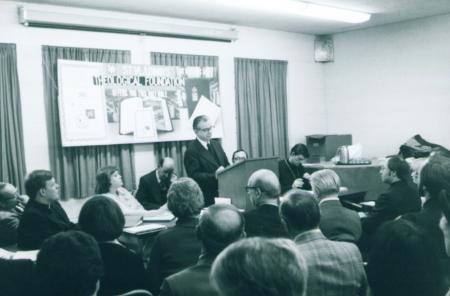
One of Verhovskoy’s former students, Michael Stankovich (Class of 1978), recalled of his beloved teacher that “Professor Verhovskoy always seemed to live ‘beneath the radar,’ until it was necessary for someone to step forward to speak the Truth, which he always did without hesitation—an issue for which he continually chided his students: ‘You are called to be “Ezekiels,” yet you are silent.’”
That Professor Verhovsoy was perhaps underappreciated yet profoundly important in the life of the Seminary was also noted by former Seminary Dean Protopresbyter Thomas Hopko (+March 18, 2015):
Under Fr. Alexander [Schmemann]’s leadership, St. Vladimir’s came to be so joined with his person and work that it was known, affectionately and not so affectionately, as the “schmemannary.” The connection, almost identification in some circles, of St. Vladimir’s with Fr. Alexander was understandable but also seriously misleading in that many others played enormous roles in the life of the school. First among them was Professor Sergei Sergeevich Verhovskoy, whom everyone at the school called “Prof.” “Prof” was the Seminary’s bulwark and anchor. He lived at the school from his arrival from France in 1951 until his death in 1986. He loved meeting with the seminarians, favoring especially the women students and seminarians’ wives, of whom he was the most devoted advocate. In addition to teaching he was provost and financial officer, largely involved in finding the Crestwood property that the seminary occupied in the fall of 1962. He loved the Crestwood campus. Woe to the one who trimmed a tree without “Prof’s” approval!
Prof. Verhovskoy taught dogmatic and moral theology (which he pronounced “feeology”), and lots of other things as well. He clearly considered himself the strongest (if not the sole) defender of Orthodoxy on campus. As his handpicked successor I met with him for several hours every week, even after I began teaching in the graduate division with him in the early 1970s. “Prof” taught me his thoughts and convictions about everything, multiple times, before finally turning things over to me. He threatened me with his “eternal malediction” if I ever taught any of my own ideas as Church doctrine. He promised me the same if I ever allowed the Seminary to cut one minute of the six semesters of required dogmatics. I think I’m still out of harm’s way in regard to the former threat.¹
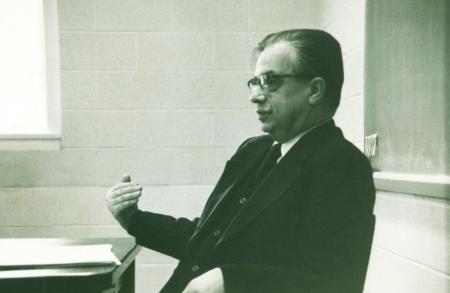
Though Verhovskoy was primarily known for his teaching activities, he also led a fruitful life in academia. Among Verhovskoy’s publications are the book God and Man (in Russian), the work The Light of the World published by St. Vladimir’s Seminary (SVS) Press, and various articles in theological journals. In addition, Protopresbyter John Meyendorff remarked that during Verhovskoy’s teaching years at St. Sergius “he was something of a star-performer at meetings with Roman Catholic theologians (rare occurrences in those days), where his articulate and creative presentations of Orthodox Trinitarian theology impressed all present. (The text of one such presentation, ‘La Procession du Saint-Esprit d'après la Triadologie orthodoxe,’ appeared in Russie et Chrétienté, 1950, No. 3-4, pp. 197-210).”²
Fr. John also spoke of Dr. Verhovskoy’s tremendous individual character.
“Together with [his] agonizing concern for truth, Verhovskoy was also a moral perfectionist. Seeking an incarnation of the faith which was not merely ‘ritual,’ he visualized Christian ethics, together with doctrinal truth, as the absolute demand of authentic Christianity.”
Professor Verhovskoy was unexpectedly thrust into the position of leading St. Vladimir’s Seminary following the resignation of Fr. Georges Florovsky in 1955. He then bore the titles of Provost and Dean of Students. After 1962, with Fr. Alexander Schmemann as Dean, Dr. Verhovskoy continued as Provost, assuming responsibility for personnel, finances, and plant operation of the new campus located in the Crestwood neighborhood of Yonkers, NY. He held this position until his retirement in 1981.
In his later years, after his beloved wife Olga died of sudden cardiac arrest while preparing to attend Liturgy on St. Thomas Sunday, Professor Verhovskoy surrounded himself with his former students in discussion and fellowship, and he immersed himself in the writings of St. John Chrysostom.
“It is impossible to define, in a few words, the full extent of his responsibilities and actual contributions to the life of the Seminary, to which he devoted practically all his time, even at the expense of further research and writing,” wrote Fr. Meyendorff. “He loved to teach, and he spent hours in meeting students. He was very personally concerned with the details of their lives, to the extent that some of them would say: ‘Fr. Schmemann is our spiritual father, but “Prof” is simply our father.’”
May his memory be eternal!
¹ Thomas Hopko, “Remembering our Leaders, 1957–1983,” SVS News, Autumn 2003
² John Meyendorff, “In Memoriam: Serge S. Verhovskoy,” St. Vladimir’s Theological Quarterly 30, no. 4 (1986): 283–287
