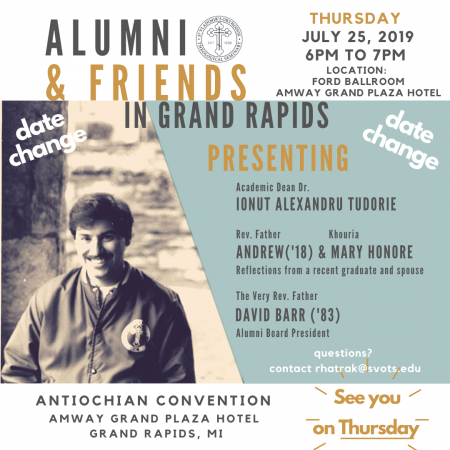
Will you be at the 2019 Antiochian Archdiocese Convention this July? Or will you be in the Grand Rapids, MI area around that time? Meet us there for a gathering of alumni and friends!
The SVOTS event will be held from 6 p.m. to 7 p.m. Thursday, July 25at the Ford Ballroom of the Amway Grand Plaza Hotel.
Questions? Contact Matushka Robyn Hatrak at rhatrak@svots.edu.
The Board, chaired by His Beatitude Metropolitan Tikhon, primate of the Orthodox Church in America (OCA), made the decision at its semi-annual meeting on Friday, May 17, 2019.
The trustees in attendance voted unanimously to appoint Fr. Chad to a new five-year term. His current term expires in June.
“Father Chad has faithfully served the seminary now for twelve years, first as chancellor and then as president after the Seminary launched its new governance model in 2016,” said Deacon Michael Hyatt, executive chair of the Board of Trustees. “We are excited about his vision for the Seminary’s future and confident in his ability to lead us there.”
“With the looming clergy shortage on the horizon and the challenges of an increasingly secular society, the Seminary’s mission is as pressing as ever. That’s why it’s so important that we have a trusted, visionary leader like Fr. Chad at the helm,” Hyatt added.
“The work of St. Vladimir’s Seminary is so important, and it remains renowned all over the Orthodox world and beyond for its excellence in theological education and formation,” said Fr. Chad. “So, I am humbled to accept this appointment and am grateful for the full support of the trustees.”
Archpriest Dr. Chad Hatfield came to SVOTS in 2007 from St. Herman Seminary in Alaska, where he served as dean from 2002 to 2007. His experience in various pastoral, teaching and administrative roles, spread over some 40 years of ordained ministry, are now blended into his ministry at SVOTS. He holds multiple advanced degrees from Nashotah House Theological Seminary, Nashotah, WI, and Pittsburgh Theological Seminary.
At its Commencement Ceremonies Saturday, May 18, St. Vladimir's Orthodox Theological Seminary (SVOTS) conferred degrees upon twenty-two graduates, including fourteen Master of Divinity, three Master of Arts, and five Master of Theology students, and the Seminary also awarded two honorary doctorates.
On Saturday morning, His Beatitude the Most Blessed Tikhon, archbishop of Washington and metropolitan of All America and Canada of the Orthodox Church in America (OCA), presided at Divine Liturgy at Three Hierarchs Chapel. At the Divine Liturgy, His Beatitude elevated Rev. Dr. David Mezynski, the Seminary’s Director of Residential Life and Admissions, to the dignity of archpriest.
Metropolitan Tikhon officially opened the 2019 Commencement Exercises Saturday afternoon, followed by welcoming remarks from Seminary President Archpriest Chad Hatfield. Among the many distinguished guests were His Holiness Moran Mor Ignatius Aphrem II, patriarch of Antioch and All the East of the Syriac Orthodox Church; His Eminence Nicolae (Condrea), Metropolitan of the Romanian Orthodox Metropolia of the Americas; His Eminence Mor Dionysius John Kawak, archbishop and patriarchal vicar of the Archdiocese of the Syriac Orthodox Church for the Eastern United States of America; His Eminence Ayub Mor Silvanos, archbishop of America, Canada & Europe Regions of the Malankara Syriac Knanaya Archdiocese; His Grace Zachariah Mar Nicholovos, metropolitan of the Northeast American Diocese of the Malankara Orthodox Syrian Church and Seminary Board member; and His Grace Bishop Vahan Hovhannisyan, primate of the Diocese of France of the Armenian Church.
His Holiness Mor Ignatius Aphrem II was one of this year’s honorary degree recipients, along with longtime Trustee Alex Machaskee. The Seminary bestowed the degree of Doctor of Divinity upon Mor Ignatius and the degree of Doctor of Humane Letters upon Mr. Machaskee.
“We have warm memories of the time His Holiness spent as an archbishop of the eastern United States, where he was known for his work with the youth and overseeing the growth and expansion of his parishes,” said Metropolitan Tikhon. “Now as the 123rd patriarch of Antioch and All the East, he serves not only as an archpastor to his flock, but as an ardent advocate for the protection of Christians in Syria and the Middle East and throughout the world.”
“Publisher, philanthropist, patron of the arts, humanitarian—Alex Machaskee, you are an accomplished leader who has worked tirelessly and have served in numerous capacities of leadership,” said Archpriest Dr. Sergius Halvorsen, the faculty secretary, as he announced Machaskee’s honorary doctorate. “You exemplify the virtues of dedication, clear vision, and sacrificial charity in the care of the neighbor.”
The Commencement Exercises continued with the Salutatory Address given by Laura Zane Wachsmuth, this year’s class salutatorian
“In all of these opportunities, through all of the blessings we have been given at St. Vladimir’s, it is clear to me that Christ is at work here in a powerful way,” Laura said in her address.
Laura graduated cum laude with a Master of Arts (M.A.) degree, with a commendation for service to the community.
Father Alexander, a popular professor at St. Vladimir’s, received a standing ovation as he approached the podium to speak.
“The knowledge that comes from theological education should not satisfy us with the satisfaction of simple vocational outcomes based on clearly stated goals or even broadly based education… but a knowledge of Him who was not found in the tomb; a knowledge of Him who Mary Magdalene thought to be the gardener,” said Fr. Alexander, who also reminisced about the events that led him to pursue studies in the Church and celebrated the discipline of theology.
“I’m not asserting that you need to be an academic to be saved—God alone saves,” he said. “I am, however, arguing that we all must come to a knowledge of God in order to be saved.”
“The glory of seminary education is to fulfill the canonical mandate of teaching on one hand and acquiring knowledge on the other…so that this knowledge can be taught and acquired anew.”
Listen to Archpriest Alexander Rentel’s 2019 Commencement Address
Following the Commencement Address, Academic Dean Dr. Ionut Alexandru Tudorie led the conferral of degrees on the Class of 2019. Two of the twenty-two graduates received their degrees in December from the Seminary but were formally honored and participated in Saturday’s ceremony.
President of the Student Council Daniel Bein then announced the winner of this year’s St. Macrina Award for Excellence in Teaching, selected each year by student vote, to Priest Dr. Varghese M. Daniel, assistant professor of Malankara Studies.
Bein read from Seminarians who had written about Fr. Varghese’s excellent teaching and guidance.
“Father is able to take a complicated subject and makes it very simple,” wrote one seminarian. “He is able to break it down into its various parts, and this is because for him this is not a game—the spiritual life is not just something he speaks about, the spiritual life is a life that he prays, a life that he lives.”
Following the award, graduate Priest Herman Fields delivered a moving and heartfelt Valedictory Address, at times fighting back tears as he addressed his colleagues.
“I wish, in one sense, [the Seminary] would almost have given me a crown as the valedictorian, so that I could break it into little pieces and give a little piece to all of my fellow students,” he said. “You are the ones who taught me what liturgy is—liturgy is to give our lives to Christ.”
“You have sacrificed so much to be here,” he continued. “You have given up jobs and homes and financial security and knowing what’s going to happen tomorrow—you have given it up to serve God.”
“You are all my concelebrants in the liturgy.”
Father Herman graduated the Master of Divinity (M.Div.) program magna cum laude and will move with his family this summer to serve a parish in Saskatchewan, Canada.
At the conclusion of the Commencement Exercises, His Beatitude Metropolitan Tikhon offered closing remarks for the Class of 2019, recalling the message of Fr. Alexander’s commencement address.
“I encourage all of you, both the graduates and those who are continuing to search for that knowledge of God, that you will remember the strength and the beauty of our Lord Jesus Christ, who is ‘the Way, the Truth, and the Life,’ and that your own relationship with Him will build that foundation of humility and love to care for your fellows…and that you will share that with all those you are in contact with throughout your life.”
With faith in Christ and hope in the resurrection, we share news of the repose of Seminary Alumnus Peter Melnik, 88, of Wilmington, DE. Peter passed away peacefully in his home May 12 with his wife, Elizabeth, by his side following a lengthy illness.
Peter Melnik was born July 12, 1930 to John and Anastasia Melnik, who had emigrated from Eastern Europe at the turn of the twentieth century and labored in the tanneries and factories in Peabody, Massachusetts to put their son through college. Peter attended the Massachusetts Institute of Technology (MIT) and graduated in 1952 with a Bachelor of Science in Chemical Engineering. He also received two Master of Divinity degrees, one from St. Vladimir’s Orthodox Theological Seminary in 1959 and a second from Harvard University in 1962.
His work history included brief stints with DuPont, Shell, and American Cyanamid. Most of his career, however, was spent at Hercules, Inc., where he developed an expertise in the manufacture of polypropylene resins. Utilizing his theological education, Peter served as a lay leader in the Orthodox Church in America (OCA), a president of the Federated Russian Orthodox Clubs (FROC), and Editor in Chief of the FROC Journal, contributing influential articles on Orthodox Christianity in America. Peter, a gifted writer and speaker, often advocated for the education and participation of the laity in the life of the Church.
Although his life revolved around the Church and family, Peter also contributed time to other community organizations, including volunteering with his sons’ Boy Scout troops, coaching Little League, and teaching at The University of Delaware’s Osher Lifelong Learning Institute.
Peter leaves behind his wife of 63 years, Elizabeth (Kuchta), and their three children: Philip, of Voorheesville, NY (Kit Yezzi), Alexandra of Carlisle, PA (Paul Makosky), and Vladimir of Wilmington, DE (Susan Melnik). He also leaves four grandchildren: Herman, Xenia, Juliana, and John.
A viewing will be held from 8:30 to 9:30 a.m. on Saturday, May 18, 2019, at St. Michael the Archangel Orthodox Church, 2300 West Huntington Drive, Wilmington, DE, followed by the Divine Liturgy and Funeral Service at 9:30 a.m. A mercy meal will follow the services at St. Michael. The burial at St. Mary Orthodox Church Cemetery, Chambersburg, PA, is scheduled for Monday, May 20 at 11 a.m.
Memorial contributions can be made in lieu of flowers to St. Michael the Archangel Orthodox Church or Delaware Hospice (16 Polly Drummond Center, 2nd Floor, Newark, DE 19711), which provided essential support in the last leg of Peter’s earthly journey.
Three years of groundbreaking exploration into the sacred arts culminated this spring in Byzantine Materiality at St. Vladimir’s Seminary. Byzantine Materiality, a conference of the Sacred Arts Initiative, brought together scholars and members of the public May 8-11 to explore matter, materials, and materiality in Byzantine art and culture.
“The attention we devoted to materiality over these rich few days has been a vital antidote to dualism,” said Dr. Peter C. Bouteneff, the Seminary’s professor of Systematic Theology and director of the SAI. “It has been a pernicious tendency of human beings, throughout history, to privilege the spiritual world, and to vilify the material world. Christian theology, when it recalls the incarnation, has no dualist option.”
“The conviction, I think, is that the only way that God is reliably known is in and through the material world.”
Professor Bouteneff spoke at the conference, as did fellow faculty members Rev Dn. Dr. Evan Freeman, the conference organizer, and Richard Schneider. The large and diverse lineup of speakers at Byzantine Materiality also included Annemarie Weyl Carr, Laura Veneskey, James Magruder, Anthony Cutler, Sean Leatherbury, Vasileios Marinis, Mary K. Farag, Roland Betancourt, Katherine Taronas, Harry Prance, Béatrice Caseau, Stephanie Rumpza, Gary Vikan, Alicia Wilcox Walker, Holger Klein, Charles Barber, and Joseph R. Kopta.
During the conference, discussion centered around Byzantine and ancient theories of matter and form; the use and significance of materials such as wood, stone, gold, and glass in ecclesiastical and other contexts; the roles of matter and materials in the Eucharist, icons, relics, and reliquaries; the rite for consecrating a church; sensory experiences of liturgy; and the neuroscience of viewing icons.
“As an art historian, I’m accustomed to thinking about form and image in Byzantium,” said Freeman, “but this conference challenged us also to think carefully about the stuff of which objects were made, how materials mean, and the ways that matter and materials impacted people in Byzantium and its larger Mediterranean networks.”
Members of the SAI plan to publish a book based on the discussions and findings presented at Byzantine Materiality.
St. Vladimir’s Orthodox Theological Seminary (SVOTS) has signed an agreement of partnership with New Georgian University, the Seminary’s first-ever agreement with an academy in the Republic of Georgia.
Archpriest Chad Hatfield, SVOTS president, represented the Seminary at the Solemn Signing Ceremony of Partnership. The agreement was signed May 2, 2019 at the University campus in Poti. Also at the ceremony was His Eminence, Metropolitan Grigoli of Poti & Khobi, the rector of New Georgian University and the chairman of the Georgian Orthodox Patriarchate's Department of Publishing and Reviewing.
“Through this partnership agreement, we could potentially see new Georgian seminarians at St. Vladimir’s and new publications and translations,” said Fr. Chad. “This is also a good sign of exchange between the Orthodox Church in America and the Georgian Orthodox Church.”
Father Chad traveled to the Republic of Georgia at the invitation of Metropolitan Grigoli. First-year Seminarian Priest Giorgi Tskitishvili, a native of Georgia, accompanied Fr. Chad on the trip.
"Much can be said, as this agreement has many benefits. To mention one, it really opens avenues for Georgian students,” said Fr. Giorgi. “What has been observed through the prism of books now has become touchable. Now they can experience and be partakers of the tradition that St. Vladimir's Orthodox Theological Seminary has been building for years. These Georgian seminarians will be given opportunity to share what they will learn, and they can become a bridge between past and present which will bear fruit in the future."
During the trip to the Republic of Georgia, Fr. Chad also received an honorary doctorate from New Georgian University, delivered an inaugural lecture, and took part in a full-day conference on the topic of "Church and Modernity" with faculty and theologians.
The St. Vladimir’s Seminary community came together for another beautiful celebration of Holy Week and Pascha on campus. Seminarians, faculty, staff, and other members of the community participated in services throughout the week at Three Hierarchs Chapel. His Beatitude Tikhon, archbishop of Washington and metropolitan of All America and Canada (Orthodox Church in America), presided over Divine Liturgy on Lazarus Saturday.
To view scenes from Holy Week at St. Vladimir’s Seminary, see the gallery
Dr. John Barnet, associate professor of New Testament, delivered a meditation on Great and Holy Friday. Listen to the message in its entirety below.
Since the conclusion of Fall Semester 2018 in December, one bishop, four new priests, five new deacons, and one Stavrophore have been added to the ranks of our Student Body and Alumni fellowship.
Ordinations, receptions, and elevations from Fall Semester 2018 can be viewed here.
We keep them in prayer as they continue in their ministries. Axios!
HOLY EPISCOPACY
Bishop Daniel (Findikyan), Alumnus (M.Div. '89) Jurisdiction: Armenian Church of America, Eastern Diocese of America Holy Priesthood: Ordained to the Holy Priesthood by His Eminence Archbishop Khajag, eleventh primate of the Eastern Diocese of the Armenian Church of America in 1997 in New York, NY Elevation to Doctor of the Church: Elevated to the rank of Vartabed (doctor of the church) in 2006 in Vagharshapat (Etchmiadzin), Armenia Elevation to Primate: Elected twelfth diocesan primate by 116th Diocesan Assembly of Eastern Diocese of the Armenian Church of America 4MAY18 IN West Harrison, NY; Confirmed as primate 8May18 by His Holiness Karekin II, the Supreme Patriarch and Catholicos of All Armenians; Enthroned 8May18 at St. Vartan Armenian Cathedral, New York, NY Holy Episcopacy: Consecrated bishop 12MAY19 by His Holiness Karekin II, the Supreme Patriarch and Catholicos of All Armenians, at Holy Etchmiadzin, Armenia Current Ministry: Primate of Eastern Diocese of America of the Armenian Church of America Education and Professional Background: Doctor of Liturgical Studies, Pontifical Oriental Institute, Rome, Italy; Master of Arts degree in Musicology, City University of New York, Master of Divinity, St. Nersess Armenian Seminary, Armonk, NY; Master of Divinity, St. Vladimir’s Orthodox Theological Seminary, Yonkers, NY. Currently the director of the Krikor and Clara Zohrab Information Center of the Diocese of the Armenian Church (Eastern), New York, NY; professor of Liturgical Studies at St. Nersess Armenian Seminary, Armonk, NY; professor of Armenian Studies, St. Vladimir’s Orthodox Theological Seminary, Yonkers, NY; president of the Society of Oriental Liturgy; visiting pastor of St. Sarkis Armenian Church, Charlotte, NC, from 1998 to 2005; author of more than 60 scholarly articles and books.
HOLY PRIESTHOOD
Priest George Ninan Manampuram, Alumnus (M.Div. ’17) Jurisdiction: Diocese of South-West America of the Malankara Orthodox Syrian Church (MOSC) Holy Diaconate: Ordained 21DEC 18 by His Grace, Zacharias Mar Aprem, Metropolitan of Adoor-Kadampanad Diocese (India) and Auxiliary of South-West American Diocese, at St. Mary’s Orthodox Church, Kuttemperoor, Mannar, India Holy Priesthood: Ordained to the Holy Priesthood 21DEC18 at St. Mary’s Orthodox Church, Kuttemperoor, Mannar, India by the hand of His Grace Dr. Zacharias Mar Aprem, Assistant Metropolitan of the Diocese of South-West America (MOSC) Current Ministry: Awaiting assignment Education and Professional Background: Bachelor's degree in Psychology, Widener University’ Masters in Counseling Psychology from Rosemont College; Counseling and Case Management Supervisor for victims of domestic violence at Domestic Abuse Project of Delaware County, PA
Priest Givargis (Abu) Koshy George (M.Div. ‘08) Jurisdiction: Diocese of Northeast America of the Malankara Orthodox Syrian Church (MOSC) Holy Diaconate: Ordained 2June12 by the hand of His Grace Geevarghese Mar Ivanios of Kottayam Diocese (MOSC), at St. Basil's Monastery (Mor Baselios Dayro), Njaliakuzhy, Kottayam, Kerala, India. Holy Priesthood: Ordained 23DEC18 at St. George Orthodox Church of Westchester, Port Chester, NY, by the hand of His Grace Zachariah Mar Nicholovos, Metropolitan of the Diocese of Northeast America (MOSC) Current ministry: Awaiting assignment Education and Professional Background: MBA from Fordham University, NY; MS Computer Science candidate at Fordham University; Financial and Compliance Auditor for Financial Industry Regulatory Authority (FINRA)
Priest Kuriakose (Alex) Abraham (M.Div., ’16)
Jurisdiction: Diocese of Northeast America of the Malankara Orthodox Syrian Church (MOSC) Holy Diaconate: Ordained 23OCT18 by the hand of His Grace Metropolitan Youhanon Mar Dioscorus at St. George Orthodox Church of Parampuzha, Kerala, India. Holy Priesthood: Ordained 30March19 at Sts. Baselios & Gregorios Orthodox Church, Plainfield, NJ, by the hand of His Grace Zachariah Mar Nicholovos, Metropolitan of the Diocese of Northeast America (MOSC) Current ministry: Assigned as spiritual adviser for annual Winter Summit conference for Malankara Orthodox college students; awaiting parish assignment Educational and professional background: B.A. in Psychology from Rutgers University
Priest Thomas (Shawn) Thomas (M.Div., ’16; Th.M. ‘17) Jurisdiction: Northeast American Diocese of the Malankara Orthodox Syrian Church (MOSC) Holy Diaconate: Ordained 27OCT18 by the hand of His Grace Metropolitan Zachariah Mar Nicholovos at St. Thomas Chapel, Diocesan Metropolitan’s Residence (Aramana), Muttontown, NY Holy Priesthood: Ordained 27April19 at St. Gregorios Orthodox Church, Elmhurst, IL, by the hand of His Grace Zachariah Mar Nicholovos, Metropolitan of the Diocese of Northeast America (MOSC) Current Ministry: Awaiting Assignment Educational and professional background: B.S. in Molecular and Cell Biology from the University of Illinois Urbana-Champaign
HOLY DIACONATE
Deacon Geevarghese (Bobby) Varghese (M.Div., ’17)
Jurisdiction:Diocese of Northeast America of the Malankara Orthodox Syrian Church (MOSC) Holy Diaconate: Ordained 21December18 by the hand of His Grace Metropolitan Zachariah Mar Nicholovos at St. Thomas Chapel, Diocesan Metropolitan’s Residence (Aramana), Muttontown, NY Current ministry: Chaplain at Brooklyn VA Hospital, under the VA NY Harbor Healthcare System; assigned as spiritual advisor for diocesan youth association Missions Board Educational and professional background: Chaplain at Brooklyn VA hospital, under the VA NY Harbor Healthcare system
Deacon Stefan Djoric (M.A., ’18, Seminarian, Th.M. Program)
Jurisdiction: Eastern American Diocese of the Serbian Orthodox Church Holy Diaconate: Ordained 23DEC18 by the hand of His Grace Bishop Irinej at Holy Transfiguration Monastery, Ellwood City, PA Educational and professional background: B.A. studies in Theology at the University of Belgrade
Patriarchal Hierodeacon Aetios (formerly Dimitrios) Nikiforos (M.Div., ’18)
Jurisdiction: Ecumenical Patriarchate Monastic Tonsure: Tonsured 16March19 by the hand of His All-Holiness Ecumenical Patriarch Bartholomew at the Venerable Patriarchal Church of St George, Istanbul, Turkey. Holy Diaconate: Ordained 17March19 by the hand of His All-Holiness Ecumenical Patriarch Bartholomew at at the Venerable Patriarchal Church of St George, Istanbul, Turkey. Current ministry: Working at the Chief Secretariat of the Holy and Sacred Synod of the Ecumenical Patriarchate; 1st Patriarchal Office. Educational and professional background: LLB (Aristotle University of Thessaloniki School of Law); LLM in Public Law & Political Science (Aristotle University of Thessaloniki School of Law); LLM in Legal Theory (NYU School of Law); PgCert in Canon Law (Cardiff School of Law & Politics); Attorney-at-law.
Deacon Nathaniel Trembley (2nd-year Seminarian, M.Div. program)
Jurisdiction: Antiochian Orthodox Christian Archdiocese of North America (AOCANA) Holy Diaconate: Ordained 31March19 by the hand of His Eminence JOSEPH, Archbishop of New York and Metropolitan of All North America (AOCANA), at St. George Orthodox Cathedral, Worcester, MA Educational and Professional Background: Before seminary, Dn. Nathaniel was an affiliate philosophy instructor at Highline College, teaching philosophy, ethics, world religions, and atheism and philosophy; he holds degrees in philosophy and comparative religion from Washington State University, where he also earned a Master’s degree in philosophy.
Deacon David McCready (Seminarian, Non-degree track)
Jurisdiction: Antiochian Orthodox Christian Archdiocese of North America (AOCANA) Holy Diaconate: Ordained 25April19 by His Grace JOHN, Auxiliary of the Diocese of Worcester and New England (AOCANA), at St. George’s Orthodox Church, Lawrence, MA Current ministry: Deacon David and his wife, Andrea, will be moving to Colorado in June 2019 to pastor a small Western Rite parish in Lafayette, just outside Denver. Educational and Professional Background: Former Anglican priest; Holds a number of degrees, including a Ph.D. from Trinity College, Dublin
MONASTIC TONSURE
Mother Macrina (Roeber) (formerly Sister Margarete) (M.A., ’16; Th.M., ’17) Jurisdiction:Orthodox Church in America (OCA) Monastic Tonsure:Tonsured to the rank of Stavrophore 19DEC18, by the hand of His Eminence Benjamin, Archbishop of San Francisco and the West, at Holy Assumption Monastery, Calistoga, CA. Current ministry: Member of Holy Assumption Monastery, under Abbess Melania; obediences as cantor and bookeeper Educational and professional background:Joined St. Barbara Orthodox Monastery, Santa Paula, CA as a novice in 2009; transferred at the blessing of bishop to Holy Assumption Monastery, Calistoga, CA, in October, 2009; tonsured to the rank of Rassophore at Holy Assumption Monastery in 2012.
Archpriest John Behr, the Seminary’s Georges Florovsky Distinguished Professor of Patristics, discussed his major new work on John’s Gospel at the Orthodox Church in America (OCA) Chancery Friday, April 19. The talk followed Presanctified Liturgy, presided over by Fr. John, and a meal on the Sixth Friday of Lent.
Listen to Archpriest John Behr’s talk (Part 1, Part 2), courtesy of the OCA Chancery
Follow along with the Lecture Notes, courtesy of the OCA Chancery
“It is rather an attempt to put into dialogue various readers of John, ancient and modern—Fathers, especially from the second and third centuries but also later figures, and modern scriptural scholars, theologians, and philosophers—with, ultimately, a theological goal: that of understanding what is meant by Incarnation and how it relates to the Passion, how this is conceived of as revelation and how we speak of it, that is, the relationship between scriptural exegesis and theological discourse.”
In order to bring those three strands together in dialogue—the Fathers, modern scriptural scholars, and philosophers (namely, Michel Henry, a French phenomenologist)—and produce such a high-level academic work, Fr. John spent nearly ten years working on the project.
“Each of them is done in the canons of their own discipline—it’s not just me dabbling,” Fr. John said in an interview about the new book. “I had to learn how to do scriptural scholarship, write philosophy, and so on, and then try and bring them into dialogue with each other as an act of theology.”
Work on John the Theologian was borne out of his previous works on Christian writers of the first centuries, especially Irenaeus and Origen, which Fr. John has produced over his career as a renowned patristics scholar. He traces his steps in the Preface:
recommended that I read I Am the Truth by Michel Henry; fascinated by this work, I found myself going even further back, this time to my initial studies in continental philosophy, to retrace the path that led to Henry and his work. It is these threads that are brought together in this present volume.
Father John said there were many surprises along the way.
“I think it’s going to take me another five or six years to digest what I’ve done in that book—to actually digest it, think about it and mull it over, and produce other works coming out of that book, just as my previous works The Way to Nicea and The Nicene Faith resulted thereafter in The Mystery of Christ and Becoming Human.”
Over the coming years, Fr. John hopes his readers engage with important questions raised and addressed in John the Theologian.
“What do we mean when we say John’s is a ‘Paschal Gospel’? Why do we read the Prologue on Easter night, when on the surface it doesn’t say anything about the Passion? But, in fact, it does!”
“It is only more recently that the Prologue has come to be read as the Christmas reading, reinforcing the idea that ‘Incarnation’ can be separated from the Passion...in the Eastern tradition (in which I stand), it is the Paschal reading, read at the midnight liturgy, the transition from darkness to light—a Paschal hymn and a prologue to theology.”
Physical copies of John the Theologian & His Paschal Gospel are expected to be available in North America in May through Oxford University Press. The book is already available in a Kindle edition through Amazon.
St. Vladimir's Seminary offices will be closed on Holy Thursday, April 25; Holy Friday, April 26; and Bright Monday, April 29. Additionally, there will be no evening hours at the library during Holy Week and Bright Week (April 29-May 3).